
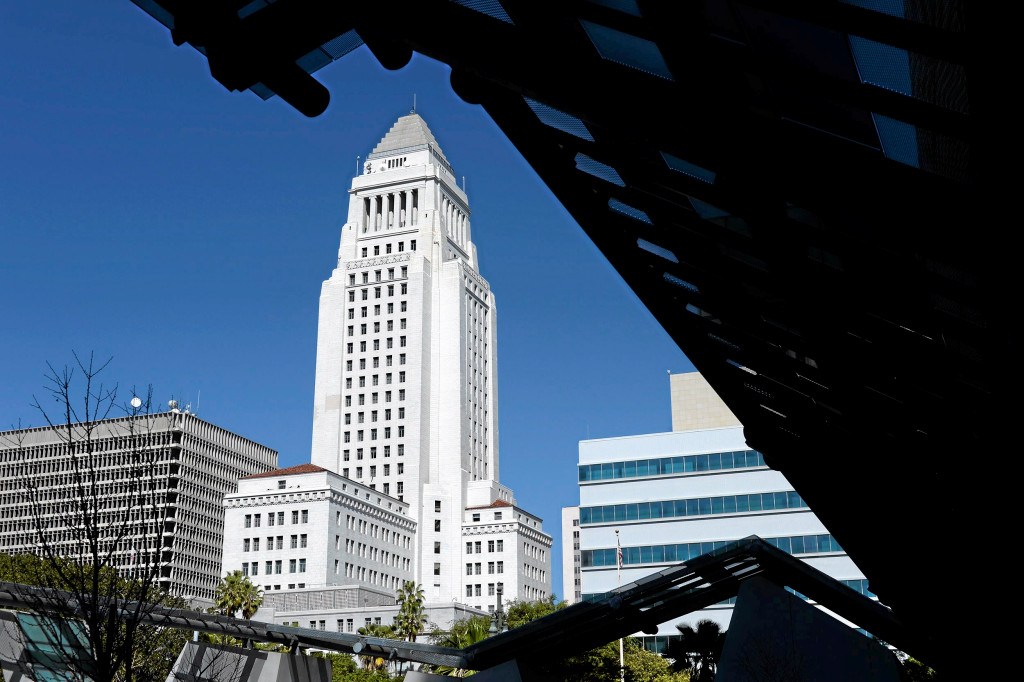
At a time in Los Angeles when public trust in local government is low, LA Charter Amendment EE has the potential to decrease City Council accountability, to the public it is elected to serve.
Amendment EE would require fewer City Council meetings, which would reduce public access to the Council on matters of public policy. Amendment EE would also make it harder to challenge City Council decisions via the referendum process. Yet EE’s ballot title fails to mention either of these ‘reforms’, effectively hiding these rotten apples in the bunch.
Currently the LA City Charter requires the council to meet at least three times a week. Measure EE would amend this to at least once.Public Participation and the LA City Charter
For the general public, speaking at City Council meetings is the only opportunity to directly address the entire council on decision-making items — an opportunity fundamental to healthy municipal government. Yet City Council Meeting Rules provide only for a minimum of 20 minutes total for public comment on all agenda items. Sometimes this is extended on the dais by the Council President. But often large numbers of speakers are still turned away. This is a major disincentive to travel to City Hall on a work day in the hope of being heard — especially when not all Council members recorded as ‘present’ are even on the dais, in the room or listening when the public speaks; and because members of the public only get one minute per agenda item to speak anyway.
City Council members argue that fewer required meetings would allow them to spend more time in their districts. But four years after the Federation tapes scandal, and after multiple federal corruption indictments of city council members — all highlighting the need for structural reform — viable ways of affecting council member workload have still not been meaningfully considered by the council — like City Council expansion and amending Council powers. Nevertheless while failing to meaningfully consider such overdue reforms, the Council wants to increase the number of petition signatures necessary to qualify a referendum on a city council decision by 50% — from 10% to 15% of the total number of votes cast in the last Mayoral election.
There is no empirical record suggesting the need to make LA’s referendum process even more difficult. Since 2013 only two referenda have even been attempted in the city, only one qualified for the ballot. And that one was ultimately withdrawn (after a state law passed on the same topic pre-empted local ordinances on the same.) Nevertheless, council members seek to justify this onerous proposed threshold, by saying it’s the same percentage of signatures as required for initiative petitions. But with ballot initiatives, organizers have four months to collect the required signatures. With a referendum, they have only 30 days. Reform the Council rules now
Instead to begin rebuilding public trust, the council should focus on amending its council rules to make it easier for the public to participate, by adopting recommendations from good government groups: publish agendas earlier, start some council and council committee meetings meetings at 5pm (and in different locations around the city), ensure a dedicated public comment period for Neighborhood Council Community Impact Statements, and increase the minimum public comment period (by comparison, the LA County Board of Supervisors hears from all members of the public.)There is good news. As of July 1, the state’s new remote access mandate means the public can now participate at regular City Hall Council meetings by phone or zoom — although this still comes out of the limited total time for public input — which is another reason to increase it. Remote access is being added to the Van Nuys City Hall and will be in place in 2027. Building upon this, the council should invest in IT and tech support for all 15+ Council committees, to enable remote participation and to video record them. This should be an absolute necessity before reducing the required number of full council meetings.
Why vote No on Amendment EE The need for local government reform in Los Angeles remains strong. But Amendment EE is not the reform LA needs. There is no empirical reason to make LA’s referendum process even more difficult. And any decrease in the required frequency of City Council meetings should only be part of a larger package of charter reforms that fit together.
If and until then, Amendment EE would only exacerbate the City Council’s over-concentration of powers and lack of accountability. For that reason, it should be rejected by voters.
Michael Feinstein is a former Santa Monica Mayor (2000-2002) and City Council member (1996-2004), a co-founder of the Green Party of California and a 2026 Green candidate for California Secretary of State.