
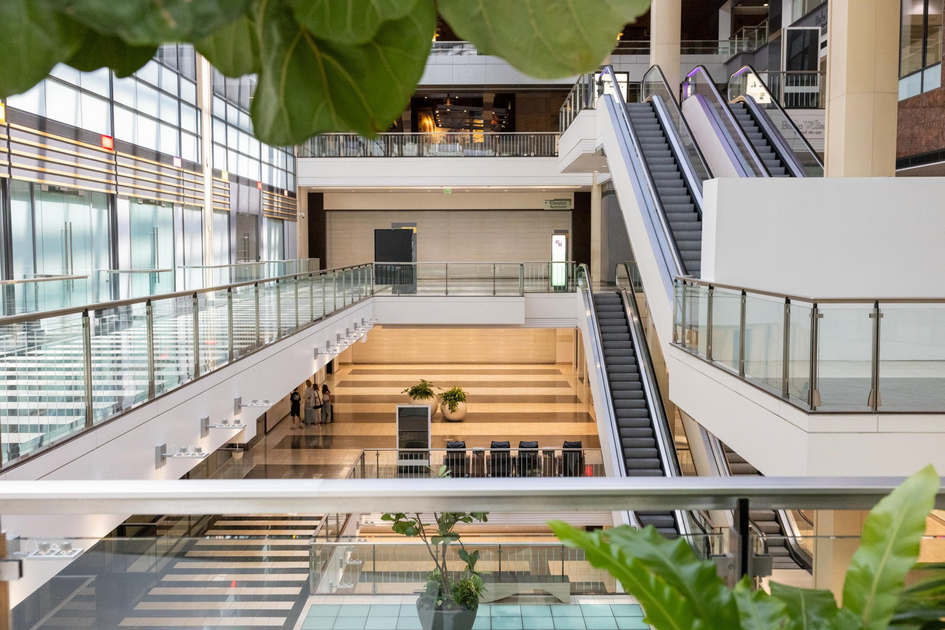
It’s housing! It’s a soccer stadium! It’s a basketball academy! It’s … a data center?
A technology company is interested in the downtown San Francisco Centre Mall as a site for a data center, according to the San Francisco Chronicle (opens in new tab). Development consultants KG Growth Partners confirmed to The Standard that it worked with the technology company to submit a bid for the entire mall, including the former Bloomingdale’s.
But KG Growth Partners dispute the characterization of the proposal as a data center. “This is not a data center in the traditional sense,” Jared Krieger, CEO of KG Growth Partners, told The Standard. “It’s a new category: a regenerative urban energy center.”
If the project moves forward — which would require it to clear major hurdles, beginning with the selection of its bid by the mall’s sellers — critics worry it could be a departure from a vision for downtown that centers on revitalizing retail and public spaces, much of it focused on the blocks immediately surrounding the mall. That vision has been boosted by the mayor’s office and the Downtown Development Corporation.
Krieger said this company, which he declined to name, would aim to create more energy than it uses and support downtown activity. Only a third of the mall site would be allocated to the “regenerative urban energy center.” The other two-thirds would be dedicated to culture, retail, sports, wellness, design, and free education, he said, with six acres of green space atop the building.
“The project gives downtown two things it needs: reliable, sustainable power for its future, and a large public destination in the heart of the city,” he said.
The mall’s shuttered state hardly fits into that image, and the process of finding a new owner has been drawn out and frustrating for those who want to see Market Street revived. The mall closed at the beginning of this year after telling its last remaining tenants to leave following years of departures, leaving a hollowed-out shell at the center of downtown.
In July, Presidio Bay and Prado Group walked away from plans to buy the mall. The seller received new bids during a round that ended last month, including plans for a basketball-centric athletic complex with a sports bar.
Mayor Daniel Lurie last week signed a 45-day moratorium on data centers being constructed in San Francisco, intended to give the Planning Department time to study the impacts of the facilities and develop regulations governing their construction. Emails obtained by The Standard indicate that the Planning Department is meeting this week with Supervisor Shamann Walton, who authored the moratorium, to discuss whether the department should rework the category it uses to classify data centers, which also includes other types of facilities.
In statements, speeches, and social media videos, Lurie has emphasized the need to bring people back downtown, a priority laid out in his “Heart of the City” directive last year.
The directive says signs of success downtown will include more hotel bookings, more San Franciscans living downtown, and increased transit use. City-backed initiatives have included programs to fill vacancies with small businesses, privately funded grants to support large retailers moving in, and infrastructure projects designed to improve and beautify corridors that receive heavy foot traffic from conference-goers and tourists.
“We want to see a strong vision for a mixed‑use development that is active, vibrant, and serves as a regional destination, one that advances our vision for a 24/7 downtown,” Anne Taupier, executive director of the Office of Economic and Workforce Development, told The Standard.
Krieger said that under the technology company’s plan for the mall, only a third of its space would be dedicated to hardware. The other two-thirds would be for public infrastructure, therefore fulfilling the mission of downtown’s revival.
“That’s a reason for people to come downtown every day, not just a building they walk past,” he said.
The plan Krieger presented is a far cry from the data centers spanning more than 1 million square feet and accompanying substations that have popped up next to suburban and rural U.S. communities.
But the Chronicle’s reporting revealed that KG Growth Partners had inquired with the city’s Department of Building Inspection about using the space for a data center. Those invested in San Francisco’s revival expressed reservations about the plan. Even small data centers can draw substantial amounts of energy from the grid. They also employ fewer people (opens in new tab) than traditional offices.
“We’d like to see housing, we’d like to see retail, we’d like to see offices, anything that brings people to the area,” said Karin Flood, one of the owners of the Flood Building across the street from the shuttered San Francisco Centre.
But central to the downtown development conversation has been the area’s outsize contribution to the city’s tax base, which shrank during the pandemic as offices and storefronts emptied out. In communities across the U.S., data centers have been drivers of economic development and tax revenue.
“There’s certainly benefits to it,” said Ben Keethler, a founder of CivicLink Partners, a consulting firm that works with local governments to navigate data center development. Keethler reached out to city officials as San Francisco passed its data center moratorium, offering advice based on his work in Loudoun County, Virginia, and other communities.
“But there’s guardrails that you need to be smart about if it’s an industry you want to contemplate,” he said.
Stakeholders are skeptical that the technology company’s bid will be chosen. Even if it is, after the moratorium lifts, it could hit permitting obstacles and delays related to development demands. If it makes it past that stage, neighbors are calling for high standards.
“If a data center does move into SF Centre, its success should benefit the local area, with a public ground floor featuring shops, food, arts, access to the dome, local hiring, and direct support for nearby businesses and cultural groups,” said Fernando Pujals, executive director of the Mid-Market Business Association. “Whatever happens next with this building should build on Market Street’s momentum, not only take energy.”
Still, locals questioned whether a proposal for a data center could gain the public support needed to become a reality in the empty mall.
“That would be political, not to mention Union-Square-comeback-story, suicide, and there’s been a lot that’s been bet on Powell Street,” said Sarah Lacy, who owns The Best Bookstore nearby.
Her business landed on Powell Street thanks to a city-supported grant from Vacant to Vibrant. It’s part of a corridor that’s been filling up with retailers along the cable car tracks across Market Street from the mall.
“The city needs to fill it, but if they make a wrong turn, it can impact Union Square negatively forever,” Lacy said.