
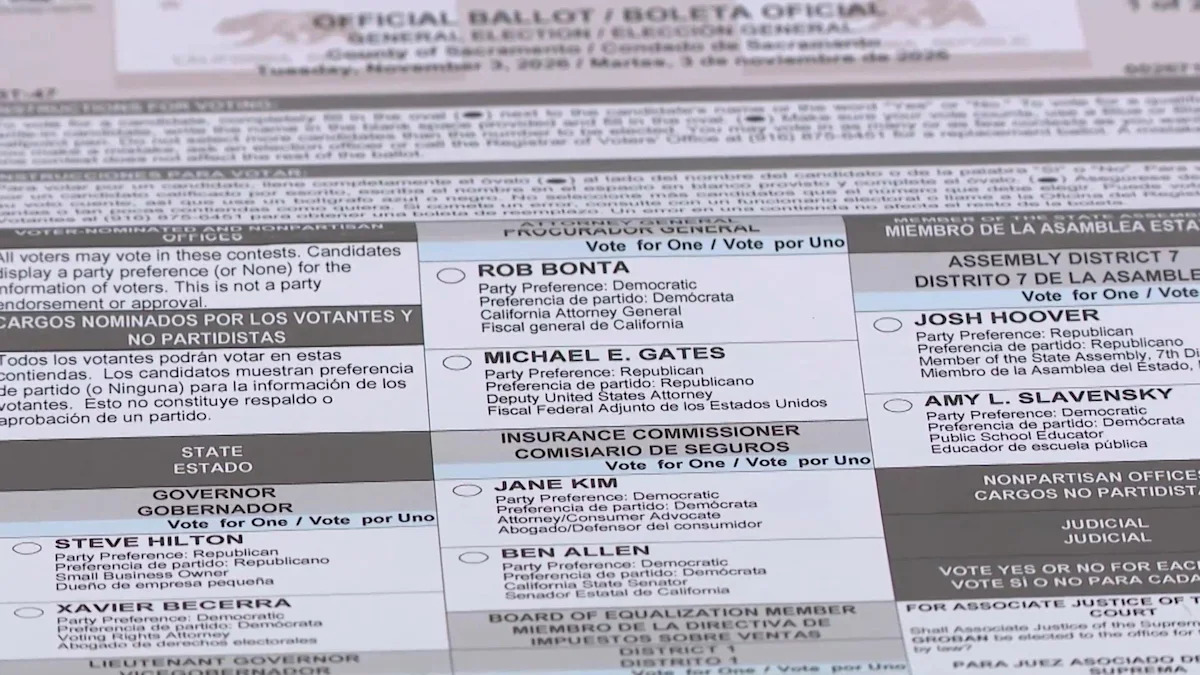
With two weeks until Election Day, California is seeing low early voter turnout.
Nearly 1.7 million ballots had been returned as of Tuesday afternoon, 7% of registered California voters, according to Paul Mitchell, an election data expert with Political Data Inc.
Mitchell and political strategists said turnout is expected to increase as Election Day approaches, but they anticipate participation consistent with a typical nonpresidential election year.
“Voters are having to sift through 14 initiatives. It’s a pretty meaty ballot,” said Andrew Acosta, a Sacramento-based Democratic strategist. “Voter participation at the moment isn’t amazing. It’s going to be a pretty standard nonpresidential year turnout.”
California voters will decide the governor’s race at the top of the ticket, followed by congressional contests, statewide offices, local races and 14 ballot measures on Nov. 3.
Sacramento-based Republican strategist Tim Rosales said voters are being exposed to campaign messages across multiple platforms, but it remains unclear how much of that information is resonating.
“We’re getting inundated with mail and ads and all of these types of things, but how much of it is sticking, really?” Rosales said.
Already-low interest comes amid heightened tensions with the federal government over alleged noncitizen voting.
As of Tuesday morning, the U.S. Department of Justice had arrested at least 12 people and charged 28 foreign nationals as part of its “Operation Protect the Vote.”
The allegations have raised concerns among state leaders and election experts about the potential impact of federal enforcement on voter participation.
Mitchell noted only time will tell: “Whether or not that acts to overall suppress votes or whether in a state like California, it has this rebound effect where voters who are upset with what’s happening with President Trump and national Republicans, whether they turn out in even bigger numbers to kind of send a message back.”
Political strategists, meanwhile, said the ballot and the candidates themselves may be bigger factors in the current turnout numbers.
“For voters, it’s that there’s disinterested and uninteresting candidates,” Rosales said. “That’s what I think is kind of driving it more than anything else.”
Acosta agreed: “I think voters are now clicking in there’s an election, and they’re trying to figure out how to sift through the ballot,” Acosta said. “I don’t know if this other noise impacts what they’re going to do.”
The early ballots are not necessarily representative of the broader electorate. As Mitchell noted, voters who routinely return their mail ballots as soon as they receive them tend to vote first. Those being older white voters, many of whom are homeowners, Mitchell said.
As for party breakdown, Democrats accounted for 50% of ballots returned so far, while Republicans accounted for 30%, according to Mitchell. The breakdown roughly reflects Democrats’ registration advantage in the state.
“The partisan breakdown of these early votes doesn’t skew much from the registration,” Mitchell said.
The governor’s race is one of the most closely watched contests on the ballot, with Democratic candidate Xavier Becerra facing Republican Steve Hilton. But experts say they also expect some voters to leave portions of their ballots blank, a practice known as undervoting.
That could be particularly relevant in races where voters feel as though they have limited choices, including contests in which candidates from the same party are competing, such as the insurance commissioner race, excluding voters of the other party.
Watch more: 11 foreign nationals arrested in California over alleged illegal voting