
The five-member Public Safety Committee approved Councilmember Hugo Soto-Martinez’s motion by a 3-2 vote. Councilmembers Nithya Raman and Curren Price joined Soto-Martinez in supporting the motion, while Committee Chair John Lee and Councilmember Traci Park voted no.
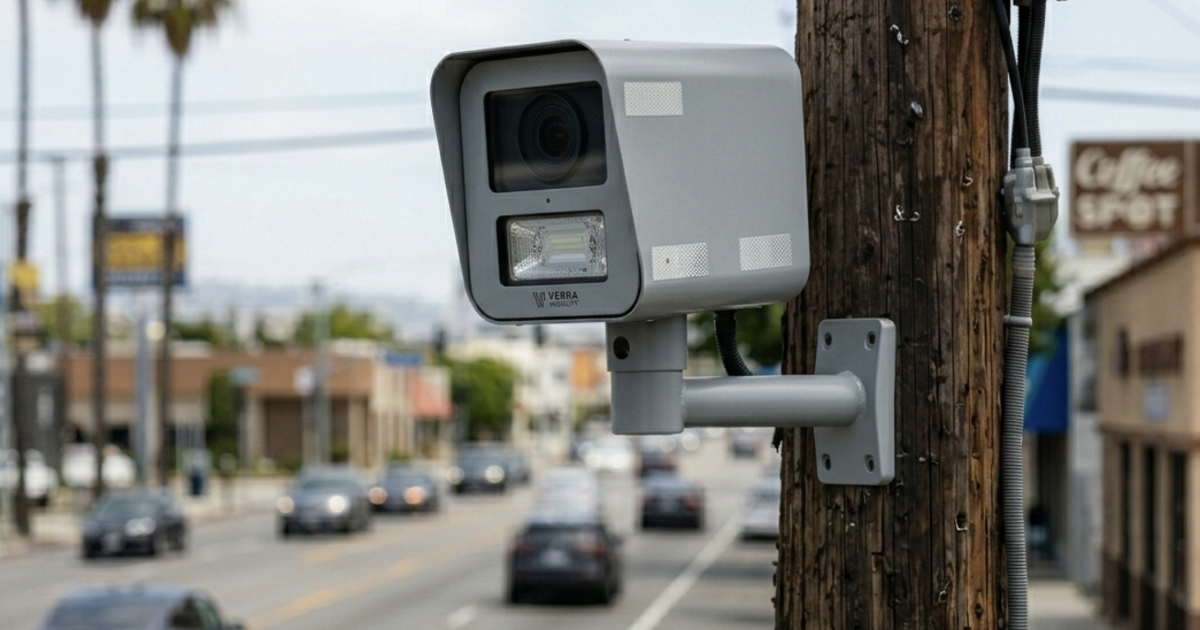
The Los Angeles Police Department wants to execute a contract with Axon Enterprise for a no-cost, three-month pilot program. Under the proposal, 30 automated license plate readers, or ALPRs, would be clamped to the tops of streetlights and powered by the lights’ electrical connections, according to Ubicquia Inc., an Axon subcontractor that would install the cameras.
Lee and Park had earlier sought to advance the item to the full council without a recommendation.
The City Council took up the matter after voting Oct. 6 to assert jurisdiction over the Police Commission’s September decision approving the pilot program.
LAPD uses automated license plate reader technology to identify stolen vehicles and vehicles associated with wanted suspects. Axon Enterprise and Motorola Solutions provide ALPR technology or related services to the department.
Soto-Martinez sought further council review over concerns about privacy and data-collection policies. He questioned LAPD officials Tuesday about the number and location of cameras, as well as who would be able to access the data they collect.
LAPD Cmdr. Randy Goddard, assistant commanding officer of the department’s Information Technology Bureau, described the technology as a public-safety tool. He said the system does not use facial recognition, geometric interpretation or audio recording. It does not identify a driver or passenger, he said, and does not create data fields identifying a person’s race, ethnicity, medical status or immigration status.
“The system generates an alert. Under department policy it is not probable cause. An officer must verify the plate and confirm the underlining status through an independent source before taking action,” Goddard said.
California law and department policy set limits on how ALPR information may be used and shared. State law prohibits sharing ALPR data with federal and out-of-state agencies, including U.S. Immigration and Customs Enforcement. LAPD also prohibits searches based solely on First Amendment activity or other legally protected characteristics or activities.
Goddard said ALPR technology has helped LAPD investigate crime and solve cases.
LAPD Chief Information Officer Dean Gialamas, who also serves as commanding officer of the Information Technology Bureau, said the Police Commission approved the Axon pilot Sept. 22 under an enhanced governance framework created by LAPD.
“It established a considerably more restrictive and accountable operating model to test, evaluate and report back before any longer-term decision is made. It established a new path forward,” Gialamas said. “Importantly, many of these safeguards are already being implemented.”
Chief Jim McDonnell issued a departmentwide notice Oct. 16 outlining new ALPR guidelines on data ownership, privacy, safeguards related to data sharing and access, audits, accountability and transparency, according to Gialamas. The policy was based on recommendations and feedback from the Police Commission, residents and other entities.
Gialamas said the Axon contract would serve as a template for future ALPR vendors. He said LAPD had also updated its data-retention and data-sharing policies to strengthen civil-liberties and privacy protections, which would be implemented alongside the pilot.
The updated policy would prohibit unauthorized secondary use and unauthorized sharing of information while preserving city ownership of the data. It would restrict access to captured data to 4,000 officers and reduce searchable data from two years to 90 days. After 90 days, the data would no longer be available for routine searches.
The policy would limit data sharing to certain law-enforcement agencies, including police departments in Torrance, Huntington Park, Hayward, Signal Hill, Simi Valley, La Mesa, Glendale, Alhambra, West Covina and Livermore, as well as sheriff’s departments in Los Angeles, Madera and San Luis Obispo counties, among others.
LAPD would also adjust the frequency of audits and require officers authorized to access the system to obtain supervisory approval, complete online video training and pass a test.
Gialamas said standing or direct access to LAPD’s ALPR system within California is currently suspended. Case-specific requests must be documented on official agency letterhead and would be reviewed individually before information is provided.
“No new standing data sharing agreements will take effect until the pilot is completed, and the final policy changes and agreements are reviewed and approved by the police commission,” Gialamas said.
He said fixed cameras would not be installed within 200 feet of a licensed health care facility or clinic whose primary service is reproductive or gender-affirming health care.
Goddard said the department would issue monthly reports on inspection results, the pilot’s status and its progress.
“Let us test the technology under our enhanced safeguards, measure its public safety value, and our compliance with those safeguards, identify any remaining risks, and repot the results back publicly before any longer-term decision is made,” Gialamas said.
Soto-Martinez argued LAPD should establish its policies before testing the technology.
Council members said ALPR use raises significant concerns, citing cases in other states where officers used the technology to stalk former romantic partners and investigate women seeking reproductive health services outside their communities. They also cited incidents in which partial or incorrect data led officers to make aggressive stops of people who were not suspected of crimes.
Lee and Park argued LAPD needs the technology to respond to calls for service, particularly as the department faces recruitment challenges. Park referred to Pacific Palisades after the January 2025 fire.
“Those cameras were providing an important layer of protection for a very vulnerable community that needed it,” Park said.
Soto-Martinez said the level of data collected on Angelenos is unprecedented. He alleged LAPD has not had an ALPR policy since the pandemic. LAPD first introduced its policy in December 2020 and has revised it since.
“Never has the city had so much information on our residents where we can see what they’re doing and where they’re at,” Soto-Martinez said.
Gialamas defended the department, saying it is strengthening its ALPR policy to prevent misuse, which he said has not been identified.
Soto-Martinez said he did not have enough information to determine whether allowing 4,000 LAPD officers to access ALPR data was appropriate. He also said LAPD’s updated auditing requirements did not go far enough.
“I think that there is more work to be done. I don’t like that there’s 4,000 people without an analysis whether they deserve to keep having (access to ALPR data) or not. I don’t feel comfortable why we cut off the external… we haven’t talked about the direction those folks want to move forward. The lack of auditing, and not being able to bring a third party in,” Soto-Martinez said.
In September, the Police Commission approved a new 10-year, $235 million contract with Axon. The company is expected to provide more than 1,600 patrol-car cameras with ALPR technology, along with thousands of replacement body-worn cameras, Tasers, cloud storage for video footage and artificial-intelligence features that would generate initial drafts of police reports from body-worn-camera recordings.
In July, the Police Commission suspended LAPD’s use of ALPR technology supplied by Flock Safety, citing concerns about data collection and retention. LAPD’s three-year contract with Flock expired that month, although officials have said they are working on a new agreement intended to better define and enforce data-security and privacy protections.
The Flock decision followed an audit by the LAPD Office of the Inspector General, which found officers had improperly investigated 161 people whose vehicles were incorrectly flagged as stolen in the ALPR system.
The full City Council is scheduled to take final action on the streetlight-camera pilot Wednesday.
Editor’s Note: This story includes reporting from City News Service, a content partner of Westside Current.