
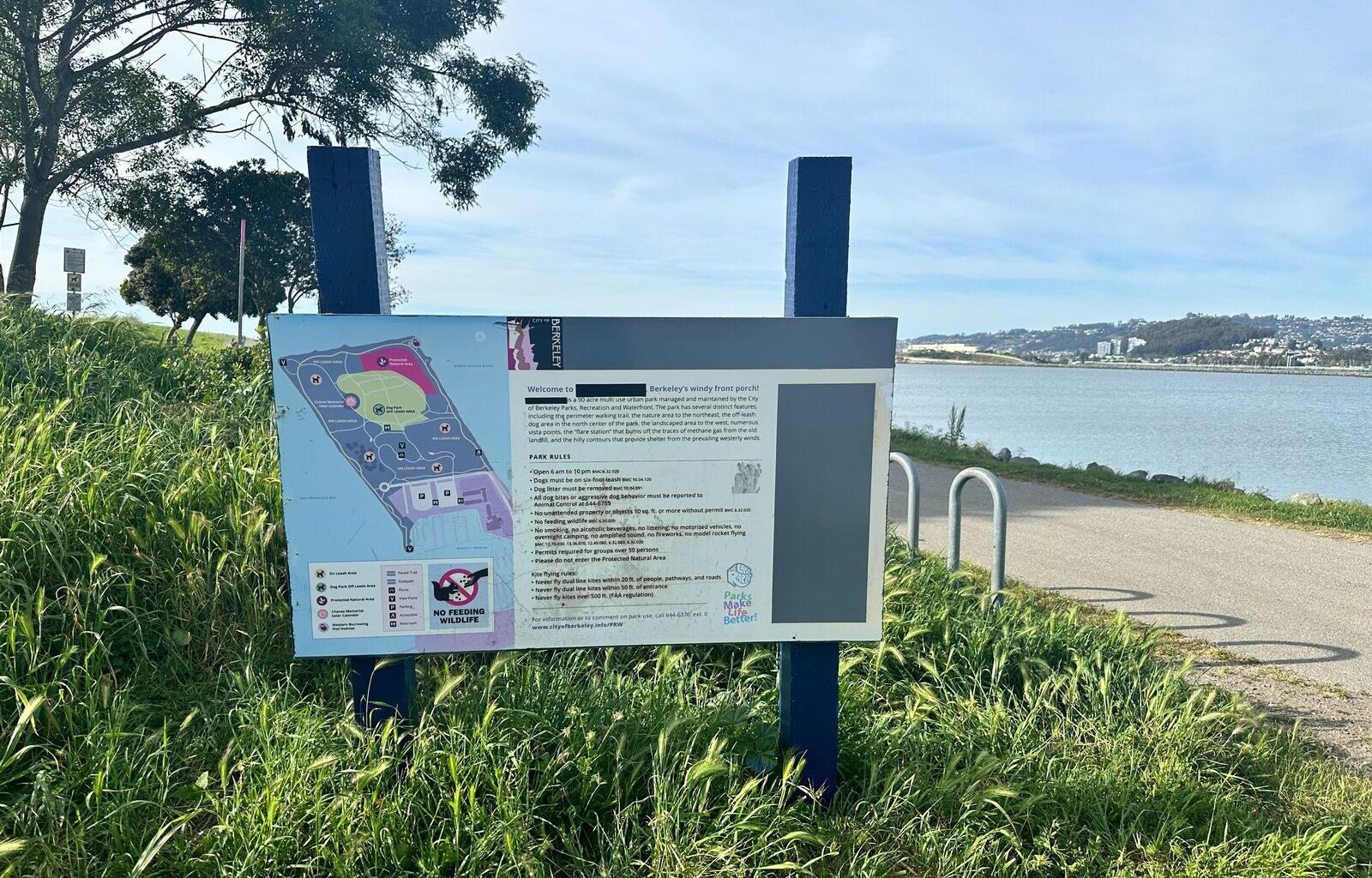
 A sign at the West Berkeley park formerly named for Cesar Chavez is seen shortly after his name and images of him were removed in March. Credit: Tracey Taylor/Berkeleyside
The waterfront Berkeley park once named for Cesar Chavez could soon be rechristened with the slogan of the farmworker movement the disgraced labor icon led.
Get ready to fly a kite, watch a sunset or spot burrowing owls at Sí Se Puede Park.
That’s the recommendation of a working group assembled by Berkeley’s Parks, Recreation and Waterfront Commission, after city leaders in March voted to rename the open space in the wake of reports that Chavez sexually assaulted women and girls. His name was swiftly covered or removed from signs at the park, which sits atop a former landfill and was named in his honor in the 1990s.
Cities across the country have moved to rename streets, schools, parks and events that lionized Chavez in the months since The New York Times revealed the assault allegations. Many of those efforts are still underway: San Francisco is considering renaming its Cesar Chavez Street as either Sí Se Puede Street or Las Campesinas Street, using the feminine form of the Spanish word for farmworker, according to Mission Local. At UC Berkeley, where Chavez’s name was removed from a student center in April, spokesperson Dan Mogulof said this week that the university is not working to rename the facility.
The Berkeley City Council is slated to approve the new park name at a meeting Oct. 27. The proposal appears on the meeting’s consent agenda, a batch of typically non-controversial items the council can pass with a single vote.
Sí Se Puede Park was the “strong consensus” of a 21-member working group made up of representatives from local government and community organizations, according to a report from the panel. It included former mayor and state Sen. Jesse Arreguín, former Berkeley Unified School Board Director Ana Vasudeo and Beatriz Leyva-Cutler, a current school board director and founder of Latinos Unidos de Berkeley, plus representatives from organizations such as the Multicultural Institute and UC Berkeley. The group’s process was based on one Berkeley Unified used to rename two elementary schools over the past decade.
The phrase the working group chose is the motto for the United Farm Workers Association, coined in 1972 by Dolores Huerta, the union’s co-founder and one of the women who said Chavez assaulted them. It translates literally to “yes, you can” or “yes, it can be done”; Barack Obama used a version of the saying, “yes we can,” as the slogan for his 2008 presidential campaign.
“Sí Se Puede connects directly to the history of the Farmworker Movement and conveys a celebratory sense that ‘we can do it,’ which is uplifting and engaging,” members of the working group wrote in a report on their choice. “It is a beautiful expressíon of what Berkeley is all about.”
Two-thirds of the group’s members picked the name as their first choice in votes, saying the phrase honors farmworkers, labor organizing and Latino heritage, paying tribute to Huerta and the movement without being tied to a single person. In a nod to the painful process that has followed the allegations about the once-revered Chavez, they wrote a name like Sí Se Puede park will “endure.”
“There is not likely to be any controversy over this saying,” they wrote.
Not everyone is cheering the new name, however.
Martin Nicolaus, CEO of the nonprofit Chavez Park Conservancy, which has vowed to change its name, wrote in a recent blog post that “Sí Se Puede” is a “terrific political slogan.” But Nicolaus, who was part of the working group, questioned whether it “is a good name for a park today,” noting the phrase doesn’t specifically reference the farmworker movement.
“People who remember who coined ‘Sí Se Puede’ and what it signifies form a graying and fading niche of the many thousands who visit the park each year,” Nicolaus wrote.
He pushed for the working group to pick the name Campesino Park, which Nicolaus wrote “honors the real heroes, the men and women who work the fields and orchards that keep the rest of us alive.”
That suggestion finished third in the working group’s voting. The runner-up was Esperanza Park, with members writing that the Spanish word for hope “is not necessarily as strong a word as a movement that requires action and change.”
Members of the public also wrote to the parks commission with their own suggestions. They ranged from generic names such as Bay Park and North Waterfront Park to more creative ones, such as Jardín De Los Pájaros, or “garden of birds,” or Isle of Dogs, a reference to a Wes Anderson film and the peninsular park’s popularity as a dog-walking spot.
There were also calls to name the park after Huerta, though the San Francisco Standard reported in March that a spokesperson has asked governments not to name public facilities after her.
“*” indicates required fields