
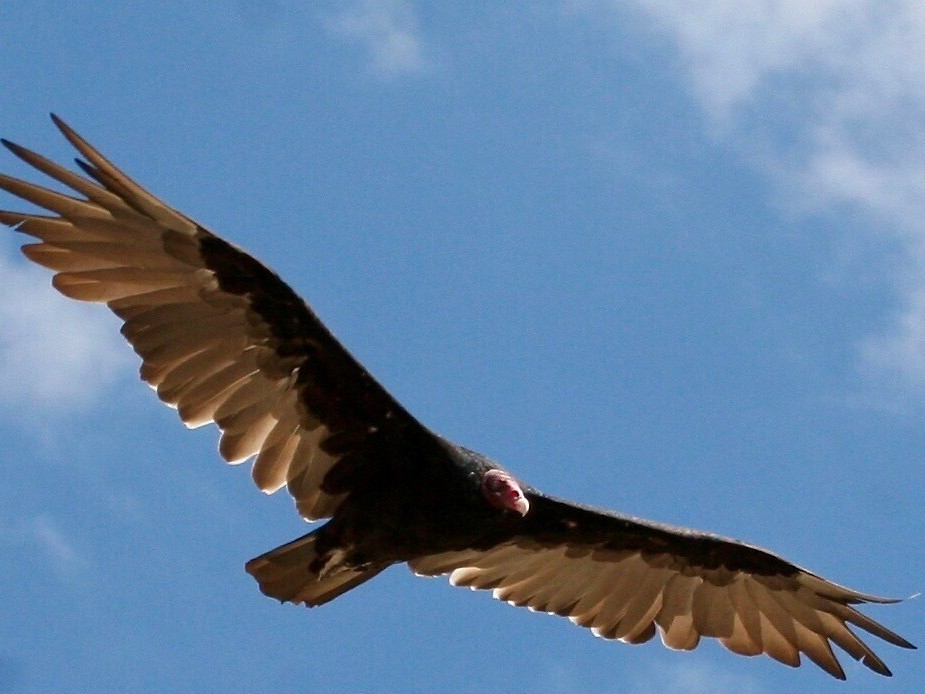
Thousands of turkey vultures are beginning their annual migration. Starting in the fall, these airborne scavengers travel from British Columbia, Canada, down to Mexico.
As these vultures head south, birdwatchers anticipate their yearly move as they travel through Northern California. This is the peak time of year that they pass through this region.
Darren J. Ross is a chief vulture wrangler based in Auburn. He joined Insight host Vicki Gonzalez to shed light on the migration patterns of these birds and their significance to our environment.
This interview has been edited for length and clarity.
Interview Highlights
What is so captivating about a turkey vulture?
This is something I never realized as a bird watcher, and I’ve been a bird watcher most of my life, that they migrated. And the way they migrate is what’s so spectacular. They’re obligate soaring birds, meaning they need thermals and they need wind to move. So it’s a very slow process. Because they’re scavengers, they have to conserve as much energy as possible. To get food and resources is difficult, so they don’t want to do a lot of flapping. Vultures do not like to flap. They want to soar, they want to glide, and they want to rise up on thermals.
What is kettling?
Kettling is similar to a teapot on the stove with steam coming up out of it. The vultures can locate the hot air, which is usually in the canyons up in Auburn, it’s on a south-facing slope. Those are the hottest. Those are the rocky slopes, they generate a lot of heat. And that’s where the heat rises and the vultures find them. And they go thermal hopping. They call them thermal streets, and they’re usually along the canyons and the west slope of the Sierra Nevada.
And they can just hop from one to the next going all the way down the Sierra Nevada using very little energy.
I imagine it’s a pretty long journey. Where are they headed?
They’re leaving from British Columbia, Canada, and heading down to Mexico.
And then, they will eventually migrate back north?
Most of them will, not all of them will. Some of the younger ones will stay down in Mexico for another year or so, but most come back.
This is the time of year where there are millions of birds that are migrating south. You are a bird watcher. Help us visualize what’s so unique and special about watching flocks of turkey vultures taking to the sky.
I never thought that I would be doing this with turkey vultures. It was amazing. It’s the way they migrate. It’s the way they fly. When they come down the Sierra Nevadas, they generally go along the west slope. When we go out and look at them, we go out to a hill in Auburn and the birds that we are looking at in the morning are the ones that came in the night before and landed and roosted. That’s usually up the canyon, and around 10 o’clock, we start seeing the vultures pop up. They’re coming out of their roost. They waste no time migrating. They’ve got to get down to Mexico. They don’t eat on migration. So that’s why they get up and go.
If there’s a wind, they’ll get up quicker. If there’s not a lot of wind, they’ll remain low to the canyon. It’s a slow process, it’s almost meditative. You see them in the distance coming up, they start coming down the canyon towards us, they catch another thermal and maybe another group comes in to that group, and they catch a thermal. As they come down towards us, they’ve gone through two or three thermals, and they’ve picked up a lot more vultures.
By the time they get to us, there’s these big kettles. Could be 100, 200 vultures that are rising up on hot air. That’s what’s really neat about it. Once they’ve risen up in that thermal and they get as high as they can, they’ll peel off at the top one at a time. So here you have this whole swirling mass of turkey vultures and when they get to the top, they peel off one at a time and just glide. They lock their wings and just glide to the next thermal.
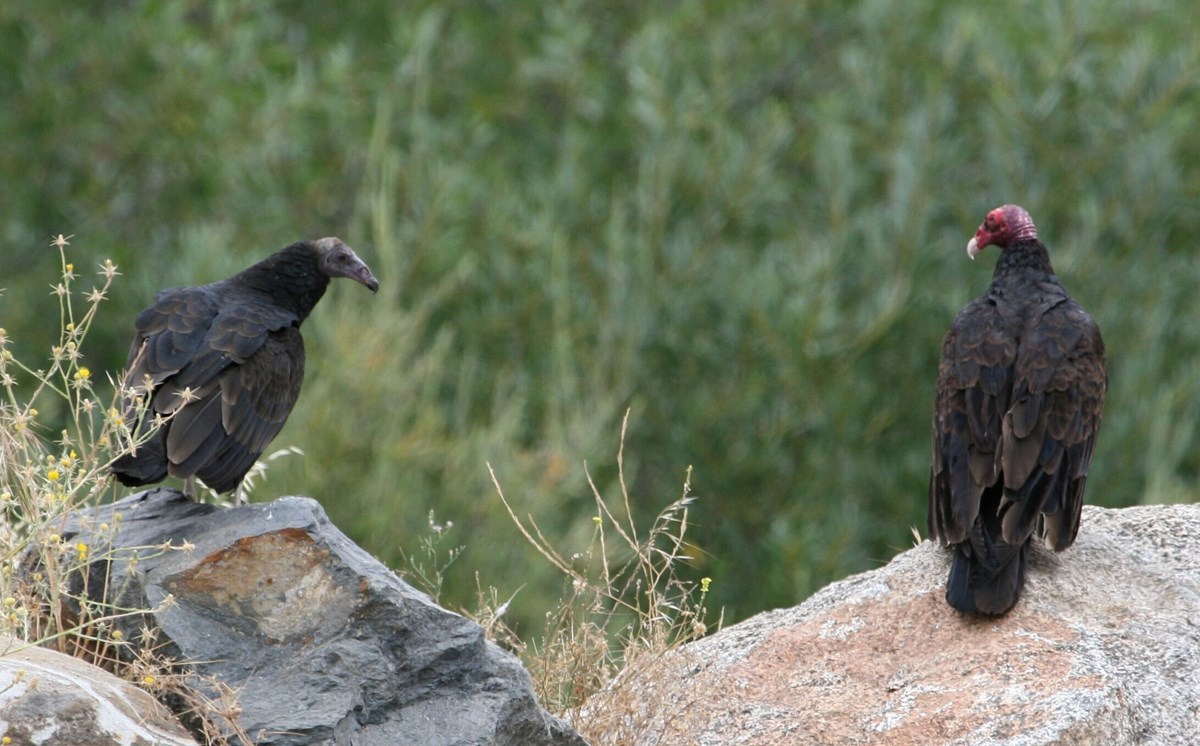 Two turkey vultures, one adolescent and one adult, perch on the boulders of Mammoth Bar in the Auburn State Recreation Area. Chief Vulture Wrangler Darren J. Ross says some young turkey vultures will stay in Mexico for roughly a year after migrating Courtesy of Darren J. Ross
How long is this migration?
They can average about 100 miles a day. It could take them a few weeks to a month and a half, depending on the climate. If we have storms coming in from the north bringing wind, they can really fly high. This year we haven’t had those weather systems up north, so it’s been a slow migration through California.
That’s a good point. How does climate change impact bird watching and wanting to see turkey vultures?
There’s a lot of variety there. It depends on the weather. So you never know from one year to the next, or ever one week to the next or one day to the next. Which is why we have to sit up there for a couple weeks. You can sit up there and have some really small numbers fly over, but then there’s going to be that big day. We’ve had big days with as many as 2,000 turkey vultures pass over in two hours. I would be willing to bet most bird watchers have never seen the turkey vulture migration in its full glory.
You’re up in Auburn of course, and you have the beautiful American River Canyon to watch all of this. If you’re at a lower elevation, like here in Sacramento, can we see some of them flying above?
You sure can. The flyway basically goes from the middle of the valley towards the eastern side of the Sacramento and San Joaquin Valley up to the Sierra Nevada Foothills. Sacramento’s kind of right on the western edge and Auburn’s kind of in the middle towards or the eastern edge of the flyway. And it depends on the conditions. Sometimes they zip right through the valley. If the conditions are right, they don’t have to thermal hop down slowly. They can just catch a big wind coming across the valley on the west slope and just go. And there’s a big roost in Sacramento as a matter of fact. Dan Airola with the Central Valley Bird Club monitors a population in Land Park.
Are there any misconceptions that you often see and need to clear up about turkey vultures? If they didn’t exist, how different would our world be?
If we didn’t have scavengers, if we didn’t have decomposers, recyclers, those are all bugs and birds and other animals that eat dead organic material. If we didn’t have those, there would be a lot more disease in the world. A lot more rotten rotten animals, rotten on the roads and what not. And those carry disease. All the way down to the bugs, up to the turkey vultures, they’re all breaking down these dead organisms, they’re consuming them, and they’re basically neutralizing their toxic effects that they can have in the environment. So, without them, it’d be a very toxic environment.
There are instances of humans and wildlife not interacting in the best way, and it could be really dangerous for wildlife. What should people keep in mind to respectfully observe wildlife like turkey vultures?
I would say the one of the biggest things is, turkey vultures are drawn to scavenging on carrion. And we often find dead animals on the roads, in the sides of the roads, in the middle of the roads. So you’ll often see turkey vultures in the roads. So I just caution people to have awareness when you’re driving through the foothills or wherever. There could be a turkey vulture scavenging on something. So, slow down.