
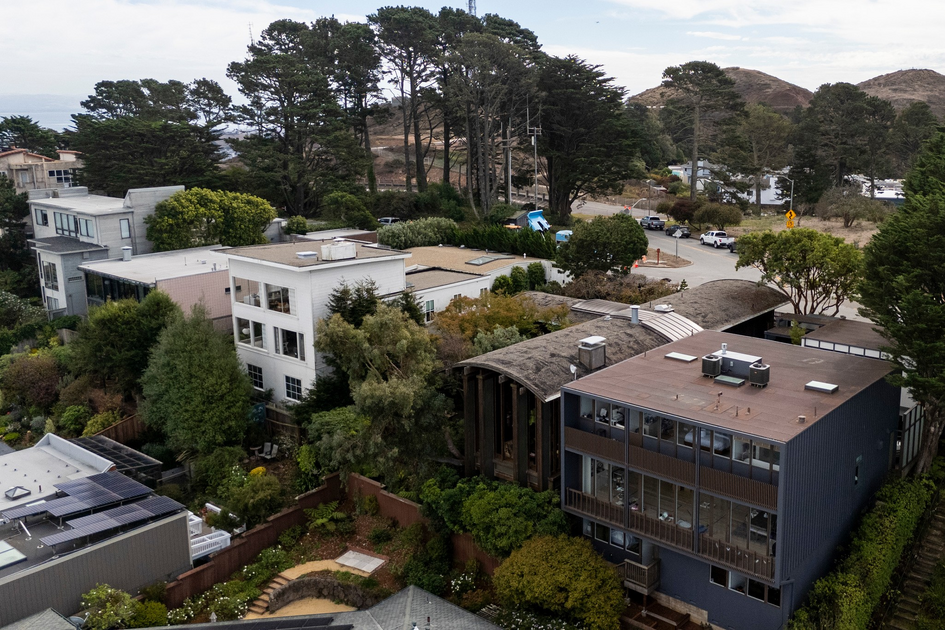
Ken Fulk, San Francisco’s designer to the stars, has listed the redwood-clad, midcentury home in Clarendon Heights that he and husband Kurt Wootton have lived in for 16 years. The Duncan House, which Fulk calls the “Tree House,” went on the market last week for $7.9 million. Fulk and Wootton bought it in 2010 for $1.925 million.
According to the listing, the 3,200-square-foot, two-story house has three bedrooms and four bathrooms. Its 26-foot-tall windows rise from the living room floor to the barrel-vaulted ceiling. The home, which has been featured in Architectural Digest (opens in new tab)and The New York Times (opens in new tab) is constructed entirely of redwood and has sweeping views of the Golden Gate Bridge and Pacific Ocean.
Fulk did not respond to a request for comment but said in an Instagram post (opens in new tab) that he and Wootton, a classical pianist, and their five dogs will move to “a new hill” in the city, one accessible by cable car. (Place your guesses in the comments section.)
“Kurt and I have made the big decision to leave our beloved Tree House high on the hill and move into the heart of the city,” Fulk wrote. “We can’t wait to be more ingrained in the day to day life of this magical town.”
Fulk’s ZIP Code, 94114, was ranked sixth on the Business Journals’ Wealthy 1000 list of the country’s wealthiest, published Monday. The ranking draws on 2024 American Community Survey data from the U.S. Census Bureau and weighs income, home equity, estimated savings, poverty rates, and population density. Fulk’s neighborhood of Clarendon Heights is home to other arts and culture luminaries, including designer Stanlee Gatti and gallerist Jessica Silverman.
 Clarendon Heights is in one of the country’s wealthiest ZIP Codes. | Source: Amanda Andrade-Rhoades/The Standard
Whoever scoops up the Duncan House will be only its third resident, following Fulk and Dr. Cloyce Duncan, a trailblazing psychiatrist who commissioned the house from the architect Charles Warren Callister in 1959. The home was finished in 1963.
Pierluigi Serraino, an Alameda-based architect who met Callister in 2001, included the house in his book “NorCalMod.” He said the Duncan House is one of Callister’s finest.

The Waggle
The Waggle is San Francisco’s guilty pleasure — and its most-read gossip column
“There’s no other project like the Duncan House,” Serraino said. “From the street it looks like a one-story house, but it’s built on a slope, so it cascades in levels on the hill below. It has a wonderful domestic character within the neighborhood but becomes grand in the common areas.”
While the home references the Arts and Crafts Movement with its use of redwood and attention to every handmade detail, Serraino said it does not fit neatly into that category because Callister wasn’t looking backward. “You’re not retreating into history,” he said. “You’re building for our time, cognizant of the traditions that preceded you.”
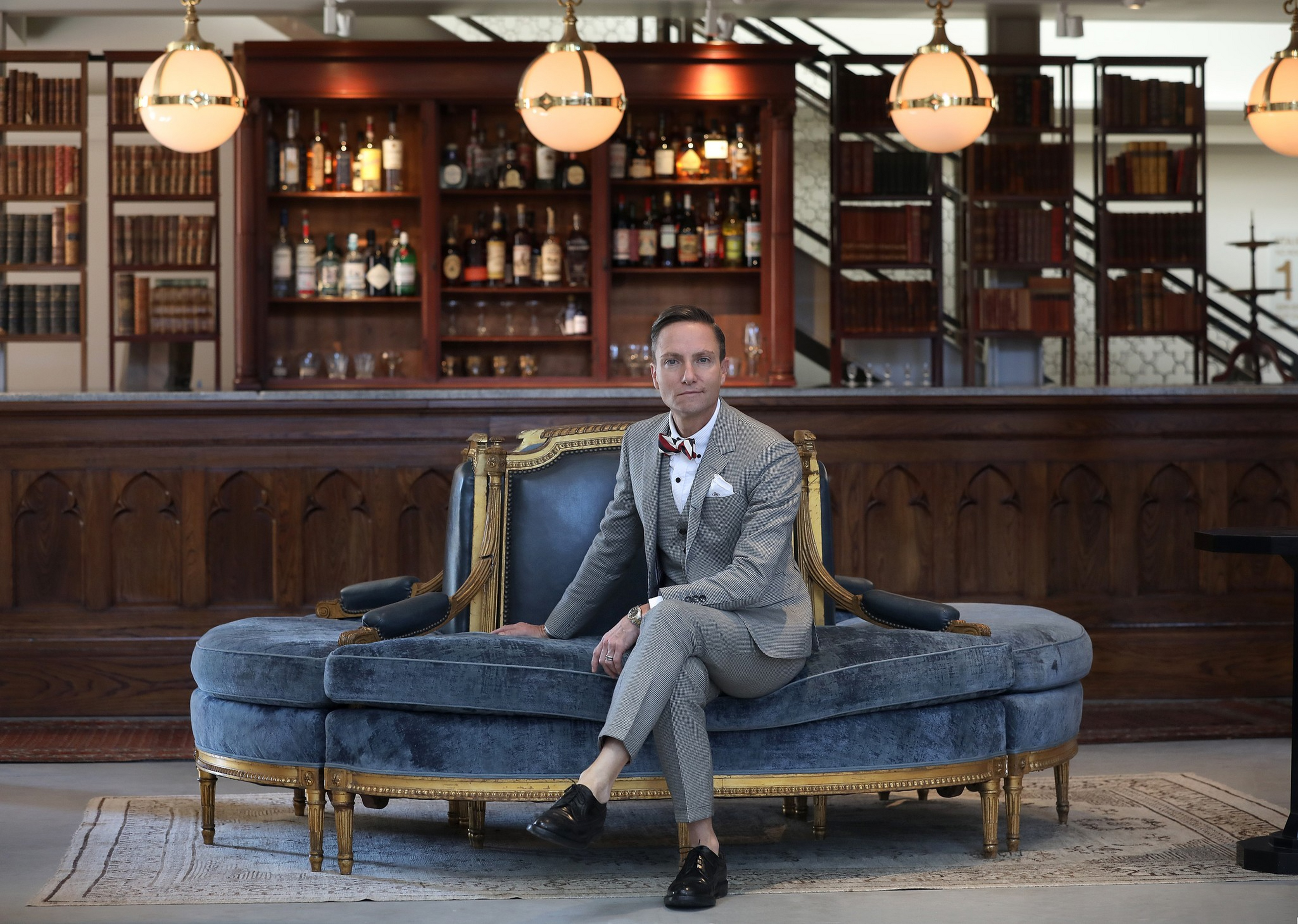 Fulk at Saint Joseph’s Arts Society. | Source: Liz Hafalia/The San Francisco Chronicle /Getty
Callister, who held no architect’s license until he was awarded one by the California Architects Board at 71 as a gesture, also designed a Christian Science church in Belvedere, which the town approved for conversion to a home in 2024 (opens in new tab), and the Flower House (opens in new tab) in Berkeley.
Fulk made few interventions to the Duncan House. “We tried to do as little as possible to the house,” he said. “[Duncan] treated it as if he had commissioned a sculpture, so every doorknob, every appliance, every tile — everything was in pristine, original condition.”
City records show one major renovation, done in Fulk’s first year in the house. Permits filed with the Department of Building Inspection cover a kitchen remodel, several redone bathrooms, and the addition of a breakfast room and laundry room to the first floor. They also cover a full electrical overhaul, new plumbing, and a new furnace. The two building permits put the cost at a combined $62,000, and the city signed off on most of the work by October 2011.
 Fulk’s Tree House appears from the street to be one story but actually cascades down the hillside. | Source: Amanda Andrade-Rhoades/The Standard
The Duncan House is the third Fulk property to be on the market this year. In August, he sold his former offices, the Magic Factory, for $6 million after buying the building for $3 million in 2007. In March, he and Wootton listed a Napa Valley ranch for $4.5 million; it was purchased in 2005 for $750,000.
In July, The Standard reported that Fulk’s efforts to renovate a cluster of hotels in Marin County had ensnared him in a morass of legal, financial, and zoning issues. A spokesperson for Fulk told The Standard at the time that the sale of his properties was not related to the struggling hotel project in Marin.