
Less than a month after Los Angeles’ sales tax climbed above 10%, city voters are being asked whether to raise it again — this time to provide hundreds of millions of dollars a year to the Los Angeles Fire Department.
Measure FD on the Nov. 3 ballot would impose a half-cent sales tax in the city, increasing the rate from 10.25% to 10.75% and generating an estimated $345 million each year for the Fire Department. The money could be used to hire firefighters and paramedics, purchase and maintain vehicles and equipment, build and upgrade fire stations and increase funding for brush clearance.
Supporters say the measure would address decades of underinvestment in a department that has struggled to keep staffing and infrastructure in step with the city’s population and emergency call volume. Opponents say Los Angeles residents are already paying some of the highest sales taxes in the region and argue that fire protection should be prioritized within the city’s existing budget.
The debate comes less than two years after the devastating Palisades fire and as wildfires again burn across Southern California amid dangerous Santa Ana winds. On Friday, Oct. 16, firefighters were battling fires in Malibu, Orange County and Camp Pendleton during red-flag conditions.
What would Measure FD do?
The measure would create a special fund dedicated to the Fire Department and impose a new one half percent (0.5%) sales tax in the city.
For every $10 in taxable purchases, consumers would pay an additional 5 cents in sales tax. The measure is expected to generate about $345 million annually. If approved, the tax would take effect on the first day of a calendar quarter more than 110 days after the measure’s adoption and would remain in place unless voters later repeal it.
The measure also includes a provision intended to prevent the city from using the new revenue to replace money it already spends on the Fire Department.
Under the provision, the city would generally have to maintain Fire Department funding at no less than its average share of discretionary city spending over the previous 10 fiscal years. If the city failed to meet that requirement in a given year, it could not collect the Measure FD tax that year.
The measure would also require annual audits and create a five-member citizens’ oversight committee, appointed by the mayor, fire chief, city controller, city administrative officer, and the chair of the City Council’s Public Safety Committee, to monitor spending.
Measure FD was placed on the ballot through a voter initiative, and requires a simple majority to pass.
Why supporters say the money is needed
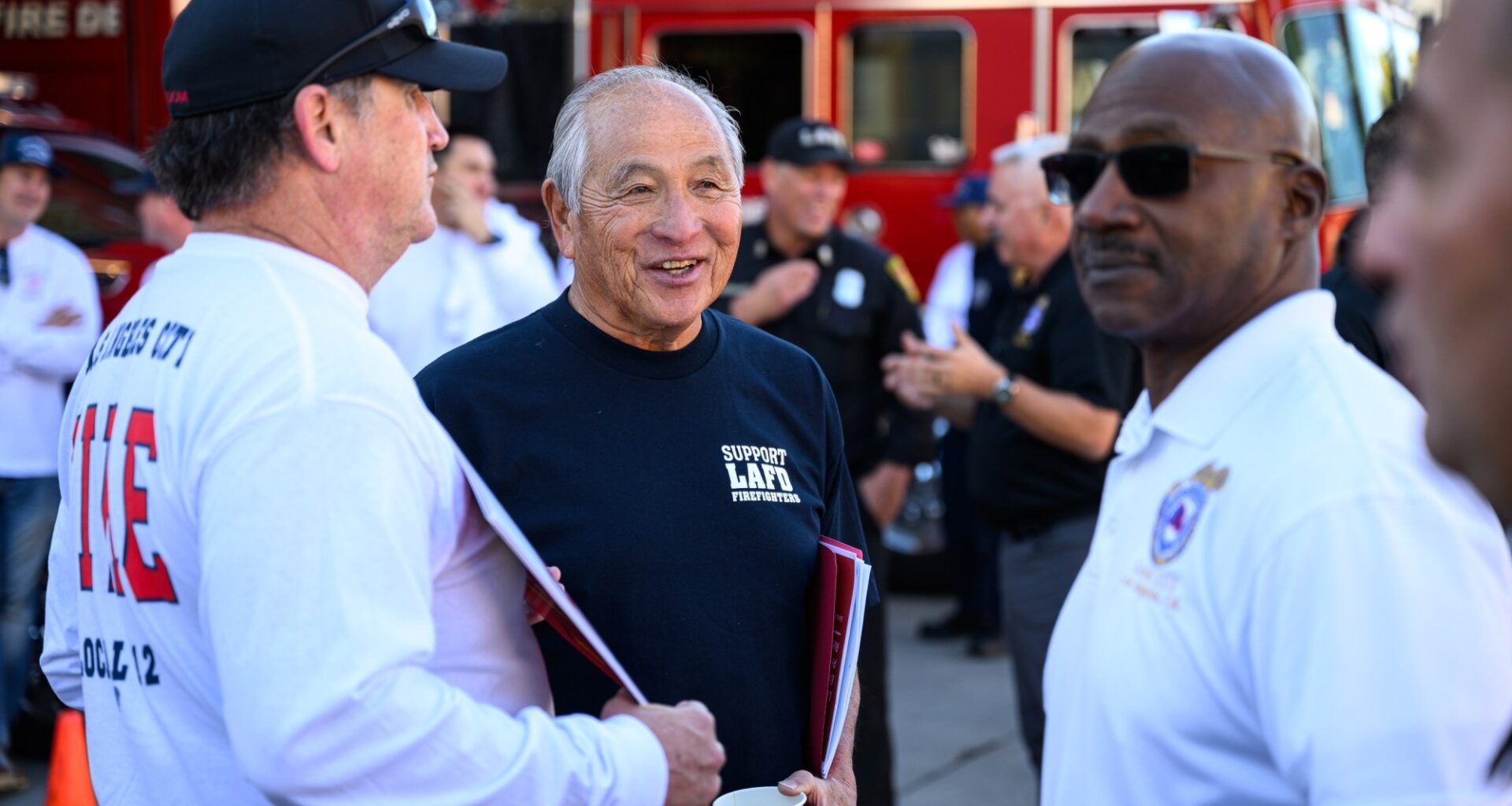
Measure FD was spearheaded by United Firefighters of Los Angeles City Local 112, the union representing rank-and-file LAFD firefighters and paramedics.
The union argues that decades of underinvestment have left the department without enough firefighters, paramedics, stations and equipment to keep pace with a growing number of emergency calls.
UFLAC said the department responded to about 497,000 calls in 2025, nearly five times the roughly 100,000 calls it handled in 1965, while operating the same number of firefighters and six fewer stations — 106 today compared with 112 in the 1960s.
“Over the past 60 years, the City of Los Angeles has repeatedly demonstrated that they cannot or will not properly fund the LAFD,” the union said in a statement provided to SCNG Friday, Oct. 16. “That’s why our firefighters and paramedics have taken it upon ourselves to address this problem.”
For comparison, LAFD reported an operating budget of about $898 million for 2026, while the city’s overall budget for the 2026-27 fiscal year totals $14.85 billion.
UFLAC also said average emergency response times have climbed to 7 minutes and 53 seconds, arguing that every second can make a critical difference during fires and medical emergencies.
Supporters say the additional revenue would allow the department to hire at least 1,000 additional firefighters and paramedics, while paying for new and upgraded fire stations, vehicles and other equipment.
The measure comes after the January 2025 Palisades fire, which killed 12 people and destroyed more than 6,800 structures. Supporters have pointed to the disaster in arguing that Los Angeles needs more firefighters and equipment to respond to major emergencies.
Mayor Karen Bass, Fire Chief Jaime Moore and Councilmember Traci Park, whose district includes the Palisades, are among the measure’s supporters. Councilmember Nithya Raman, Bass’ opponent in the Nov. 3 election, has said she supports the measure but argued that the city’s broader budget problems have increasingly forced taxpayers to pay more for basic services.
UFLAC acknowledges the measure would add to Angelenos’ cost of living but argues that the city has failed for decades to adequately fund the department through its existing budget.
“We understand that the cost of living is difficult right now and that nobody likes new taxes,” the union said. But it argued that even if Measure FD passes, Los Angeles’ sales tax rate would remain lower than rates in several neighboring cities. UFLAC says the measure is needed because the department does not have enough firefighters and paramedics to respond to emergencies on time and because decades of seeking additional resources through City Hall have failed to solve the problem.
Why opponents say voters should reject it
Opponents do not necessarily dispute that LAFD needs more firefighters and resources. Instead, they argue that city leaders should find the money within the existing budget rather than impose another sales tax.
Los Angeles Police Protective League President Ricky Mendoza said in an interview Oct. 16 that the union supports hiring more firefighters but objects to making the sales tax increase permanent.
“This tax is going to hurt every Angelino, but it’s particularly going to affect the elderly, the young, and the people that are on fixed incomes,” Mendoza said. “Any type of taxes is a bad idea right now. The permanency of this tax is just bad.”
Mendoza said he believes the City Council should conduct a line-by-line audit of city spending, identify areas where money could be cut and redirect those funds toward public safety.
“When you take on that job and responsibility, they need to be the ones to be able to identify where those cuts should be made,” Mendoza said.
The Howard Jarvis Taxpayers Association has made a similar argument, saying fire protection is a core city responsibility and questioning why officials cannot prioritize the department within the existing city budget.
The group also points to a series of recent sales tax increases.
Los Angeles County voters approved Measure A in 2024, increasing the sales tax to fund homelessness programs. In June, voters narrowly approved Measure ER, another half-cent increase to support the county’s public healthcare system. That increase took effect Oct. 1, bringing the sales tax in the city of Los Angeles to 10.25%. Measure FD would bring it to 10.75%.
The taxpayer association estimates the measure would cost an average of $86 per person annually, or $345 for a family of four, though the amount any individual pays would depend on their taxable purchases.
The association also criticizes Measure FD for requiring only a simple majority to pass, calling the lower threshold for special taxes placed on the ballot by voter initiative a “loophole.” It noted that Proposition 43, also on the November ballot, would require voter-initiated special taxes to receive two-thirds approval beginning Jan. 1, 2027.
Police and firefighters clash over the measure
The campaign has also opened an unusual divide between two of Los Angeles’ most influential public safety unions.
The LAPPL, which represents sworn LAPD officers, announced earlier this month that it opposes Measure FD. Mendoza told SCNG that the union’s board has allocated $2 million to the campaign against the measure and that the money has already been committed.
Mendoza said the union’s opposition should not be interpreted as opposition to firefighters or additional LAFD staffing.
“We are absolutely for hiring more firefighters,” Mendoza said. “We are just against the permanency of this tax.”
He compared the disagreement to one between siblings, saying police officers and firefighters remain fellow first responders even when they disagree on an issue.
“I’m all for hiring more firefighters, equipment, all those things, but I just think that the way that it’s being done through a tax measure is just bad,” Mendoza said.
The police union’s entrance into the campaign prompted the firefighters union to escalate its own spending.
UFLAC said its members approved an additional $3 million during a special meeting on Oct. 16 to support Measure FD, on top of $3 million they had previously allocated to the effort beginning in late 2025. The union said the additional money would be used to make voters aware of what it described as an urgent need for more firefighters, paramedics and LAFD resources.
“The public doesn’t trust city hall with good reason. Neither do our firefighters and paramedics,” UFLAC said. “That’s why we’re taking the case directly to the voters and asking them to trust us.”
Voters will decide Nov. 3 whether that need justifies another increase in Los Angeles’ sales tax.