
Los Angeles Mayor Karen Bass walked out of Palisades Garden Cafe last Thursday morning wearing a Los Angeles Fire Department jacket.
“We’re here for the red flag warning,” she told me. The city’s fire chief, Jaime Moore, was still at Pacific Palisades’ Fire Station 69 down the street, she said. She had just spoken with him.
It was the first dangerous fire weather warning from the National Weather Service for Pacific Palisades since the Palisades fire more than 20 months ago. Other parts of the region faced higher fire risk from these Santa Anas, yet the trauma of the fire is still fresh here and an independent report recently laid bare all the ways the city failed in January 2025. So the Palisades last week was a testing ground for the city’s emergency preparedness.
The mission was to not only be better prepared than last time, but also win back public confidence. Many here have not regained a fraction of what they lost in the fire, and several cited the upcoming elections as the probable reason Bass and city officials seem so attentive. Moore, standing outside Station 69 as firefighters jumped into fire engines, spoke with compassion.
“Some people are suffering from PTSD, and it’s understandable,” he said. “The biggest thing we need to do is recognize the potential, be quick to respond, be quick to communicate, and make sure that we get the resources there to be able to put it out really fast. That’s what’s going to build the trust in this community.”
So, how did they do?
You’re reading Boiling Point
The L.A. Times climate team gets you up to speed on climate change, energy and the environment. Sign up to get it in your inbox every week.
By continuing, you agree to our Terms of Service, which include arbitration and a class action waiver. You agree that we and our third-party vendors may collect and use your information, including through cookies, pixels and similar technologies, for the purposes set forth in our Privacy Policy such as personalizing your experience and ads.
Mayor Karen Bass was about 7,500 miles away from Station 69, at a cocktail party in Ghana, when the Palisades fire exploded.
“I am so profoundly sorry that I was not in my city when my city needed me,” Bass said at a recent mayoral debate.
For Palisades residents, it was a welcome change of tune from the mayor. In the weeks after the Palisades fire, Bass had accused the then-fire chief of failing to warn her about the dangerous fire weather — even though the National Weather Service’s dire forecast was widely publicized days in advance.
This time around, Bass was aware of the danger and actively coordinating with her fire chief, in person.
The Los Angeles Fire Department, before the Palisades fire, pre-deployed only three of its own engines anywhere in the city. None were in Pacific Palisades. Roughly 1,000 firefighters remained unassigned as LAFD opted not to schedule on-duty staff for extra overtime shifts as the wind built.
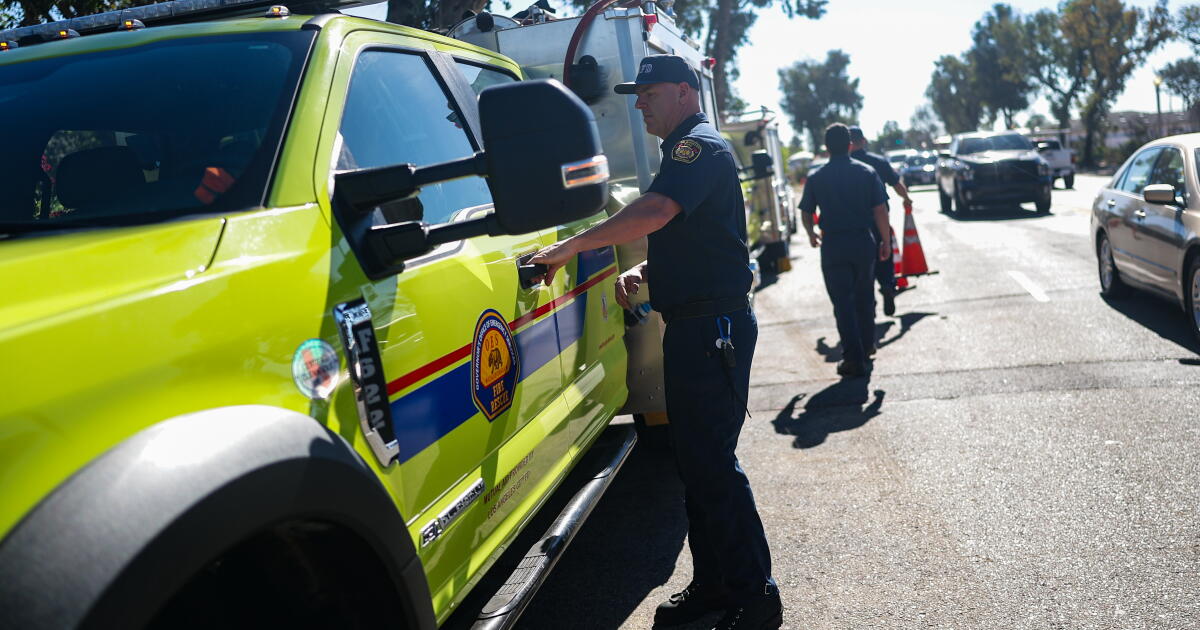
Last week, however, Moore said LAFD called all off-duty firefighters to join pre-deployment efforts. In Pacific Palisades alone, LAFD positioned three additional engines of its own, he said, and assigned its firefighters to five extra engines provided by the Governor’s Office of Emergency Services.
“You’re having a really fortified effort here in the Palisades,” Moore said.
Indeed, it was hard to spend an hour in Pacific Palisades without at least one bright-yellow OES engine driving by.
The Los Angeles Department of Water and Power came under intense scrutiny for leaving its damaged Santa Ynez Reservoir empty during the Palisades fire. The recent independent report found that if it had been at normal levels, it might have kept hydrants flowing longer during the Palisades fire, but it was unclear how much that would have helped.
As last week’s red flag warning took effect, the reservoir remained out of service after a series of setbacks during repairs. The department started refilling it at the start of October and anticipates it will again be serving the Palisades’ drinking water system by the end of the year.
Since the reservoir is covered, it is not used for aerial firefighting. To keep hydrants flowing, LADWP has laid six miles of hose to connect backup water sources to the Palisades and stationed backup generators and tanker trucks in the area. For residents, the reservoir nonetheless remains a painfully visible symbol of the city’s shortcomings.
Residents, meanwhile, can give firefighters the best shot at stopping a potential disaster by clearing flammable vegetation in their yards and fire-hardening their homes.
The Palisades fire has galvanized many Palisadians, who now talk about disaster preparation with the same seriousness as their fire-hardened neighbors in Topanga and Malibu. All rebuilds of destroyed homes in Pacific Palisades will have to meet the state’s cutting-edge wildfire building codes, which did not apply to homes built before 2008.
In other wildfire news
A recent study from UCLA found that climate change is cutting back the number of Santa Ana wind days — although it won’t save us from devastating wildfires anytime soon. That’s because human greenhouse gas emissions are primarily diminishing the weak and moderate winds, not the most extreme ones. Currently, it’s erasing only about 1 in every 200 wind events. By the end of the century, it will snuff out 1 in every 10 or 20.
While Pacific Palisades emerged from the recent winds unscathed, the Norte fire destroyed at least six homes in San Juan Capistrano on Friday. It came just days after an El Niño-fueled storm battered San Clemente’s beaches down the street. As the Santa Ana winds keep blowing and Pacific storms keep bringing unruly surf with little rain, beach towns up and down the coast will have to face both climate-fueled threats — water and fire — at the same time.
Malibu had its own wildfire scare during the winds. Firefighters were able to quickly gain the upper hand on the Bryson fire, preventing it from becoming the next Palisades or Woolsey fire. However, it was enough to trigger trauma and anxiety among locals. To survive tough times like these, Malibu residents have learned to lean on one another.
A fast-moving grass fire killed four Canadian soldiers and left 39 injured, including 19 in critical condition Saturday. The fire broke out during a high-intensity training exercise with live munitions, including hand grenades, on a military base in Wainwright, Alberta, Kevin Maimann reports for CBC News. “Uncommon, rapid” winds spread the fire. The incident is under investigation.
More climate news
A California program to subsidize hybrid and zero-emission vehicles — which has spent more than $1 billion — paid at least $1 million for vehicles that were never assembled or seemingly did not exist, and funded thousands of fossil-fuel-burning vehicles, some of which were the subject of an emissions-cheating scandal, a new investigation by my colleagues Tony Briscoe and Sandhya Kambhampati found. In one case, the program paid out more than $50 million to an electric vehicle company after its former chief executive was indicted on suspicion of misleading investors, Briscoe reports.
California has designated its first tribal-led marine protected areas, which will join a network of “underwater parks” along the state’s coastline, my colleague Lila Seidman reports. Some commercial fishers objected, warning they will suffer an economic hit as they lose access to key waters.
A boom in lithium mining across the American West is jeopardizing the clean air of rural communities and pulling water from arid areas that are already seeing a dwindling supply due to climate change, an analysis from Inside Climate News and Columbia Journalism Investigations found. Lithium is a key ingredient in electric car batteries.
This is the latest edition of Boiling Point, a newsletter about climate change and the environment in the American West. Sign up here to get it in your inbox.
And on the Boiling Point Podcast this week, we’ll hear an insider talk about the making of the Inflation Reduction Act, and you’ll hear a little from me, as well.
For more wildfire news, follow @nohaggerty on X and Noah Haggerty on LinkedIn.
More from Climate California