
Shared starting points don’t mean shared destinations — especially when it comes to art, and especially when it comes to Los Angeles.
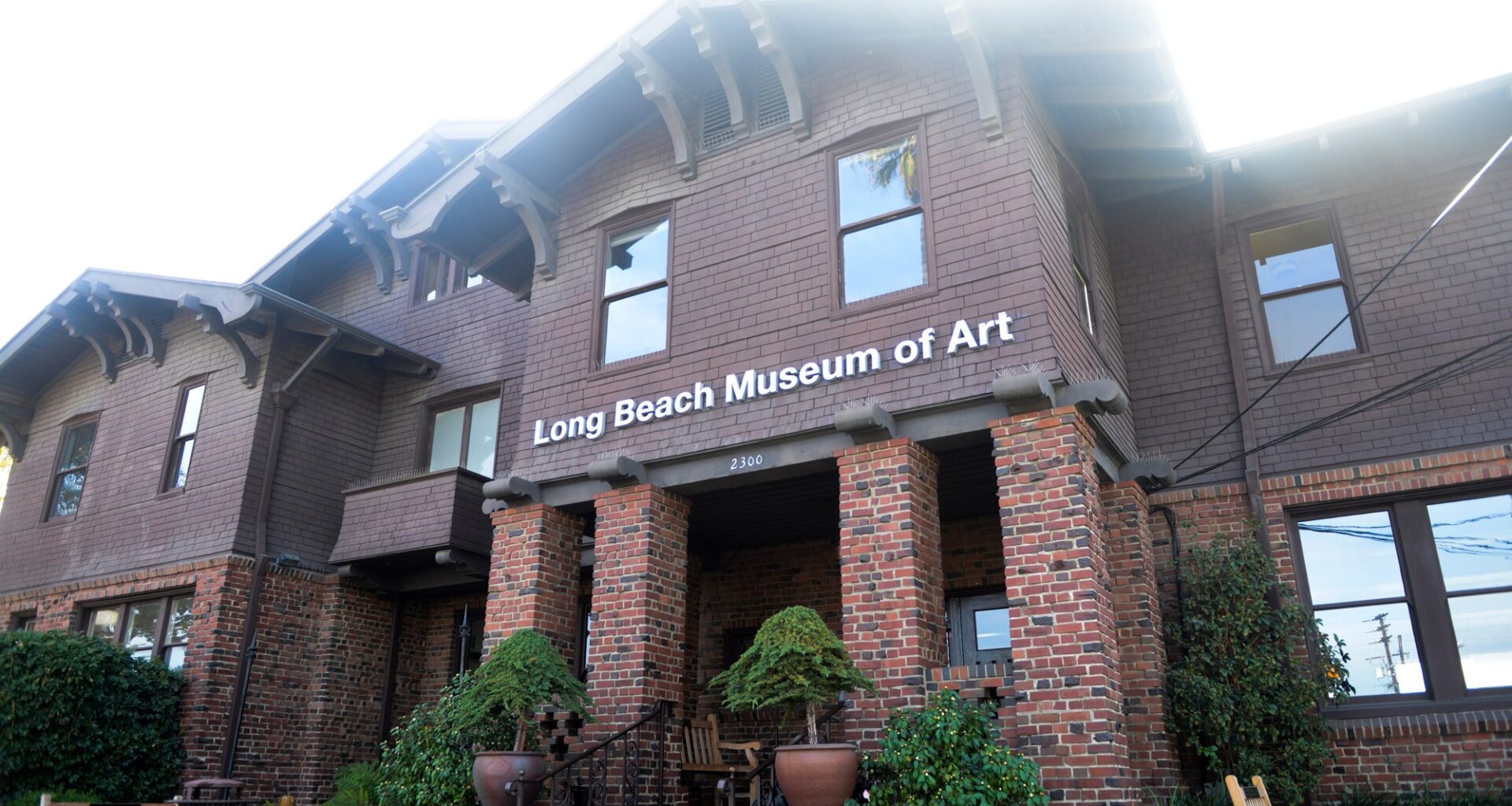
At the Long Beach Museum of Art, the exhibition “Mario Ayala and Alfonso Gonzalez Jr.” brings together six years of collaborative-yet-divergent work by two L.A. artists whose practices investigate how shared images shape our understanding of identity and history.
The exhibit, which runs through Feb. 28 at LBMA, 2300 E. Ocean Blvd., traces the artists’ shared practice from 2020 to 2026.
For those six years, Ayala and Gonzalez have worked as neighbors in the same Los Angeles studio building, developing their work through proximity, shared references and encounters with the same aesthetic environments.
Their painterly approaches, however, diverge.
Born in L.A. in 1991, Ayala draws from the visual culture of the West Coast, incorporating references to murals and tattooing into his work. He brings together forms in surreal compositions that reflect the constant interplay of images that shift from personal experience to the wider world and back again.
Gonzalez, born in L.A. in 1989, approaches the city’s visual landscape through the traditions of commercial sign painting, a craft he learned to appreciate by observing his father’s work.
His layered paintings examine weathered signs and everyday public surfaces as records of labor and hard-won memory.
Together, the two artists reveal how connections between fine art and commercial craft, family history and public space, and representation and abstraction can emerge from the seemingly ordinary details of our city.
The exhibition at LBMA extends these connections beyond the artists themselves through selections from the museum’s permanent collection, chosen by Ayala and Gonzalez.
By placing historical works in conversation with contemporary art, the presentation treats the collection as a living archive in which unexpected relationships emerge.
For more information, go to lbma.org.
‘Sediment/o’
At the Long Beach City College Art Gallery, “Sediment/o” explores migration, memory and the layered realities of life along the U.S.-Mexico border through photography, video and art installation.
On view through this Saturday, Oct. 24, the exhibit takes its title from artist, poet and scholar Omar Pimienta’s 2024 poetry collection, continuing his longstanding investigation of the relationship between geography and personal experience.
As a poet, Pimienta brings language and personal experience into conversation, considering how human and nonhuman movement leaves lasting marks on the borderlands of the United States and Mexico.
Raised in Tijuana, Pimienta draws on his experience of life between these two countries to explore the ways borders shape both individual identities and collective history.
Can forms of resilience, for example, develop across national boundaries? If so, can they survive an ever-shifting landscape?
In “Sediment/o,” the idea of “sediment” offers a way to understand history as an accumulation: layers that remain present even as natural landscapes — and personal circumstances — change.
While he is a poet and author of five poetry collections, Pimienta also holds a master of fine arts in visual arts, with work appearing in exhibits like the Getty Foundation’s “Pacific Standard Time: LA/LA,” the Casablanca International Biennale and the Transborder Biennial in El Paso and Ciudad Juárez.
Pimienta will discuss his interdisciplinary work during an artist talk and closing reception from 1 to 3 p.m. Saturday at the LBCC Art Gallery, 4901 E. Carson St.
For more information, go to lbcc.edu/arts/sedimento.
‘First Pride’
The first Pride march took place in New York City on June 28, 1970, exactly one year after the police raided Stonewall Inn.
Now, Pride celebrations occur in every single U.S state, every single year.
And on Nov. 1 at Long Beach Playhouse, 5021 E. Anaheim St., South Coast Chorale will revisit that key moment in LGBTQ+ history with “First Pride: Songs and Stories from the Birth of a Movement,” a concert exploring the origins of Pride through music and storytelling.
Told through 14 musical selections, the program moves across themes of uprising, longing and belonging, tracing the emotions and experiences behind a movement that transformed America.
The repertoire ranges from simple rounds to intricate choral classics, with several pieces inviting audience participation.
Even though we’re still far from Pride Month in June, this concert offers an opportunity to reflect on the origins of Pride while considering the ongoing significance of the movement’s central ideals: visibility, solidarity and the freedom to belong.
Be sure to arrive at 2 p.m. for a preshow panel for additional historical and cultural context before the 3 p.m. concert.
For more information, go to shorturl.at/C9DDa.