
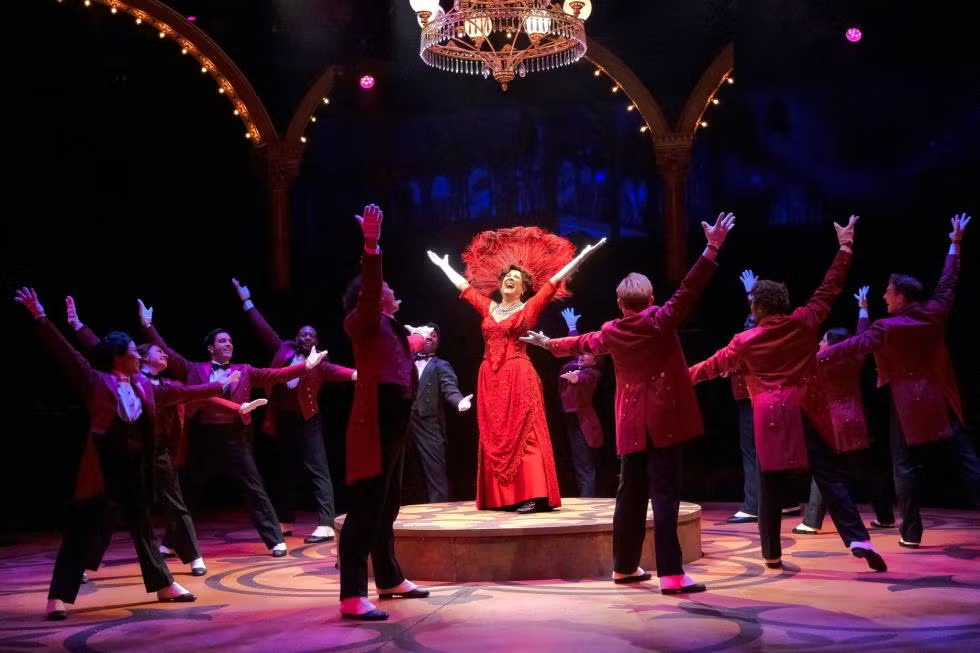
When Russell Lewis and Howard Young brought Music Circus to
Sacramento in 1951, they did not imagine that they were founding
an institution. The maker of their striped canvas tent warned
them that it probably had only about five years of life in it.
They thought that was a perfectly reasonable time span.
Seventy-five years later, the tent is gone, but the company it
housed remains.
I set out to celebrate that improbable longevity when I began
writing ”Broadway Sacramento: 75 Years of Theater Magic.” I
had known Music Circus since moving to Sacramento in 1984 and
later served for nearly a decade on the organization’s board,
including two years as chair. I expected to preserve its
productions, artists, traditions and people. What I did not
expect was how much the research would change my understanding of
why Broadway Sacramento survived when so many comparable theaters
disappeared.
For more than two years, I worked through company archives and
decades of newspaper coverage and interviewed the artists,
administrators and civic leaders who had made the history
themselves. Gradually, another story emerged alongside the
theatrical one: a story of entrepreneurship and financial
discipline, of a company repeatedly changing its business model
as audiences and economics changed and of civic leaders stepping
forward when its future depended on more than philanthropy and
ticket sales alone.
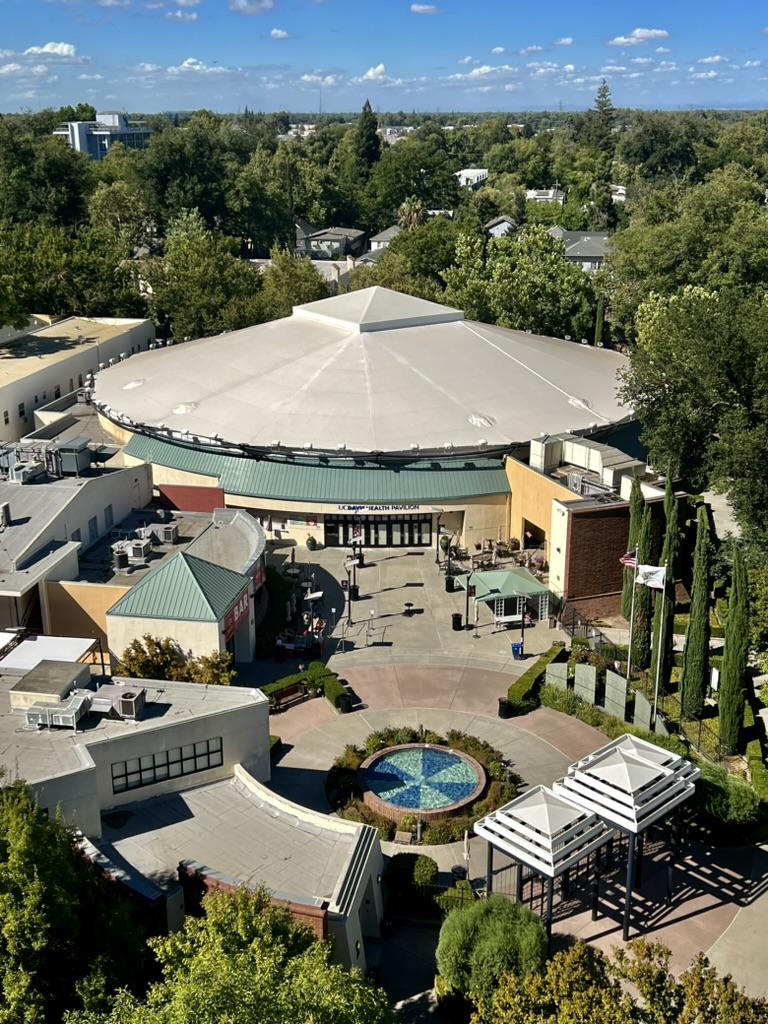
Music Circus’ round theater brings an intimacy to its stagings.
(Photo courtesy of Music Circus)
What emerged was a case study in how a nonprofit cultural
organization survives for three-quarters of a century — and what
happens when a city decides, generation after generation, that an
institution is worth sustaining.
A five-year experiment
Lewis and Young were experienced theatrical producers who had
mounted eight Broadway productions and 17 national tours after
World War II. But Broadway was an unforgiving business. By 1950,
a recent failure had bruised their finances and confidence, and
they began looking for a more durable model.
They found one in Lambertville, New Jersey, where producer John
Terrell was staging summer musicals in the round beneath a tent.
Arena staging required less scenery than a proscenium production;
a tent cost far less than a permanent theater; and at summer’s
end everything could be packed away. Lewis and Young began
looking for a Western location.
Then Eleanor McClatchy heard about their plans.
The publisher of The Sacramento Bee was also an ardent
theater lover who had studied playwriting at Columbia University
and helped create the Sacramento Civic Theater (later Sacramento
Theatre Company). In late 1950, she met Lewis and Young at the
Polo Lounge of the Beverly Hills Hotel and asked what it would
take to bring Music Circus to Sacramento.
Young’s answer: money.
McClatchy and her associates assembled an offer other cities
could not match: a site adjacent to the Civic Theater,
free Bee advertising and a startup loan and financial
support for five years. Lewis and Young agreed to produce ten
musicals each summer, a new show every week.
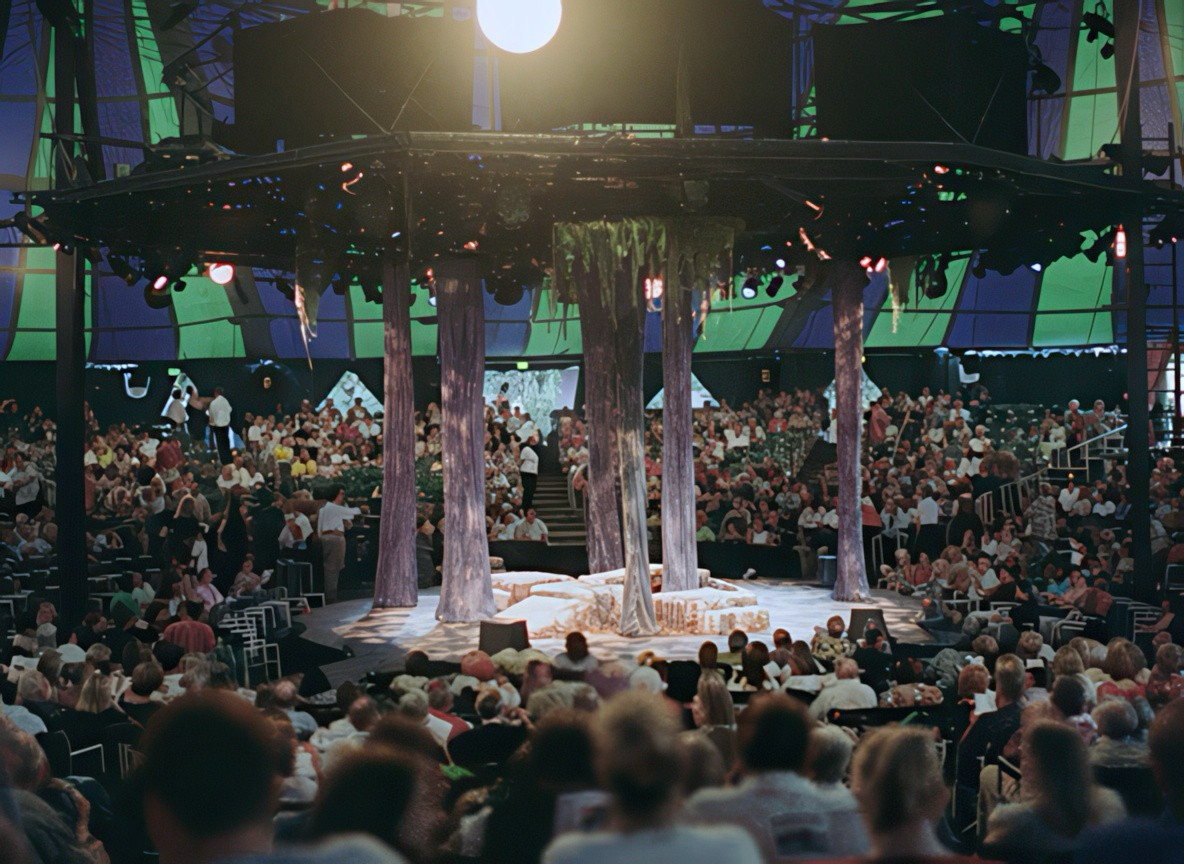
Theater in the round allows stages to be visible from all angles.
(Photo courtesy of Music Circus)
The first green-and-yellow-striped tent rose at 15th and H
streets in 1951. With just 13 rows around the stage, audiences
sat unusually close to the performers. Singers and actors came
from New York and Los Angeles because Lewis and Young could
attract them. Sacramento wholeheartedly embraced
theater-in-the-round and the new summertime experience.
But box-office success did not make the economics easy. By the
end of the first two seasons, expenses outpaced income. Raising
ticket prices seemed the obvious answer. Young found another.
In 1953, Music Circus became the nonprofit Sacramento Light Opera
Association. Nonprofit status brought formal governance and
accounting, but it also qualified the company for exemption from
the 20 percent federal admission tax, allowing ticket prices to
remain static while the company retained 20 percent more revenue.
It also carried an obligation to operate for the “public
benefit.”
Balancing artistry and the bottom line
Lewis and Young — and every leader who followed — understood that
artistic ambition and financial discipline were not opposing
values. The discipline was what made the ambition possible.
Their original producing model was industrial in its intensity:
one show played at night while the next rehearsed by day. Yet
they surrounded themselves with first-rate professionals and
refused to treat summer theater as second-rate theater.
They were especially cautious about fixed costs. For decades,
Music Circus shared the H Street property with Sacramento Civic
Theater, using it during the summer rather than carrying a large
year-round facility. Elsewhere, successful summer theaters built
permanent houses only to discover that neither programming nor
audience demand could support them 50 weeks a year. Most
eventually disappeared. Sacramento avoided that trap.
The artistic model evolved as well. By the 1980s and 1990s,
producing director Leland Ball was moving the company away from
heavy reliance on celebrity casting and toward excellence across
the entire production — acting, choreography, design and music.
At the same time, Ball diversified the business. In 1989, the
organization launched what became the Broadway Series, presenting
national tours at the city-owned Community Center Theater while
continuing to produce Music Circus in the round at the H Street
site. Over time, touring became the larger economic engine,
typically generating more than 60 percent of annual revenue and
providing a financial cushion for the producing side of the
company. Artistic ambition and fiscal restraint were not
competing priorities; they were parts of the same strategy.
From canvas to a permanent home
By the late 1990s, the old tent had become increasingly difficult
to defend as the home of a major professional theater. The chairs
sagged, the summer heat was punishing and technical possibilities
were limited.
What began as an effort to improve the seating became something
larger. City and county leaders initially committed $66,000 each
annually for five years. Board members and management began
asking whether those funds could help support a permanent
pavilion that preserved the intimacy of theater in the round
while adding modern comfort and technology.
Financing it required creativity. A conventional bank loan was
not realistic because the nonprofit lacked sufficient assets to
secure one. The eventual model combined projected ticket and
concession revenue, naming rights, facility fees, municipal
financing and philanthropic commitments. The numbers worked only
if the city and county extended their annual contributions from
five years to 25. They did.

The pavilion under construction. (Photo courtesy of Music Circus)
The pavilion opened in 2003. Its larger lighting grid, flying
capability and automated stage systems changed what artists could
create and demanded a more sophisticated staff to support them.
Broadway performers increasingly sought out Sacramento; by the
mid-2000s, the company spent many weeks a year in New York
auditioning more than 2,000 actors for about 125 Music Circus
roles. Today, over 30,000 actors submit resumes to gain an
opportunity to audition in New York, Los Angeles and
Sacramento.
A public-private investment in infrastructure had become an
investment in artistic capacity.
Knowing when to get smaller
Growth, however, was never treated as an end in itself.
During the Great Recession, the touring production of ”In
the Heights” lost approximately $300,000 in Sacramento. Then
CEO Richard Lewis, son of founder Russell Lewis, concluded that
even a subscription base of nearly 12,000 could no longer support
the two-week engagements that had become standard. He cut most
tours back to one week. Controlling inventory reduced risk and
helped restore financial stability; genuine blockbusters could
still expand, as ”Wicked” did with a four-week run in
2012.
Music Circus contracted too. At its peak it produced as many as
13 musicals in a summer. By the mid-2010s, a season typically
contained five or six, with dark weeks that gave audiences a
break and creative teams more rehearsal time. Fewer productions
meant fuller houses and better work.
That same caution remains visible under current President and CEO
Scott Klier. As new opportunities for year-round programming have
emerged, Klier has resisted adding permanent payroll faster than
the organization can sustain it.
After 75 years, the lesson remains consistent: The objective is
not maximum size. It is sufficient financial strength to keep
doing ambitious work.
The ultimate stress test
That philosophy could protect the company from bad bets and
changing audience demand. It could not protect it from a world in
which theaters simply stopped operating.
COVID-19 canceled Music Circus for the first time in its history
and kept it dark for two summers. Touring stopped as well. For
nearly two years, ticket revenue — the economic engine on which
Broadway Sacramento had always depended — largely disappeared.
What replaced it revealed another reason the company had survived
for so long: it had never survived alone. Broadway Sacramento
received $861,400 through two Paycheck Protection Program loans,
a game-changing Federal Shuttered Venue Operators Grant and more
than $680,000 in City CARES Act allocations. Board members
intensified private fundraising even as the company reduced staff
and expenses.
The combination ensured survival. Financial discipline mattered,
but so did public policy, private philanthropy and a civic
conviction that the institution was worth preserving.
Survive for what?
Financial survival, however, is not the purpose of a nonprofit
theater.
Music Circus’s 1953 obligation to operate for the “public
benefit” gradually took on broader meaning. Programs that began
with college interns grew into school outreach, accessibility
initiatives and training for young artists. Today the Broadway
Sacramento Conservatory provides professional musical theater
training while community night opens final dress rehearsals to
nonprofit and educational groups. In 2025, more than 3,000 people
from 84 organizations attended community night, many experiencing
professional theater for the first time.
A financially sound nonprofit can do more than keep its doors
open. It can help create the artists and audiences that will keep
the art form alive.
The next generation
That may be the central challenge of Broadway Sacramento’s next
chapter.
The company entered its 75th year by experimenting again. The
six-show Music Circus season stretched beyond the traditional
summer, and Broadway On Tour offered a robust eight-show 2026–27
season with recent Broadway Hits including ”Water for
Elephants,” ”The Outsiders,” ”Buena Vista Social
Club,” ”Shucked,” “Maybe Happy Ending,” “The Notebook,” “A
Beautiful Noise” and ”Death Becomes Her.”
More performances, however, require more patrons. And one
challenge is simply explaining what Music Circus is.
For generations of Sacramentans, no explanation was necessary:
Music Circus was part of summer. Younger residents and newcomers
may not know that these productions are neither community theater
nor tours arriving ready-made on trucks. Broadway At Music Circus
is a professional Actors’ Equity producing theater, producing
work on par with what one finds on The Great White Way. Actors
are cast in New York, Los Angeles and Sacramento, and each
production is created specifically for the intimate
theater-in-the-round. Broadway Sacramento describes itself as the
largest continually operating musical theater-in-the-round in the
country.
Telling that story has become harder as the local media ecosystem
that once chronicled each season has thinned. An arts
organization now must tell much more of its own story while
competing for attention across a fragmented digital landscape.
Broadway Sacramento is attacking the audience question from
several directions, including the Conservatory, Community Night
and its $35 Under 35 ticket program. But Klier recently framed
the larger challenge in Comstock’s: the company cannot
simply repeat what it has always done and expect a new generation
to show up. It must understand that audience, find ways to excite
it and at the same time, retain the patrons who built the
institution.
But the problem is not only who sits in the seats. Sacramento is
not a corporate headquarters town in the way many metropolitan
areas are, and that shapes the philanthropic landscape. Klier has
pointed out that without a strong base of major companies
headquartered here and invested in local institutions, arts
organizations have fewer natural sources of corporate sponsorship
and rely more heavily on individual patrons — people already
being asked to buy tickets and then dig deeper to give.
That makes the next chapter a two-part challenge: cultivating the
next audience and the next generation of civic partners. Broadway
Sacramento’s history is full of moments when people and
institutions decided the theater was worth sustaining — from
Eleanor McClatchy’s original backing to the city and county’s
support for the pavilion and the public and private response to
COVID.
In that sense, neither challenge is entirely new. Lewis and Young
also had to persuade Sacramentans to try an unfamiliar theatrical
experience while building the relationships that made it
possible. They changed the product, the promotion and eventually
the business model when circumstances demanded it.
Seventy-five years later, the channels are different, but the
essential questions remain: How do you persuade the next person
to come — and the next partner to help sustain what they find
there?
Broadway Sacramento’s history suggests that longevity does not
come from protecting a successful formula. It comes from knowing
what must be preserved and what must be allowed to change.
A five-year experiment reached 75 by continuing to experiment.
Margaret L. Kane is the author of ”Broadway Sacramento:
75 Years of Theater Magic,” an illustrated history of the company
and the artists who built it.
–
Never miss a story: Get Comstock’s weekly newsletter delivered to your
inbox.