
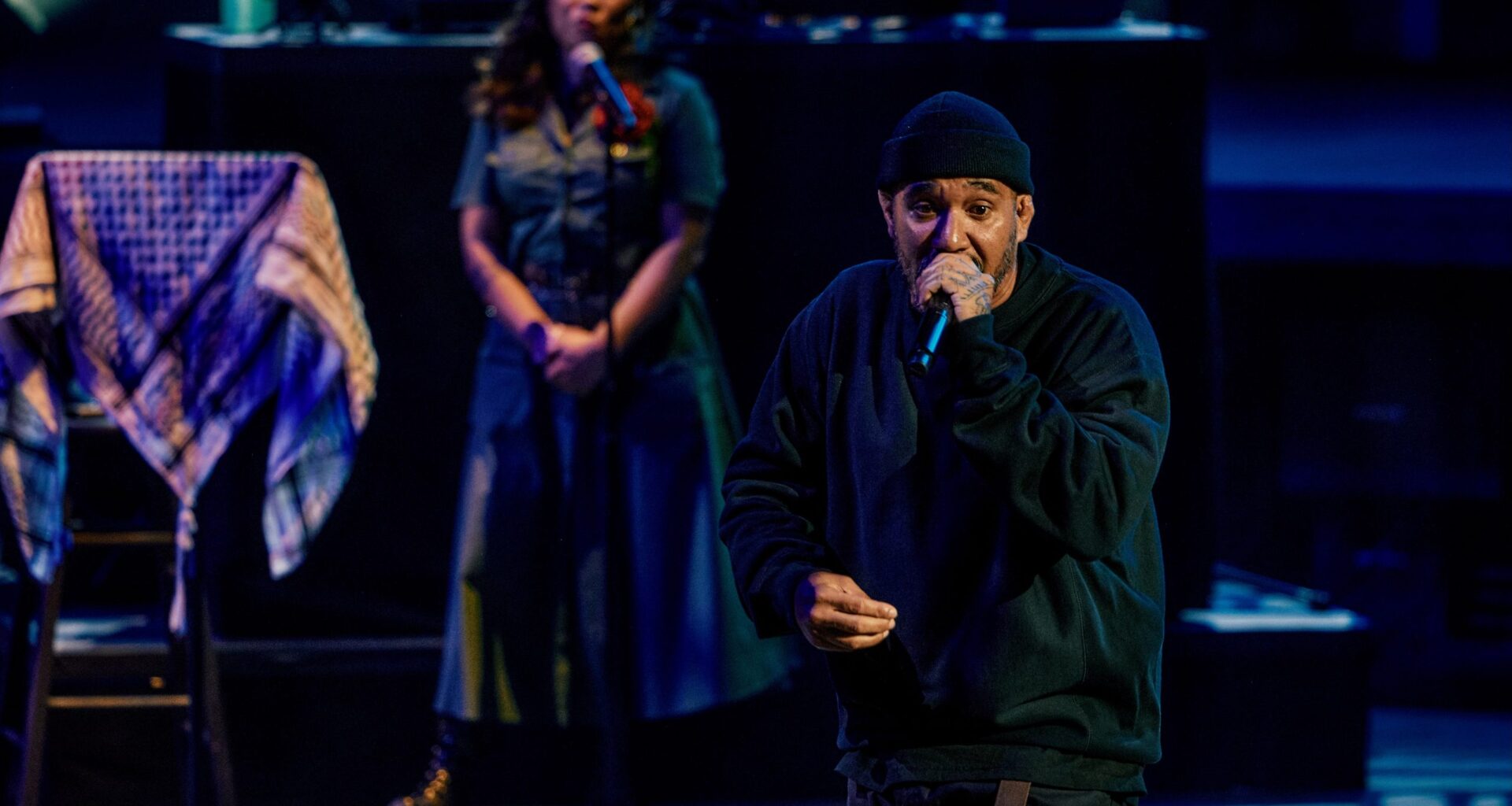
Over a year ago, Jonah Deocampo started hearing from his friends about Immigration and Customs Enforcement’s recruitment advertisements on music streaming platforms like Spotify.
Then Deocampo — the Oakland rapper and community organizer known as Bambu DePistola, known for his socially incisive lyrics that speak out against capitalism, patriarchy and genocide — heard one of those ICE ads himself. The worst part? The ICE commercials were interspersed throughout one of his own albums, without his consent or approval.
The Swedish company drew international ire for participating in the US government-sponsored campaign, and eventually stopped airing ICE ads in late 2025.
But the unsolicited, algorithm-fed listening experience was enough to disillusion Deocampo, who was already skeptical about for-profit streaming companies and their questionable allegiances.
It led him to revisit an idea he’d had since 2016: what would it take to develop a streaming player for his own music?
“Before the bullshit about the commercials with ICE recruitment, these DSP have always thrived on independent art,” Deocampo said of commercial digital streaming platforms. “Their platforms are held up by independent artists, not by corporate labels. But independent artists only get a fraction of a fraction of a cent.”
“I wanted to remove [myself] from that,” he told The Oaklandside. “I formulated an idea of a co-op model, where artists contribute regularly. We can all share it: equal voting, equal paycheck, something sustainable. I wanted to explore that.”
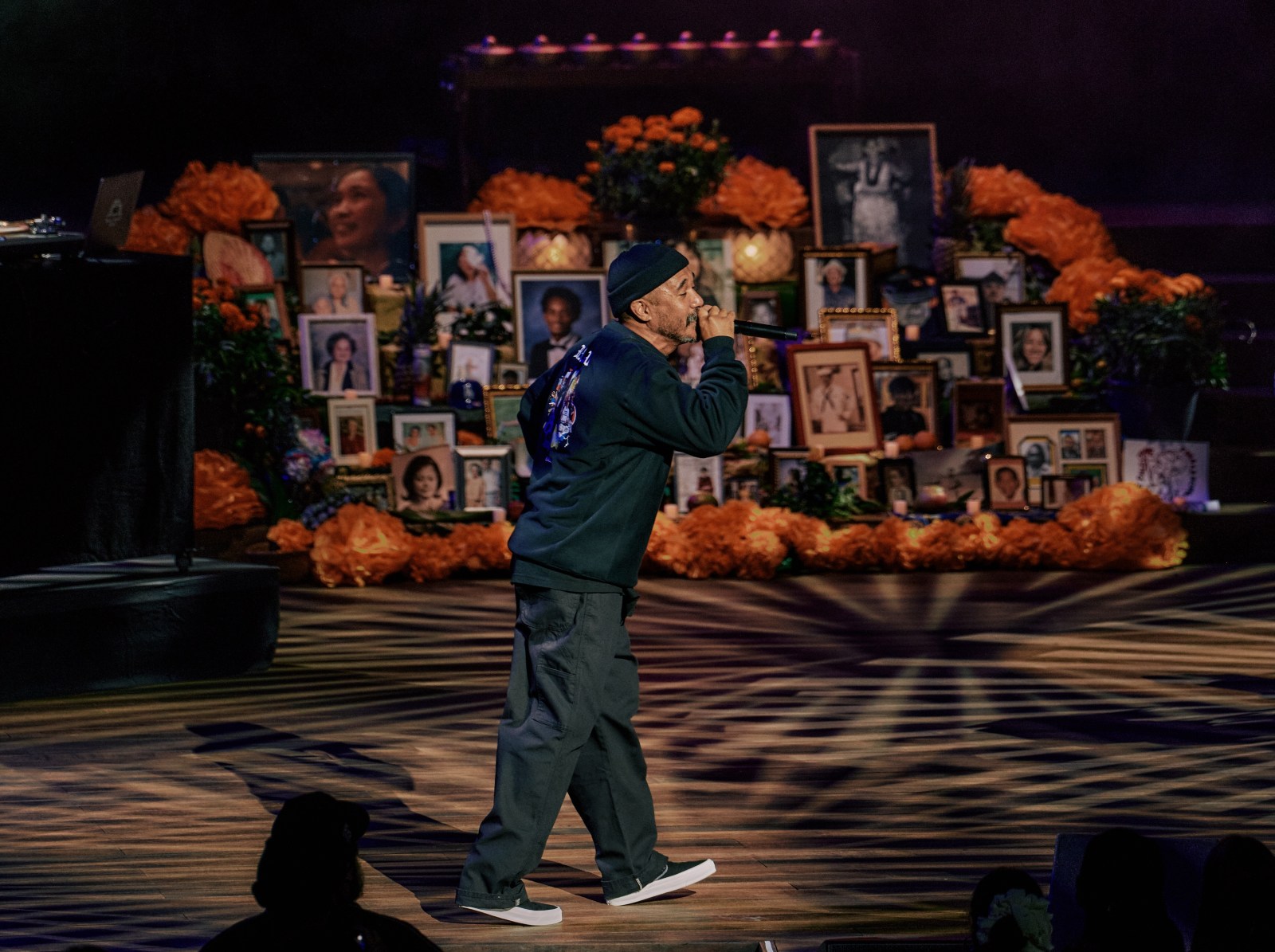 Jonah Deocampo, who performs as Bambu DePistola, at The Ford in Hollywood, Oct. 10, 2026. Credit: Beau Ryan
At the time, Deocampo said, he was quoted around $40,000 to develop such an app; he didn’t have the funding, so he holstered the idea.
But now, a decade later, the recording of his latest album coincides with the increased availability of DIY app development software. Earlier this month, the Filipino American artist launched a new album and streaming project, both with the same name: “Bass Building.”
His innovation? The rap album will be sold as its own streaming app. It’s the first in what he hopes will be a series of records to be released using the technology. The experimental approach will include liner notes, behind-the-scenes content, and other forms of digital exclusives that are meant to immerse fans in ways that Democampo recalled experiencing as a hip-hop head growing up in the Watts neighborhood of Los Angeles. In those days, albums and CDs included physical media and collectible perks to build loyal listeners. According to Deocampo, the Bass Building app will allow fans to have greater access to the artist, as the app will allow artists to add more music and content over time, making each album a living artwork rather than a static artifact.
The Bass Building app was developed by George Walters Jr. and coordinated by Sheppi Soliven exclusively for Deocampo and Beatrock Music — the gritty, underground hip-hop label that Deocampo has overseen as the label’s chairman since 2010. Deocampo said he doesn’t plan to “gatekeep” the tech; instead, he wants to subvert the streaming monopolies and spread the wealth by providing others with the tool.
“I’m trying to help young artists realize that we can go back to the old school selling CDs out of the trunk model with technology, we just need to harness it for us,” he said. “I can’t get away from it completely, but ultimately we’re trying to disrupt the way music is put out.” He said if he sells a few hundred records on the app, he’ll get paid more than a million spins on Spotify. “That’s a no brainer.”
Named in homage to hip-hop’s heavy bassline riffs and the base-building approach of grassroots activists that centers working-class communities, Deocampo is once again bucking against the corporate music industry while embracing his creative arc as a father, activist and neighborhood OG.
Revolutionary-minded rap and activism
In 2002, he co-founded the rap group Native Guns with Los Angeles emcee Kiwi and Bay Area turntablist DJ Phatrick. The group made waves in the conscious rap sphere with their unapologetic, revolutionary-minded politics and sharp-tongued lyrics. Around that time, Bambu adopted community activism as a lifestyle by participating in youth- and student-led organizations. At one point, in the early 2010s, his music was tapped by activists combating a gang injunction in Ventura during a time of increased criminalization of low-income communities in Southern California, and he recalled that protesters borrowed rhymes from his music and printed lyrics on t-shirts to raise awareness. Activists brought the artist to meet with organizers, and their resident-led mobilization ultimately pushed back the gang injunctions. Deocampo’s mission has never been to top record charts, but to affect real-world living conditions. Having worked with the Asian Prisoner Support Committee’s ROOTS program in San Quentin, Kabataang Maka-Bayan Pro-People Youth in Los Angeles, and other California organizations in the past decade, Deocampo is well-versed in community-initiated social reform.
Though Deocampo is no longer on the community frontlines — he now works for a local cannabis company while making music in his spare time — he told The Oaklandside that the album is rooted in his long-time involvement as an organizer and is centered on his faith in progress for future generations.
“I’ve been doing this shit for a long time,” he said. “Base-building is still a very vital, core part of organizing, and now my son is doing that work. That all built the climate for this album.”
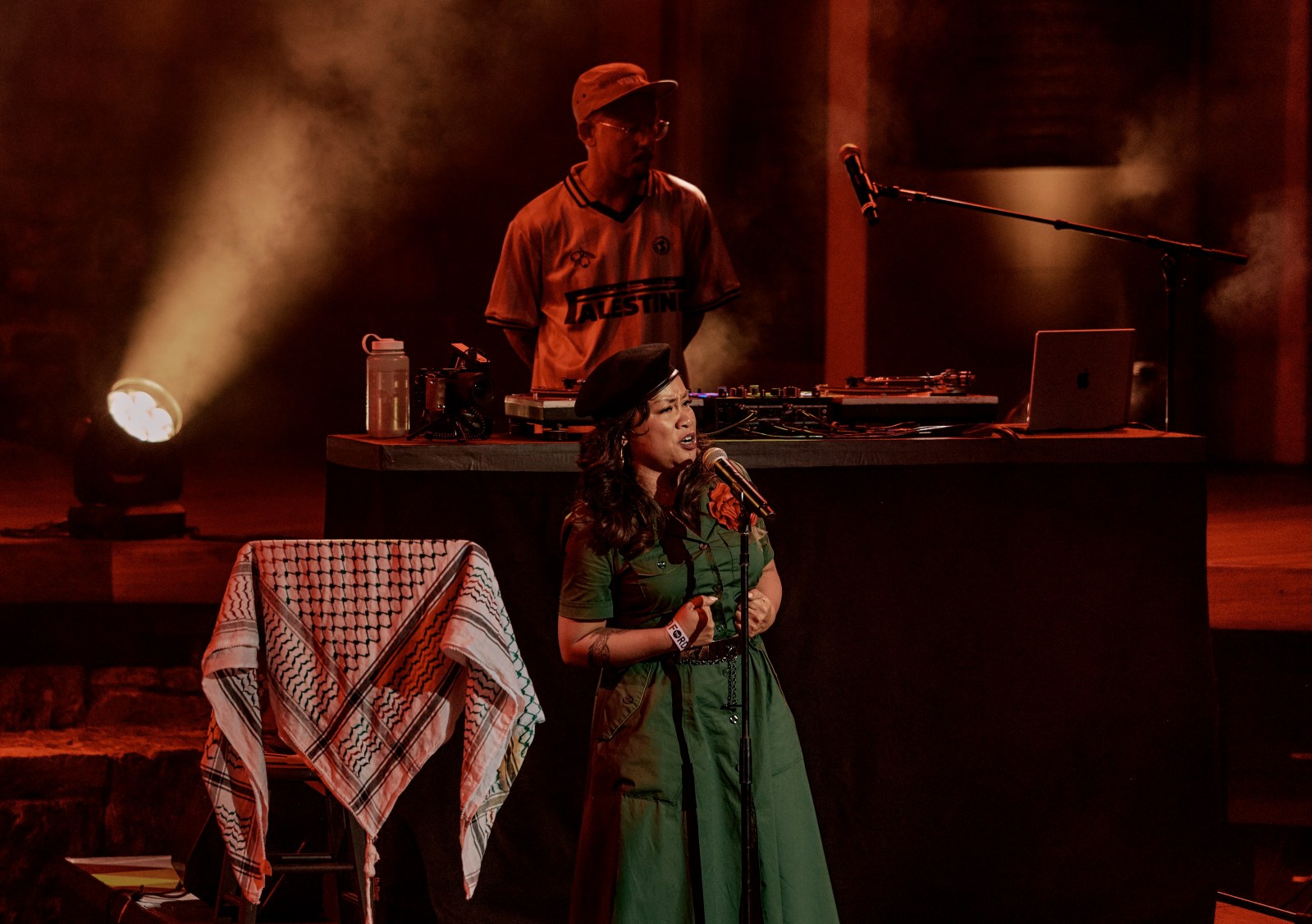 Spoken word artist Faith Santilla performs at part of Bambu DePistola’s set at The Ford in Hollywood, Oct. 10. 2026. Credit: Beau Ryan
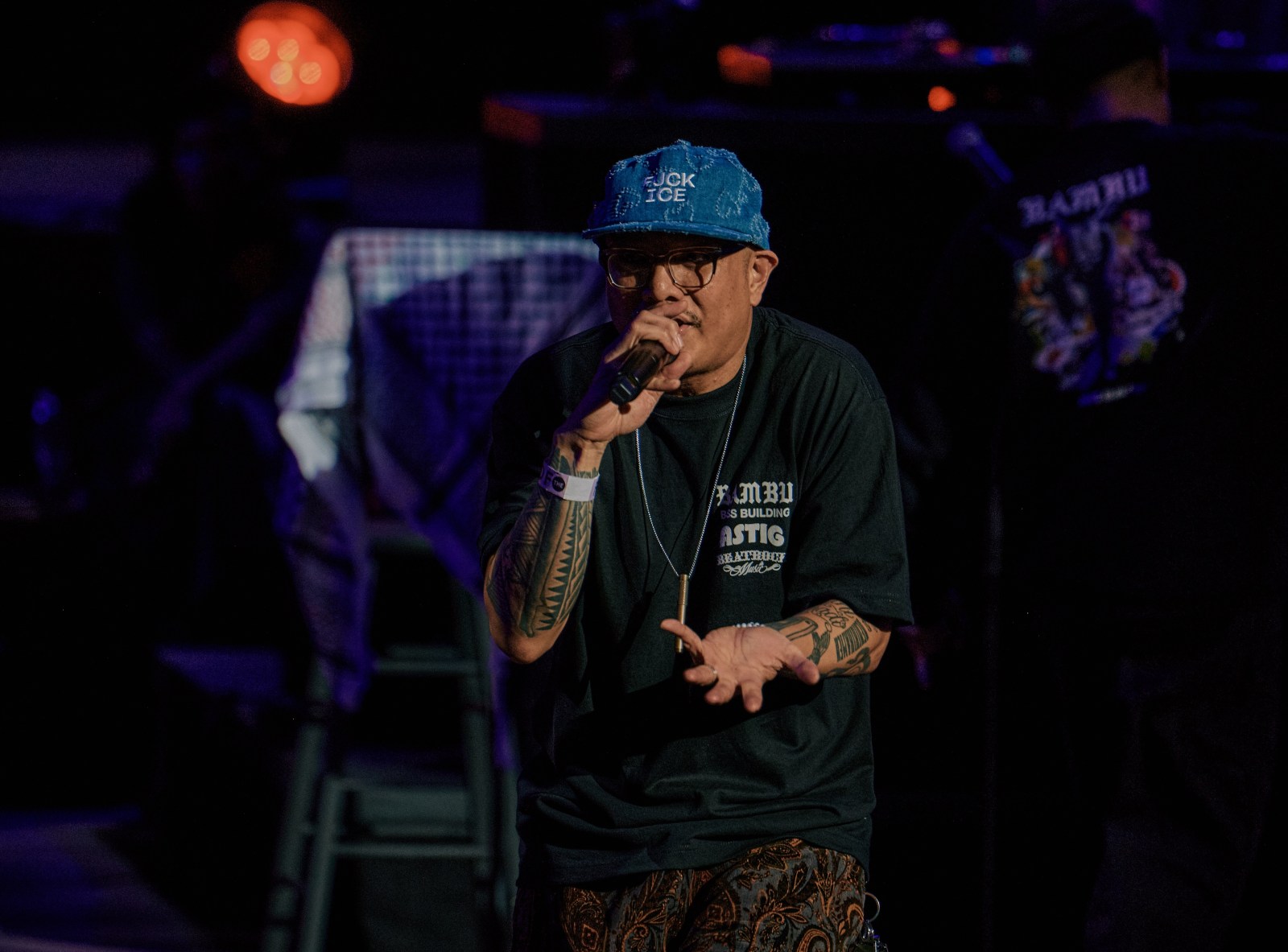 Prometheus Brown, a Filipino American rapper from Seattle, takes the stage as part of Bambu DePistola’s set at The Ford in Hollywood, Oct. 10, 2026. Credit: Beau Ryan
True to form, “Bass Building,” the album, features cameos from established and up-and-coming West Coasters, who each align with Deocampo’s radical approach and his desire for social change through art, music and labor rights advocacy. Their presence lends the album a panoply of stylistic variations and an intergenerational pedigree.
Ruby Ibarra, a San Franciscan Pinay who went viral in 2025 when she was selected for NPR’s Tiny Desk, appears on the track “Jesus Piece.” Ibarra, who is herself with the label Beatrock, is joined on the song by Miss A, a fiery representative of the Philippines-based record label MoroBeats. Prometheus Brown, a veteran Seattle rapper formerly known as Geologic of the Blue Scholars, hops on “Fukkaround.” And Mistah Lefty, an emerging battle rapper from Mandaue City, rounds out the all-Filipino cast of spitters with his appearances on “It’s Called Imperialism” and “Right Wing, Left Hook.”
Then there’s Faith Santilla — a prominent Los Angeles political organizer and poet who Deocampo said galvanized his political consciousness early on — who serves as the album’s master of ceremonies, appearing all over the project in the form of a spoken word rabble-rouser.
“She’s the godmother of that movement for my generation,” Deocampo said of Santilla, who opens “Bass Building” with a spirited poem. Her poems on the album, he said, are “meant to feel like you’re in an organizational meeting.”
California roots and Filipino instruments
The album’s energy is insurgent, political and conceptual. The production — handled by a trio of Deocampo’s FilAm co-conspirators in ET IV, DJ Phatrick and Fatgums — incorporates the kulintang, an indigenous gong-chime instrument from the Visayas region of the Philippine islands, where Deocampo’s mother hails from, blended with old school Memphis rap-influenced drum patterns. It’s an audio mosaic that reflects Deocampo’s ’80s and ’90s upbringing and honors the first-generation tapestry of being raised as a Filipino American in predominantly Black and Brown communities.
“Hip-hop was political in its inception,” Deocampo told The Oaklandside. “It was combating the lack of music and art programs. During the Reagan era, things were getting defunded. Hip-hop was the jet fuel to get shit going for the youth: ‘What is going on and what can we do to solve these problems?’”
For Deocampo, music as a form of connection, storytelling and identity-building — separate from the corporate aspects of the music industry — has been life-altering. Before he launched what would become a decades-long rap career, Deocampo was on a path toward incarceration. At age 16, he committed an armed robbery and was sentenced to two years in Los Angeles’ Central Juvenile Hall. Upon his release, a judge advised him to join the military, and he wound up serving in the U.S. Marine Corps for four years. Throughout it all, hip-hop — especially its origins in struggle and collective empowerment — provided him with a sonic blueprint for transformation.
The “Bass Building” album and app is Deocampo’s most tech-savvy form of resistance yet. It’s a way to gain agency, to imagine solutions that directly serve artists-as-laborers in an ever-shifting digital and corporate context.
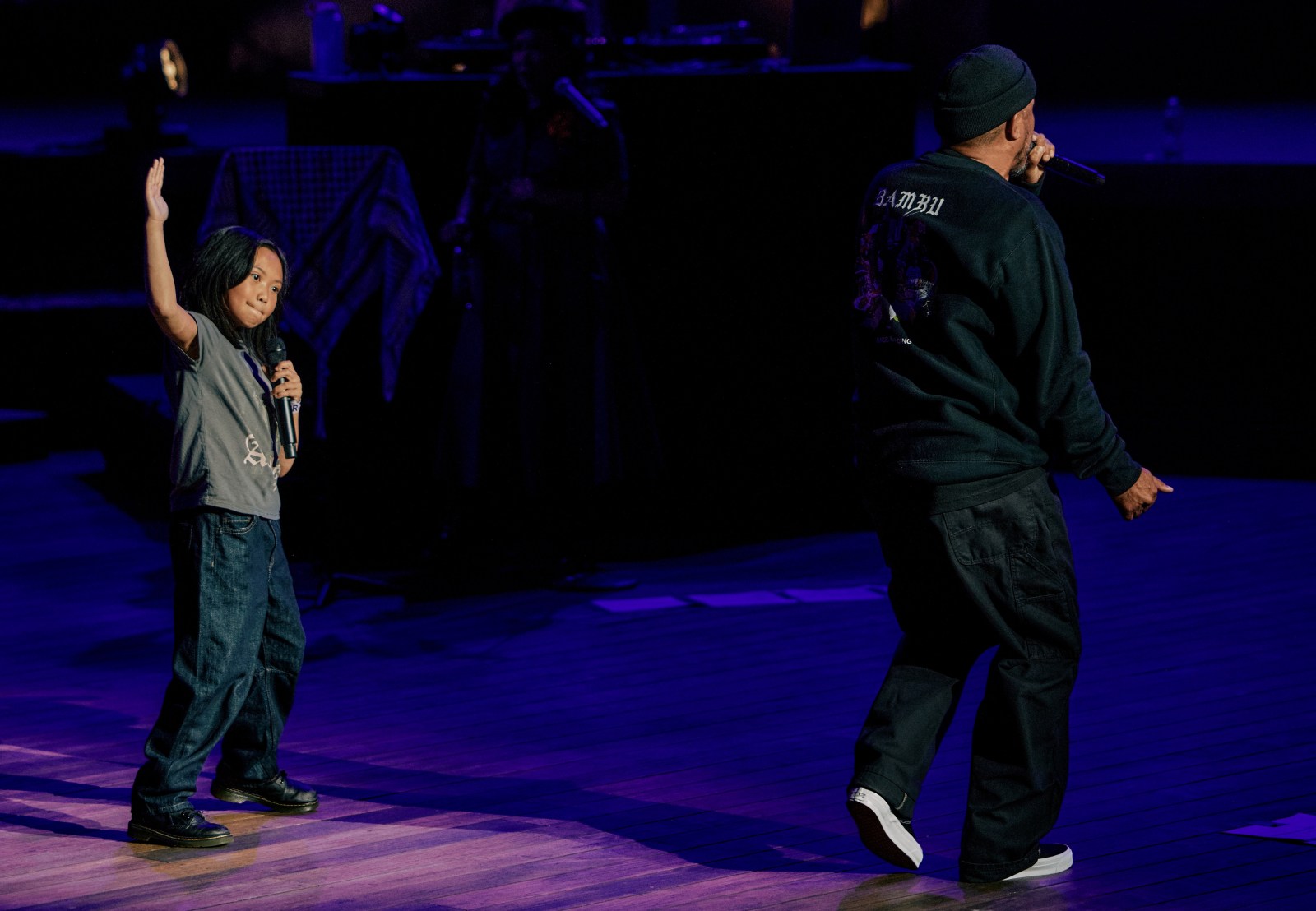 Bambu DePistola performs with his 8-year-old daughter Izzy at The Ford in Hollywood, Oct. 10, 2026. Credit: Beau Ryan
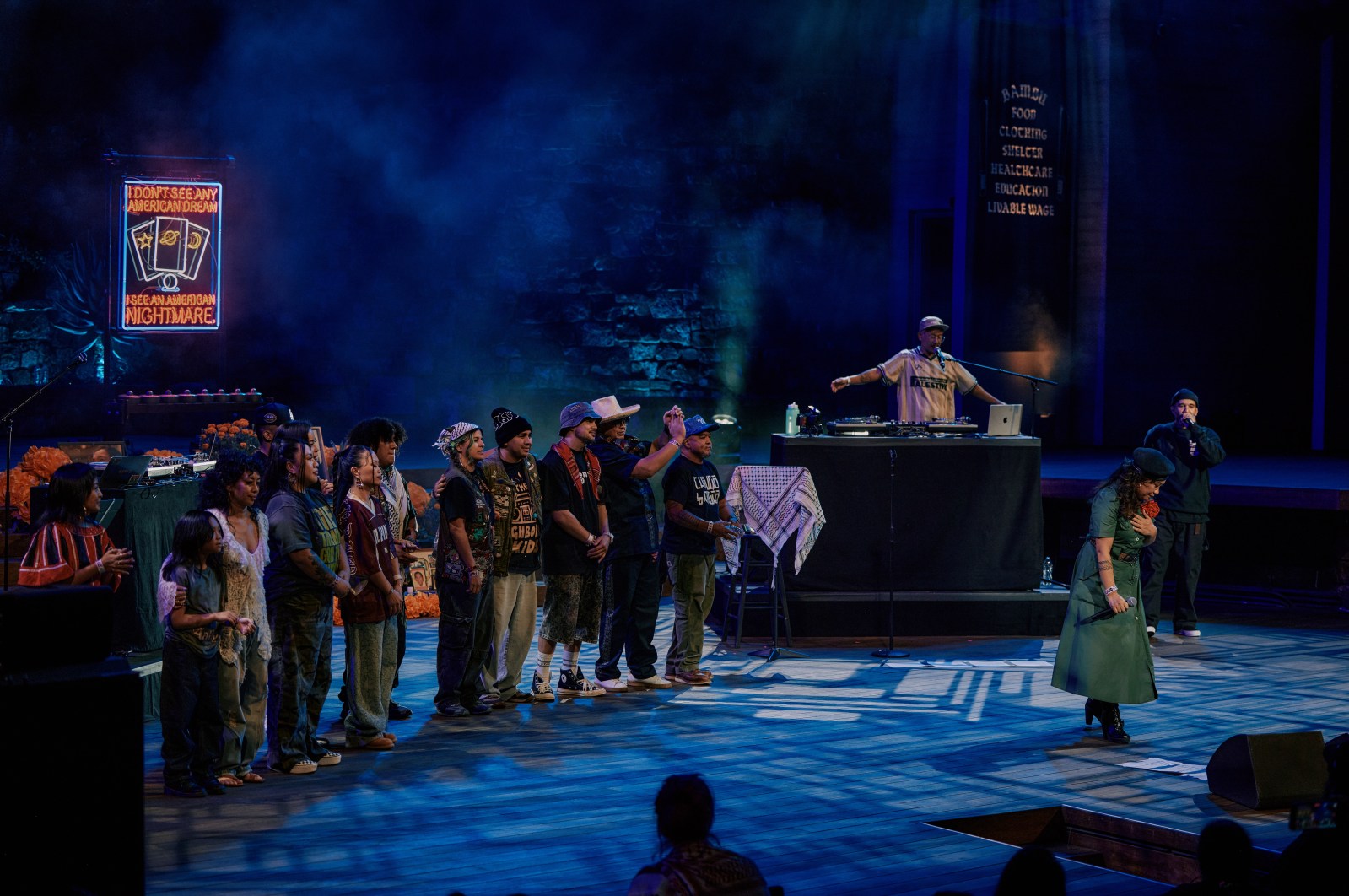 Bambu DePistola, far right, and his array of poetry and music collaborators onstage at The Ford, Oct. 10. 2026. Credit: Beau Ryan
In celebratory fashion, Deocampo and a slew of his collaborators from the album — including his 8-year-old daughter, Izzy, who delivered a bilingual freestyle in English and Tagalog — performed at The Ford, a historic Hollywood venue, on Oct. 10. The message throughout the night was clear: artists want and deserve what they are owed.
Of course, his efforts haven’t gone without resistance. While the project debuted on Android as scheduled, it has been “held hostage” by Apple, as Democampo shared in a recent Instagram post. Still, he said, he’s fighting the fight, refusing to back down from any industry goliaths.
“It’s a dream. With the app, you can support your people more directly,” he said. “We’ll see how it goes. It’s ballsy. People might not be hip to it. But this gives us that opportunity. This is that first step.”
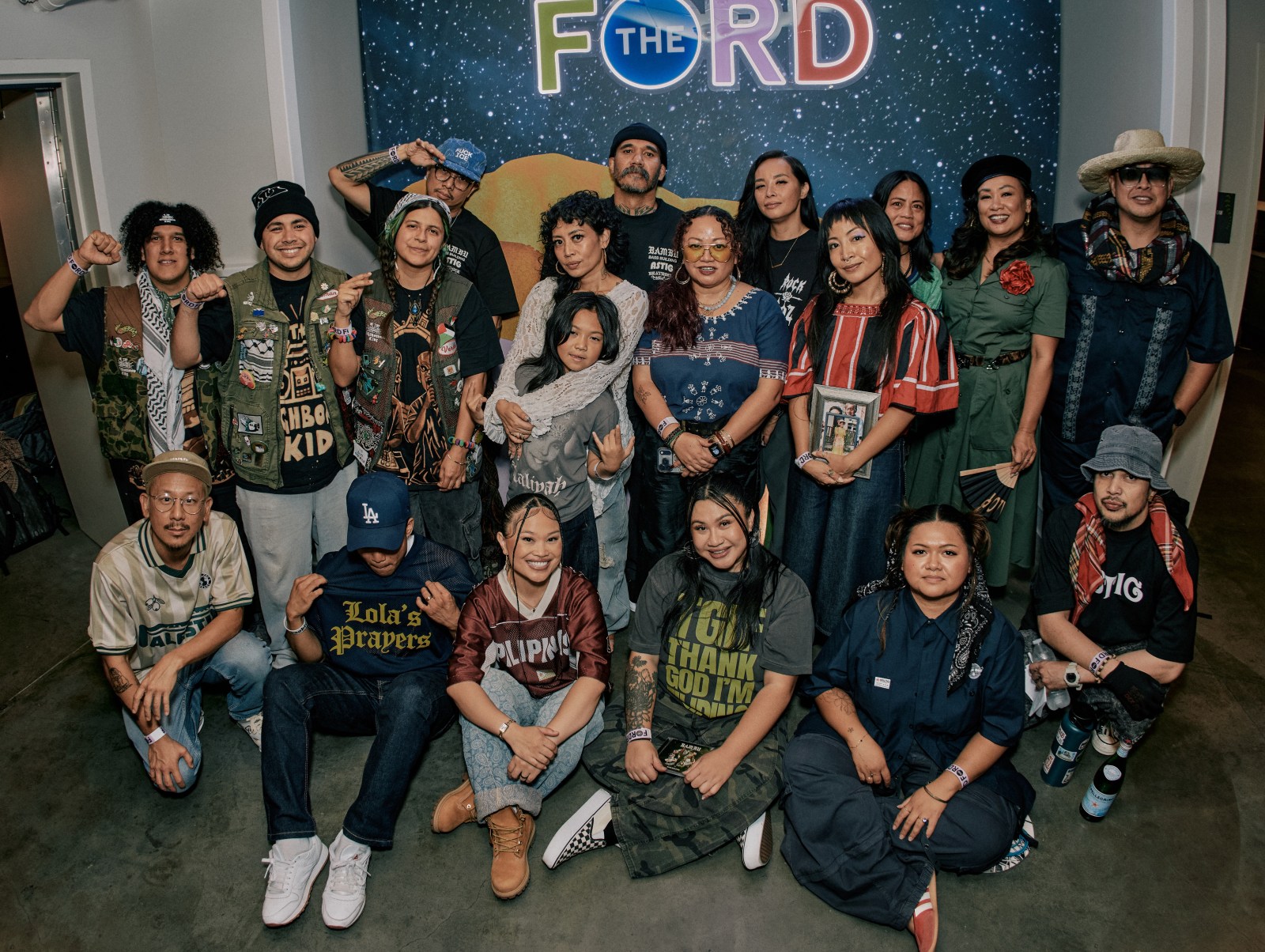 Deocampo, center rear in the black cap, and his band of collaborators backstage at The Ford, Oct. 10, 2026. Credit: Beau Ryan
“Bass Building” was released on Oct. 1 through an app of the same name. It is currently available for download on Android phones and via Bandcamp.
“*” indicates required fields