
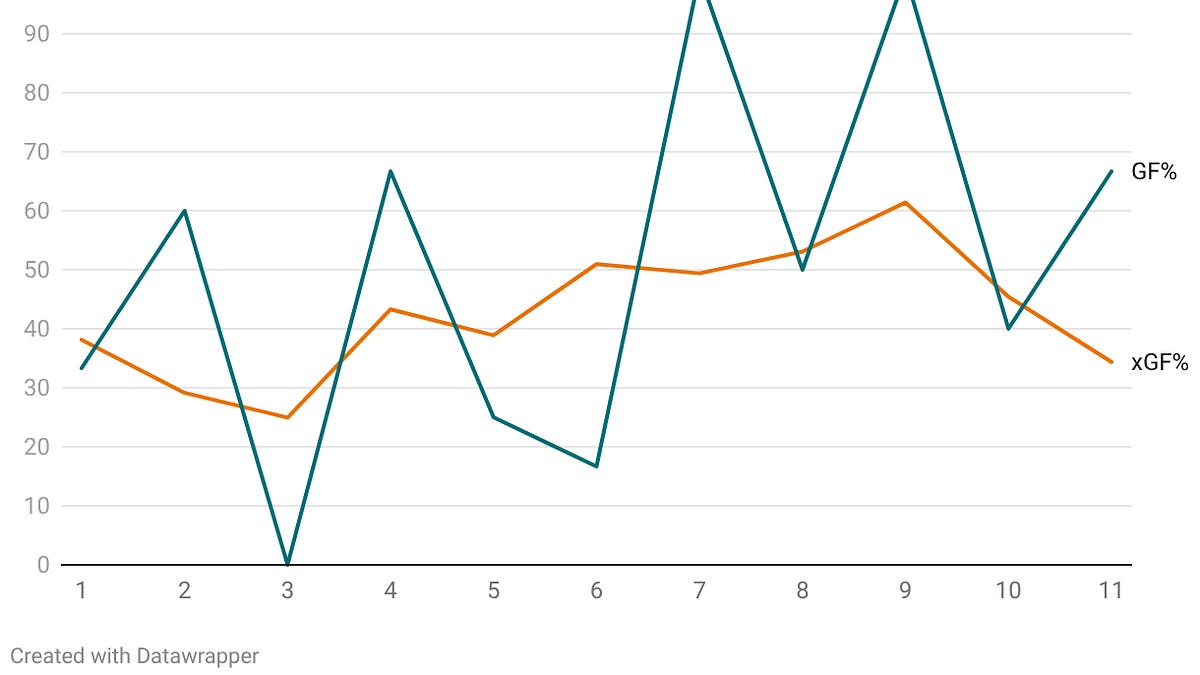
For the first time in years, the San Jose Sharks came into the season with playoff aspirations. They haven’t made the playoffs since 2019, but with Macklin Celebrini becoming the sport’s newest superstar and the team narrowly missing the postseason last year, it wasn’t insane to believe that San Jose could find a way back into playoffs this year, especially in a weak Pacific Division.
Eleven games in, and it’s hard to tell if the Sharks are ready for playoff contention so far. The Sharks are currently in a playoff spot at 6-4-1, though they still have a lot of work to do and a lot to prove. Macklin Celebrini is still incredible, but he once again needs more help around him. But with a young core that’s still getting used to the NHL level, there’s hope that the Sharks will get better as the season goes along.
There’s not too much new to say about Celebrini other than he’s still a ridiculously great player. The scary part: he might be even better this year.
Even after missing two games, he’s 15th in the league in overall points and 14th in points per 60 minutes at all strengths. He’s on pace to score 128 points, breaking his franchise record of 115 last season.
Celebrini’s elite production this year feels a little more sustainable, too. Last year, he had a 12.8 percent on-ice shooting percentage at five-on-five, which is really difficult to repeat. Celebrini was a plus-17 at five-on-five last season despite being just over breakeven in expected goals. Even for someone with Celebrini’s talent, doing that again wasn’t a guarantee.
The good news is that Celebrini’s underlying numbers are even better this year. At five-on-five, Celebrini leads the Sharks in expected goals percentage at 51.4 percent. His on-ice shooting percentage is down to just below nine percent, but he’s still finding ways to win his minutes. If Celebrini gets hot again at five-on-five, look out.
It also seems like the Sharks have figured out their best top line combination: Celebrini, Will Smith and Igor Chernyshov. Smith and Celebrini started the year with Mason Marchment, and it just wasn’t a good fit. Maybe Celebrini’s lower-body injury that took him out for a couple of games impacted that, but the 43.3 expected goals percentage together didn’t exactly inspire confidence.
The Sharks swapped Marchment with Igor Chernyshov, and the Sharks’ new top line has owned 59 percent of the expected goals in over an hour together. The goals haven’t quite come yet — that’s a teamwide issue — and it’s a small sample size, but it’s encouraging. It’s been a long time since the Sharks have had a dominant top line, but they might have one where all three members are 21 and younger. Chernyshov being sidelined with an injury is a big loss.
The Sharks are still figuring everything else out. The defense is still a mess, and a couple of the young forwards are going through some serious growing pains. At five-on-five, the Sharks are 28th in expected goals percentage and 27th in goals-for percentage. They’ve made up for their shortcomings at five-on-five with a hot start on the man advantage and a knack for winning games in overtime, but they’re going to need to be much better at five-on-five before they can be serious challengers for a playoff spot. San Jose needs to produce more chances offensively, but improving upon its measly 6.8 shooting percentage at five-on-five (28th in the league) would be a nice start, and they have the talent to do so.
The Sharks’ Celebrini-less minutes have been an adventure so far, to say the least. Without their superstar on the ice at five-on-five, the Sharks have an abysmal 39.5 percent expected goals share and a minus-7 goal differential. When Celebrini missed two games due to injury, the Sharks only lost one of them, but they were heavily outplayed. The loss was an extremely uncompetitive one against Dallas where San Jose only had a quarter of the expected goals and was outscored 5-0 at five-on-five.
That gap has gotten smaller since Celebrini came back from injury, and the team as a whole has played a lot better in that span. Plus, most teams would struggle if you took out their best player. But if the Sharks are serious about finally snapping the playoff drought, then they’re going to need more from the rest of the lineup.
On the bright side, one of the biggest X-factors for the Sharks heading into the year was if Yaroslav Askarov would rebound after a rough first full year at the NHL level. He’s delivered so far, saving 3.5 goals above expected. Both he and Alex Nedeljkovic are in the top 12 in goals saved above expected leaguewide, which has been huge. It’s a small sample size for a very volatile position, but it’s a very good start.
San Jose spent a whole lot of money and assets on revamping its defense, and it’s still not great. The Sharks are still one of the league’s worst defensive teams — they rank 31st in expected goals against per 60 minutes at five-on-five — and there’s not enough playmaking from the back end in all three zones. Of the three most-played defensive pairings this year for San Jose, none of them are even close to breakeven in either goals or expected goals.
Sam Dickinson has had some offensive flashes, and it feels like he’s starting to come into his own. Nolan Allan has been effective in a limited role, which is great for a former first-round pick who was acquired basically for free. But the lack of any true top-pairing defensemen or an elite puck-mover is killing them. Darnell Nurse is being deployed like he’s a true shutdown defenseman when he’s not. Michael Kesselring has been an upgrade, but he’s not at that level, either.
But the most worrying thing for the Sharks right now is that their two second overall picks, Michael Misa and Ivar Stenberg, are really struggling at five-on-five, which has been compounded by the fact that they’ve been playing together.
Stenberg is off to a fantastic start production-wise — his eight points in 11 games are tied with Detroit’s Michael Brandsegg-Nygard for the most among all rookies this year. But that’s a little misleading because Stenberg still has zero points at five-on-five so far. Six of those points are on the power play (not that those count less on the scoreboard), and he picked up another point on an empty-net goal. He’s currently one of three forwards leaguewide with at least 120 minutes at five-on-five without scoring a point.
Misa is actually second on the team in points per 60 minutes, but the underlying numbers have been pretty ugly. Coming into the season, the hope was that Misa would grow into being a second-line center after acclimating to the NHL level last season. That hasn’t quite happened yet. In over an hour together at five-on-five, Stenberg and Misa have a 29.7 percent expected goals percentage and a minus-4 goal differential.
It’s a tough league for teenagers — don’t let Macklin Celebrini’s rapid ascension to superstardom fool you. It’s way, way, way too early to panic about either player. But the difference between making the playoffs and not making the playoffs might be if they take a big step this year, Misa especially. The Sharks as a team massively improved over the course of the year last season, and they could very easily do the same this year.
Only one of the Sharks’ six wins has come in regulation, and they became the fourth team in NHL history to record its first five wins all after regulation. It’s not like they haven’t had opportunities to win in regulation, either. They blew multi-goal leads in their first two games of the season before rallying to win in overtime. Two weeks later, they let the Predators score two goals in the final 11 minutes (including a Steven Stamkos buzzer beater) to force before again rallying to win in a shootout. It finally came back to bite them last weekend against Detroit when the Red Wings came back from a 3-1 deficit in the third period to win in a shootout.
This has been a problem for the Sharks for a while now. Two years ago, they became the first team since the 1982-83 Devils to have a sub-.500 win percentage in games where they led after two periods. The Sharks were much-improved in that department last season, finishing ninth in the league in win percentage in games where they led after two periods (even if it didn’t really feel like it).
It just feels like they stop playing whenever they have a lead in the third period. Right now, they’re giving up the third-most shot attempts at five-on-five when leading and have somehow been fortunate to not give up more goals, per Natural Stat Trick. Everything is a small sample size this time of year, but it’s a worrying trend. It’s a young team that still has to figure out how to win consistently, but you would hope the influx of veterans like Nurse, Trouba and Marchment would help on this front.
 Courtesy of hockeyviz.com
The Sharks’ penalty kill is off to a rough start. San Jose is giving up the third-most expected goals per 60 minutes while shorthanded, and it’s been bailed out by its goaltending so far (including this incredible save from Askarov from Thursday’s win against Ottawa). San Jose doesn’t have a ton of room for error, and this could be a serious problem if things don’t change.
Advanced stats are from Hockey Stats unless otherwise noted