
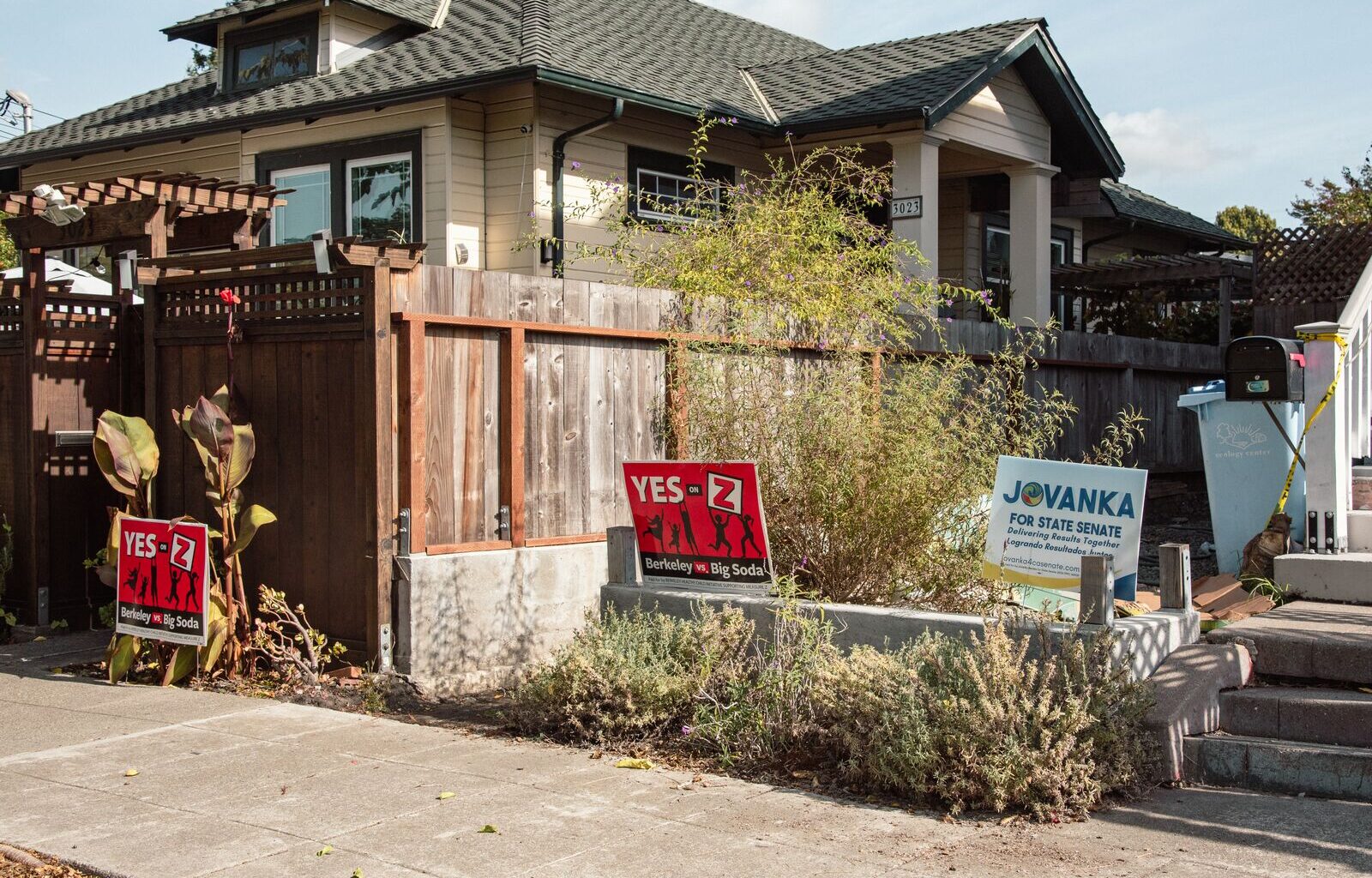
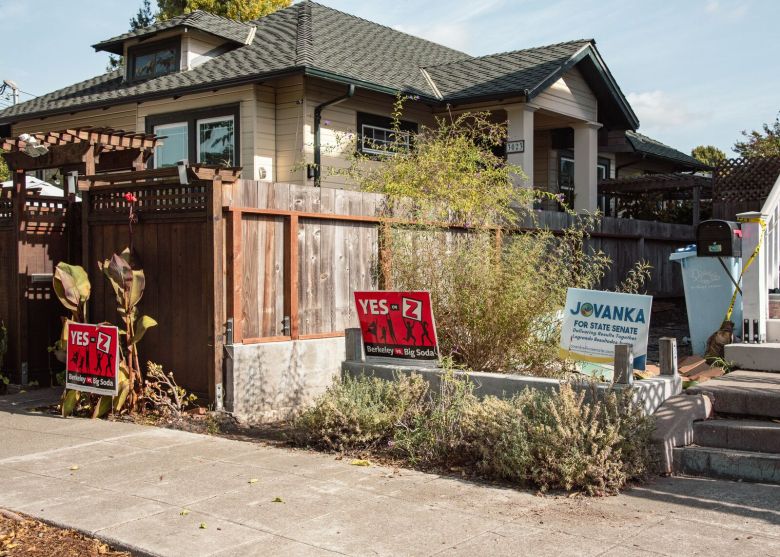
 A file photo shows signs from the campaign to extend Berkeley’s soda tax in 2024. Credit: Ximena Natera, Berkeleyside/Catchlight
If the last election is any indication, a measure to double Berkeley’s soda tax is likely to be one of the least controversial questions on November’s ballot. Two years ago, 80% of Berkeley voters agreed to extend the tax permanently after a quiet campaign with no organized opposition.
But Measure AA, which would increase the city’s sugar-sweetened beverage tax, known more commonly as the soda tax, from 1 cent to 2 cents per ounce, has become the most expensive ballot question campaign this year.
All of our coverage: Meet the candidates running for city council, rent board, school board and more. And learn about local ballot measures and how to vote.
The American Heart Association had contributed $300,318 to the committee formed in support of Measure AA as of Oct. 17, the close of the most recent campaign finance reporting period. The committee has raised another $18,768 in other contributions, for a total of $319,086. That tops the amount raised so far by this year’s second-priciest measure campaign, a proposed parcel tax to fund the arts, by more than $50,000. And soda tax proponents raised that money in just four months, compared to more than four times as long for backers of the arts tax.
In a prepared statement provided by spokesperson Nerissa Itchon, the American Heart Association said it was concerned about possible opposition from the soda industry, which spent more than $2.4 million trying to block Berkeley’s soda tax in 2014 and invested tens of millions since then trying to block similar taxes.
“Given that history, public health organizations have learned the importance of building strong campaigns early,” the statement read.
That opposition has not materialized so far — there are no committees registered against Measure AA.
“We do not base our advocacy efforts on speculation about whether a formal opposition campaign will emerge,” the American Heart Association’s statement read. “Rather, we plan based on the well-documented history of industry engagement in sugary drink policy campaigns.”
The soda industry outspent tax proponents more than two to one in the initial soda tax campaign, despite large contributions in support, like $85,000 from former New York Mayor Michael Bloomberg. Berkeley’s first-in-the-nation tax nevertheless passed handily with 75% of the vote.
Money raised from the tax goes to fund nutrition education programs through city churches and nonprofits, a cooking and gardening after-school program through the Berkeley Unified School District, and health and dental screenings through local medical providers. In the first year the tax was in effect there was a 10% drop in soda consumption in Berkeley, according to a 2017 study by the Oakland-based Public Health Institute and the University of North Carolina.
Public bank, arts measures raise six figures
The effort to pass Measure Y, which would impose a parcel tax of 7 cents per square foot to build an “arts vitality fund,” most of which would go to pay operating expenses for some nonprofit performing arts organizations, ranks as the second most-expensive campaign so far. Fundraising for the measure began in May 2025, over a year before fundraising for the soda tax increase.
A campaign committee supporting the measure had raised $266,239 as of the end of the filing period, with several large contributions from arts organizations. Berkeley Repertory Theatre was the ballot measure’s biggest overall donor, contributing $30,000. The UC Theatre gave $15,000, The Freight contributed $13,000, the Shotgun Players $12,500 and the Berkeley Symphony Orchestra $7,500.
The largest individual donor, Scott Schenker, chief scientist at the International Computer Science Institute, contributed $25,000. Steve Meckfessel, president of SRM Associates, which manages the tower at 2150 Shattuck Ave. and recently purchased the building that formerly housed Fantasy Studios, gave $15,000; performer Colin Epstein contributed $13,000.
No committee has registered in opposition.
Measure Z, which came in third in terms of fundraising, would impose a parcel tax aimed at raising $58.3 million from Berkeley over six years to fund a public bank for the entire East Bay region. Proponents hope the bank will eventually invest in progressive goals like affordable housing and clean energy.
The Committee to Keep Berkeley Money Local, which formed in support of Measure Z, had raised $190,114 in cash and loans as of Thursday, according to campaign finance records. Despite its name, only $2,170 of the committee’s money came from within Berkeley. Its largest donations included $40,000 from the Oakland based Friends of Public Bank East Bay, which has campaigned for a regional public bank for several years, and $45,000 from The San Francisco Foundation, which offers grants aimed at promoting racial equity.
The largest contributor, at $49,500, is a nonprofit registered in March called Keep East Bay Money Local, which shares a San Jose address with the committee and its political advisors, Eldridge Political Partners, according to state business records.
A committee named “Protect Berkeley, No on Measure Z” filed its first paperwork Sept. 14 but had not listed any contributions as of this week.
“*” indicates required fields