
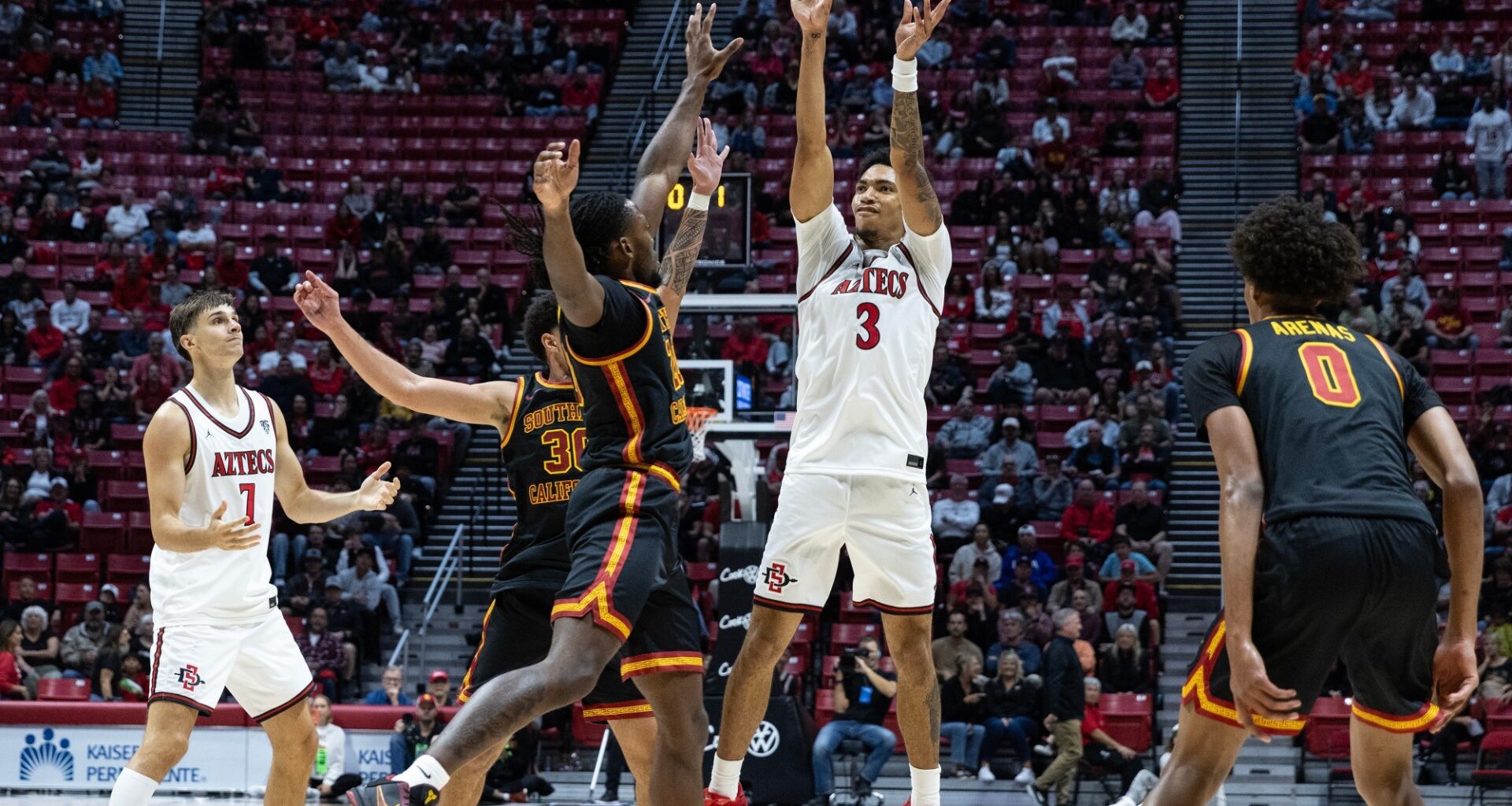
San Diego State basketball fans were back at it Friday night.
A nearly full-house crowd showed up for the season’s first home-court exhibition game, clapping at the outset, roaring amid a second-half comeback.
Just last March, the Aztecs missed out on March Madness for the first time in six years.
Why should Aztecs fans believe, as the chant almost goes, that this year’s team will win big again?
See Elzie Harrington, six months after his leg procedure.
The guard dunked in traffic and sank three long shots, led the team in points (19) and minutes played (28) and, looking fresh in the second half, bounded from behind and swatted a shot.
Say hello to Jeremiah “Bear” Cherry, the new center.
During introductions, the 6-foot-10, 270-pounder hunched over on the bench while the other four starters went out.
He answered the call by holding up against ultra-long, athletic USC in 23 minutes, despite not getting a lot of help. He blocked three shots, took four rebounds and created four free throws, making all of them on this night. His 16 points overshadowed his five turnovers.
“Bear Cherry is a legitimate Big Ten center,” USC coach Eric Musselman said after his 21st-ranked team — which will get special mention here — won 84-68, one week after edging UC San Diego 80-74 in La Jolla.
The October exhibition demonstrated that Harrington, 20, and Cherry, 23, have rebounded well from injury-shortened seasons. And it confirmed that guard Latrell Davis, a redshirt last year, is a prototypical SDSU player. Eager to defend and tough.
Tae Simmons was more fluid in traffic. The 235-pounder, listed at 6-6, made a smart reverse dunk against high-altitude USC. He ran the court better, too.
“I like what they’re doing with Simmons — playing him in the midpost and throwing it to him in transition,” Musselman said.
Exhibitions being what they are, coach Brian Dutcher didn’t go on about SDSU’s 12 first-half turnovers. Or hot-shooting USC building up a 23–point lead in the first half.
“We’re going to be good, we’re going to be good,” he said. “When we’re good, I don’t know. But in the 26 years I’ve been here, Aztecs basketball has always gotten better as the season went on.”
Aztecs fans have another reason to believe: the NCAA Tournament has been expanded from 68 to 74 games.
The exhibitions against No. 21 USC and No. 5 Arizona gave Dutcher’s team a feel of the top-tier length it may encounter against UCLA and BYU, two top-20 teams on its non-conference schedule, or in the NCAAs.
But big-boy games are further bringing home an inconvenient truth:
College basketball’s big spenders have far more upside, year in and year out, than SDSU can be rightly expected to match.
USC outspends SDSU about three to one.
Musselman took two Arkansas teams to the big tournament’s final eight. His USC roster appears to have more talent than those.
Availability is a question mark. Several players’ medical histories aren’t great.
But a trip to USC’s first men’s Final Four since 1954 wouldn’t be a big surprise.
USC posed SDSU with more length and athleticism than it will see in the Pac-12, even from No. 15 Gonzaga.
This, despite USC lacking its 7-1 sophomore center who played often for UConn last year and a 6-foot-8 forward who is ESPN’s No. 5-ranked freshman and snatches the ball with one hand like it’s a grapefruit.
The duo’s absence freed up potential NBA lottery pick Alijah Arenas — a 6-7 guard whose father, Gilbert Arenas, was an NBA All-Star — to hit SDSU with 22 points and 12 rebounds in 33 minutes.
It opened up more opportunity for a pair of 19-year-old twins, Adonis Ratfliff (7-0) and Darius Ratliff (6-11) whose father, Theo, was an NBA All-Star. Two other tall Trojans, each 6-10, troubled SDSU. So did powerful guard Rodney Rice, who’ll be 24 next month.
San Diego State isn’t complaining. There’s ample opportunity in the Pac-12.
But college basketball’s economic realities are more formidable than four years ago when Dutcher’s program reached the national championship game — a feat that can’t be mentioned too often.