
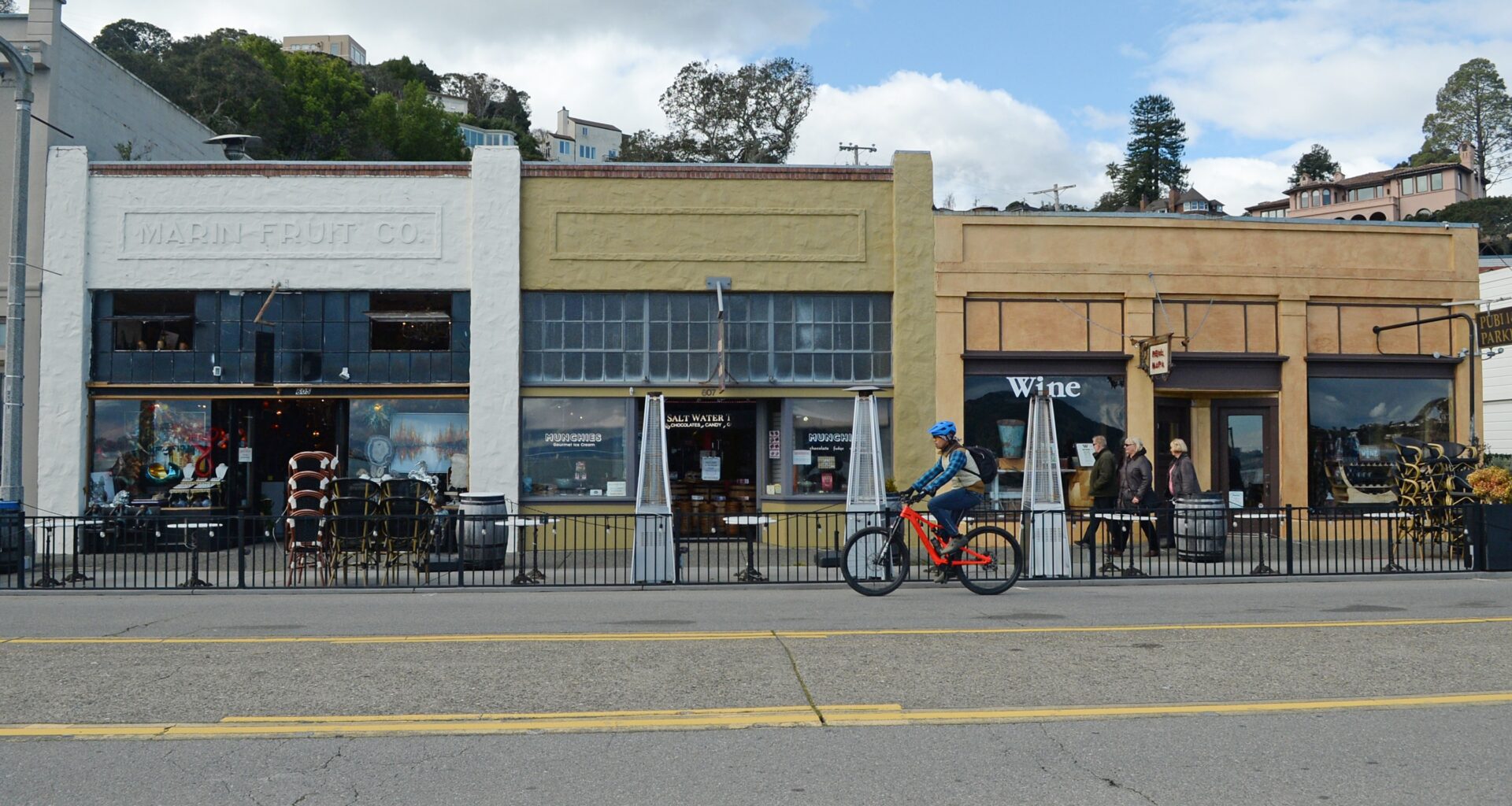
Sausalito has dealt another setback to a proposed seven-story condominium development on the waterfront.
The City Council voted Tuesday to reject an appeal by the developer and property owner, who said the city improperly deemed its project application incomplete.
“The city’s conclusions are not frivolous, pretextual, intended to cause delay and without merit,” Councilmember Joan Cox said before the vote.
The council also rejected the developer’s “challenge conduct notice,” which claimed city staff and the council intentionally delayed and blocked the 49-apartment project.
Both votes were 4-0. Councilmember Ian Sobieski recused himself from the appeal hearing because he lives near the property at 605-613 Bridgeway.
“We think the council’s totally wrong,” Kenneth Stahl, the attorney for the developer and property owner, said after the council meeting. “The law is pretty clear that you have to meet your housing element commitments.”
“Litigation is definitely a possibility,” Stahl said. “And by the way, that’s not just from us, but there are pro-housing organizations that also have the ability to sue.”
Sausalito resident Linda Fotsch owns the two parcels, and the development company is Willy’s LLC. Fotsch submitted the development proposal in 2023.
Fotsch expected it would be automatically approved because she said it complied with the city housing element, a state-mandated plan listing housing sites.
City planners said the project is in a historic district, requiring a review under the California Environmental Quality Act. They concluded her application was incomplete.
That determination led to a long stalemate. In 2025, Fotsch appealed the finding to the Planning Commission and lost. That led to the council appeal hearing on Tuesday.
In the interim, community opposition mounted, including a petition with 1,700 signatures. The council, meanwhile, amended its housing element to downsize projects at Fotsch’s site.
Her attorney and lawyers on the council — Mayor Steven Woodside, Cox and Councilmember Jill Hoffman — parried for several hours with technicality-laced arguments.
“In January of 2023, the city adopted a housing element that designated this property for 49 units with a density bonus,” Stahl said. “That means it would be approved ministerially with no discretionary permits and that the project would not be subject to the California Environmental Quality Act. … The city then reversed course, beginning in 2024.”
Sausalito planning consultant Neil Toft said the half-acre site is in the historic district, did not qualify for a CEQA exemption and is not entitled to as many residences as the developers claimed and sought to build — even with some reserved for affordable housing.
More than 200 residents submitted letters to the city, most opposing the project.
Only two people supported the plan during the public comment period Tuesday.
“Reverse the incorrect Planning Commission’s adverse decision,” said Chris Sullivan. “It’s time to change the dialogue. Marin is changing. Even other communities are welcoming improvements.”
Most speakers said the project is inappropriate for the historic downtown district, a tourism draw.
“I have lived on Bridgeway, just a few blocks from this proposal, for 35 years,” said Adrianna Dinihanian. “Please deny this proposal. There is no place for this giant enormous building in that area of town. It is completely out of scale and out of character.”
“Nobody wants this,” said Susan Keegin, a 50-year resident. “You have so many letters that have been written by my neighbors and a lot of my neighbors are sitting here. It’s a full room. You know what to do.”
Fotsch said, “I have lived in Sausalito for nearly 40 years. I raised my four children here. I am not an outside developer coming to Sausalito. This is my home too.”
During their discussion, council members said the developers didn’t undertake a California Environmental Quality Act review. They also said the city’s zoning — which is not the same as its housing element allocations — does not allow as many residences as the developers proposed.
They also said Fotsch’s team never returned with an updated application, even though her presentation slides showed a less conspicuous building.
“The city has substantial evidence from the four historic analyses that the project may cause a substantial adverse change in the significance of the buildings and of the historic district,” Cox said, referring to the threshold that required a CEQA review.
“I do want to reiterate from our staff’s suggestions that this is not a denial of the project,” Vice Mayor Melissa Blaustein said. “And I’m encouraged by potential alternative designs we’ve heard about and seen for the very first time this evening.”
After the hearing, Woodside said Fotsch could return with a scaled-down project. The city’s current housing element and zoning allow a maximum of 29 residences for the site.