
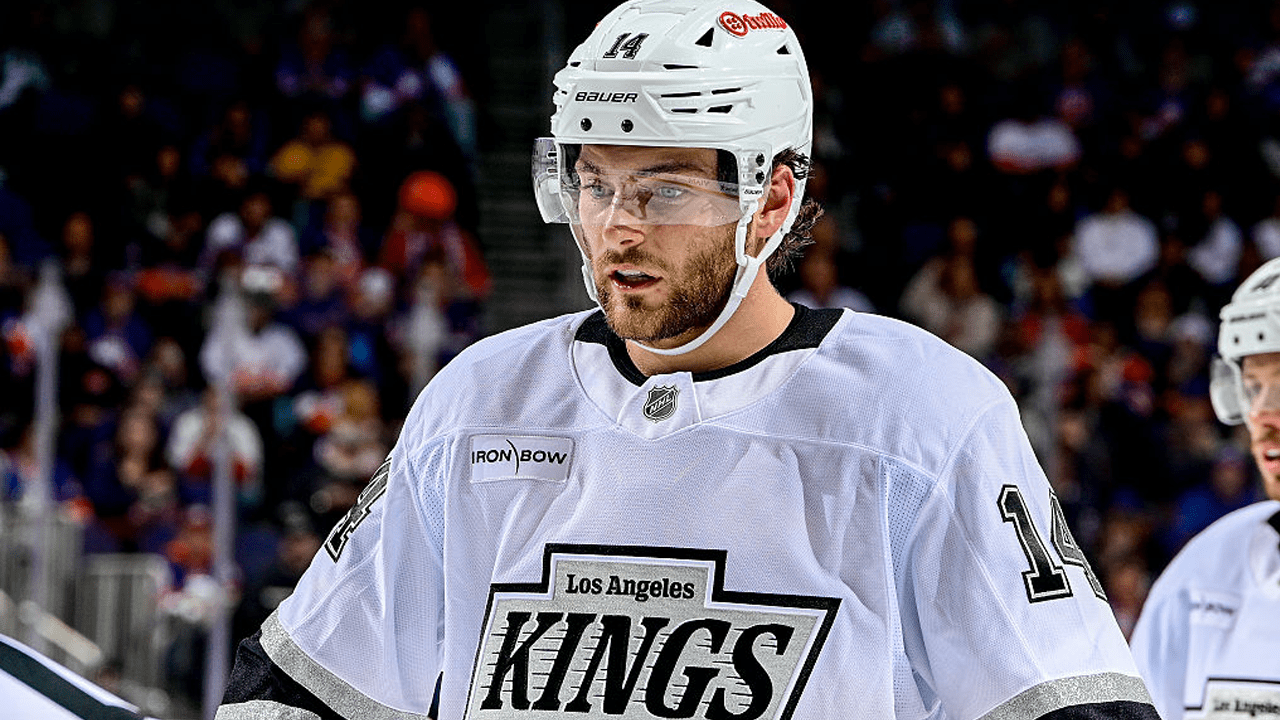
While you always think of Panarin and Kempe as being puck-dominant players, it’s actually been Laferriere’s ability to transport the puck that has stood out to Panarin. The way he can flip the script on a shift with his legs, helping to establish things in the offensive zone, which allows them all to get to work.
Panarin leads the Kings in controlled offensive-zone entries this season, per SportLOGIQ, and that is unsurprising. Second on the team, though? Laferriere, who has done so in quantity but also at a high success rate.
SportLOGIQ defines a “successful play” as the next play after the registered zone entry or zone exit, meaning does that next pass, shot or what have you work. Laferriere ranks highly in that area among Kings skaters, at just shy of 65 percent.
Equally importantly, though, has been Laferriere’s ability to exit the defensive zone with possession. He ranks third among Kings forwards in successful zone exits with possession, behind only Kempe and Panarin. Among NHL players with at least 50 controlled zone exits this season, only New Jersey’s Evan Rodrigues ranks higher than Laferriere, who has seen a “successful play” 91.4 percent of the time. Right behind him? Edmonton’s Connor McDavid.
I put those two stats together after speaking with Panarin. Often times, with Laferriere, you focus on his forechecking and his ability to get to the front of the net. To hear Panarin focus on the puck transportation, though, tells a different story, especially when you think about the player who is saying it, someone who can transport it with the best of them.
“He’s a pretty powerful skater, and I like his game when he grabs the puck that low, below our goal line and then just brings it to the offensive zone,” Panarin said. “He’s able to find some passes, and it’s a very important detail.”
I think as that line continues to develop chemistry, we’ll begin to see Laferriere’s ability to get to the net result in even more of an offensive impact.
It resulted in the goal against Boston in the most recent home game, which was a great start. His three points since have all been assists, both coming on Kempe’s goals. Even on the Kings goal where he didn’t get a helper, it was Laferriere’s tenacity on the forecheck, a couple of players earlier, which led to Panarin’s goal with just 1.2 seconds left in the period in Washington. He nearly had a goal of his own on Thursday on Long Island, but just missed a puck in front, with Panarin burying seconds later.
He gets into those areas, though, which is something that encourages his linemates to shoot the puck.
“He goes there a lot, I think that helps, he’s always in and around the net,” Kempe said of Laferriere. “You never have to worry about being on the outside too much, he usually finds finds a way to the net one way or the other and he works on tips a lot, every day pretty much. I think that he’s become really good at it. There’s some guys that are really good at getting a touch on the puck, so obviously, you like to shoot the puck when he’s there.”
The evolution of younger players is always interesting to watch, because development isn’t linear. This wasn’t suppose to be the plan. Quinton Byfield had the first crack at that spot and while the line generated a lot of zone time and a lot of chances, they scored just one goal 5-on-5 in five games together, with the Kings as a whole burying just one goal in three of the five games.
If you stack first-line centers on a chart and try to rank them, yeah, Laferriere isn’t going to be near the top of the list. But I think it’s inarguable that he’s elevated the play of the team’s two best players, while keeping pace on the scoring front at a point-per-game level. There’s no rule that the three most productive forwards on a team need to play together. Laferriere is right at 50 percent in the faceoff dot and the defensive responsibilities that come along with playing the position have never been an issue. His ability to skate and move the puck with his legs through the middle of the ice has been very noticeable, in a positive way. If you have two elite wingers, and a center who makes them better, why deviate to appease a tired narrative?
There was a time when Laferriere might’ve kept up on that line, but more as a passenger, with Panarin and Kempe sharing the driver’s seat. He’s never been a player who will hurt you, but there’s a difference between not hurting and truly helping.
In four games together, that seat is now three wide. It’s a testament to the confidence and growth Laferriere has shown in his game and the Kings have been better off for it.