
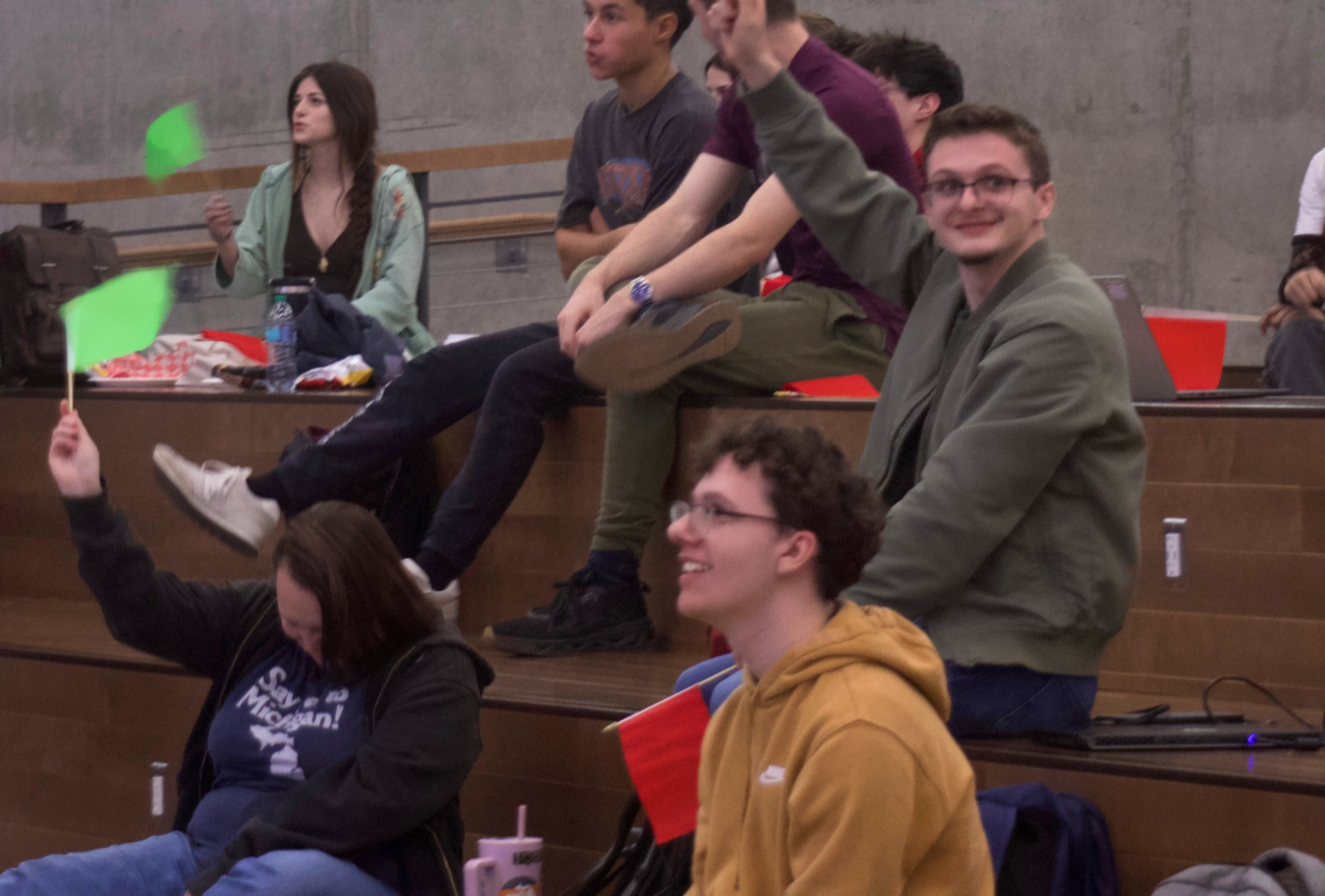
The Center for Civic Engagement (CCE) hosted a Senate Debate Watch Party Wednesday, Oct. 21, at 6 p.m. in The Habitat at Oakland University, bringing students and community members together for an evening centered on political engagement, informed voting and respectful discussion across party lines.
The community event featured dinner, a Kahoot game focused on voting information and a watch party for the Senate debate, which began at 7 p.m. The event was co-sponsored by College Democrats and College Republicans of Oakland University, Student Congress, Phi Sigma Alpha, the political science honors society, and the Pre-Law Club.
Attendees received red and green flags to indicate disagreement and agreement with candidates’ statements, encouraging audience participation throughout the debate.
Attendees were asked about their reasons for attending the watch party, the candidates they supported and the issues most important to them in the election. Responses reflected a range of political perspectives, with voting, health care, government accountability and economic concerns emerging as key topics.
David Dulio, chief community engagement officer and director of the CCE, said the watch party provided an opportunity for students to engage with political issues while building a sense of community.
“It’s great to have students gather to not only hear from the candidates but to do so in a way that creates a sense of community,” Dulio said.
Similar gatherings have been part of the university’s efforts to encourage civic engagement for years, Dulio said. The events demonstrate that people with differing opinions can gather, listen and discuss disagreements respectfully.
Sophomore Maddie Derian attended to learn more about the candidates and the electoral process.
“I’m here to learn about the political candidates and become an informed voter,” Derian said.
Morgan Moeller, secretary of College Republicans, emphasized the importance of voting regardless of political affiliation and encouraged respectful conversations among people with differing perspectives.
“I want to support voting, no matter who you’re voting for or what side you voted into. But mostly, I’m here today to promote a civilized discourse,” Moeller said.
Moeller also highlighted the importance of maintaining relationships despite political disagreements.
“We can disagree, we can have different ways of wanting to solve the problem, and still be friends, and work together,” Moeller said.
Dulio emphasized the importance of approaching political conversations with respect and understanding opposing viewpoints rather than attempting to change others’ minds.
“If we start the discussion with the intention of learning about how someone thinks about an issue rather than trying to change their mind, it’s more likely to be productive,” Dulio said.
Evan Bruce, a member of College Democrats, discussed health care, government corruption and the war in Gaza as factors influencing political views.
“I think, especially, healthcare is very important. Standing up against a lot of the corruption that we’re seeing in the government is important,” Bruce said.
Bruce expressed support for Abdul, citing positions on Medicare for All and campaign finance reform. Bruce also criticized the influence of corporate lobbying and special interests in government.
Community member Diane Kaszeta expressed concerns about political influence and the economic challenges facing younger generations. An independent voter, Kaszeta identified affordability, employment and housing costs as factors influencing political views.
“I worry about the younger generation and what we’re leaving them,” Kaszeta said.
Kaszeta cited rising housing costs, gasoline prices and everyday expenses as concerns, particularly regarding young people’s ability to find jobs and achieve financial stability. Kaszeta also criticized corporate influence in elections.
“I think as American people, Citizens United was the worst thing that happened to this country,” Kaszeta said.
During the debate, candidates discussed the economy, tariffs, the war in Iran, immigration, health care, Social Security, public safety, artificial intelligence, the auto industry, education and voting laws. The candidates’ differing positions allowed attendees to consider competing approaches to issues affecting Michigan and the country.
The debate concluded with rapid-fire questions and closing statements from both candidates, followed by applause from attendees.
Dulio said the CCE provides students with opportunities to learn about politics and participate in the democratic process. In addition to events such as the debate watch party, the center offers programs and resources related to political issues and voting.
“We aim to be a resource for students to provide what they need to take an active role in their democratic system, should they so choose,” Dulio said.
The watch party highlighted the importance of informed voting, civic engagement, and constructive political dialogue.
Student and community participation demonstrated how political events can encourage learning about candidates and respectful discussion across party lines.