
Selena Chu approached the house in San Francisco’s Balboa Park armed with a stack of Yes on G posters, feeling optimistic. Though she knew the underfunded campaign to reopen the Upper Great Highway to cars on weekdays was an uphill battle, she said the volunteers were trying their best.
The man who opened the door was not impressed.
“We just have to stop voting on it,” he said. “The people have voted once, and we are doing it again and again. It’s enough.”
His point echoes a common refrain in the lead-up to the November election, when San Francisco voters will decide on the fate of the Upper Great Highway for the third time in four years. Following three years of a weekend-only pedestrianization, a majority of the city’s voters supported closing the highway to cars permanently 24/7 by voting for Proposition K in November 2024.

Selena Chu prepares to knock on a resident’s door while canvassing for Prop G in the Pacific Heights area of San Francisco. (Minh Connors/For the S.F. Chronicle)
The issue has become a perpetual sticking point for some west side residents, who said that the closure of the major coastal thoroughfare in March 2025 has worsened congestion and traffic safety. But with the pro-highway volunteers weary of campaigning, more than two years in, the measure on the Nov. 3 election ballot could decide this issue once and for all.
As much as she believes in the cause, Chu, who’s been a key organizer of efforts to keep the highway open to cars, said this would be their final push: “I can’t wait for all this to be over,” she said. “My kids are growing up, I want to spend time with them.”
Outrage over the closure prompted Sunset voters to launch a successful recall last year ousting former District 4 Supervisor Joel Engardio, who had championed the road closure, and to put the issue back on the ballot by collecting enough signatures.
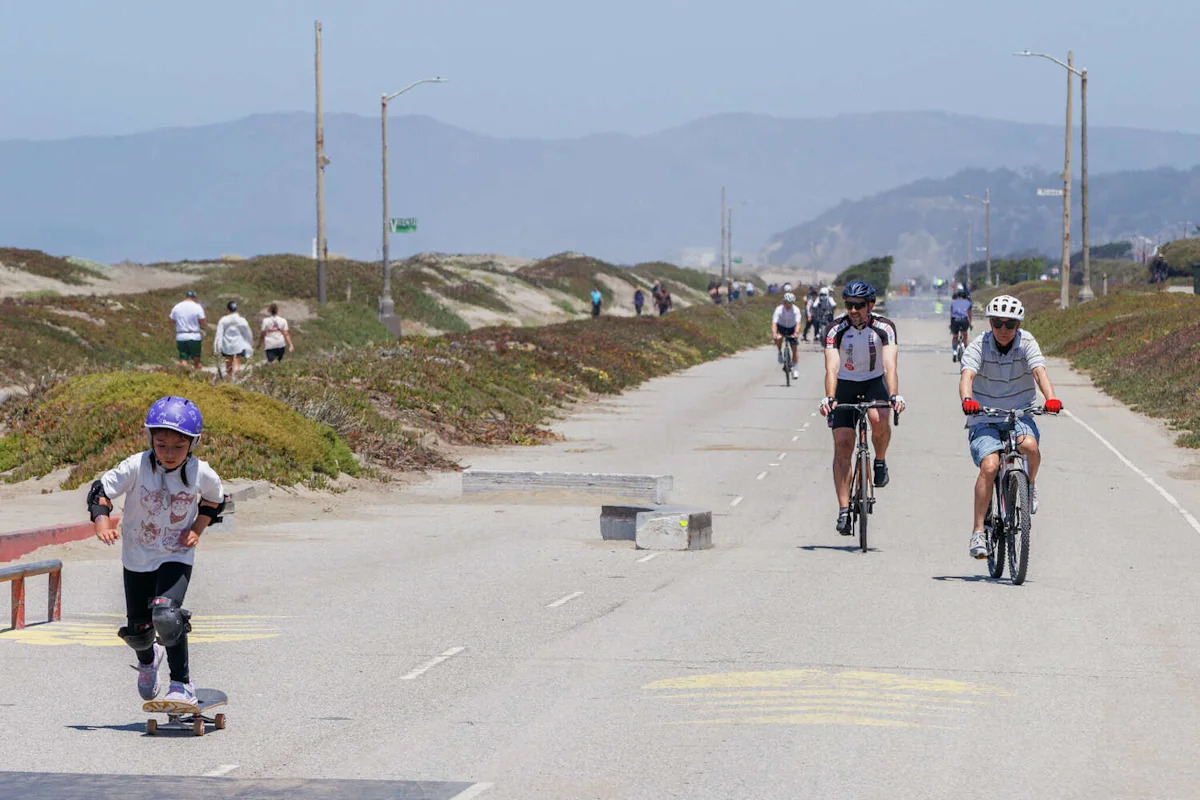
On the other side, proponents of the highway closure have celebrated the creation of Sunset Dunes Park in its place, arguing that the coast should be a benefit for all San Franciscans to enjoy as a recreation space and that the highway was already losing its utility due to coastal erosion – the Great Highway Extension, south of Sloat Boulevard, had already been slated for closure.

Vera Genkin, left, helps tape pro-Prop G signs to fellow volunteer Leonardo Lluberes holds up signs in support of Prop G in the Marina District. (Minh Connors/For the S.F. Chronicle)
The highway proponents have pitched Proposition G as a “compromise” that would allow people to enjoy the park on weekends. But park supporters have argued that opening the highway to cars on weekdays would require removing all the park infrastructure, including a playground and art installations, functionally destroying it.
The city estimated that reopening the Great Highway to cars would cost about $9.8 million in one-time costs.
Opponents of the ballot measure significantly outspent supporters.
The No on G committee has raised $818,000, including $400,000 from Yelp CEO Jeremy Stoppelman, and spent $550,000, while the pro-highway opening campaign has raised $142,000 and spent $59,000.
A Chronicle analysis showed a patchwork of traffic impacts: While some commutes sped up, others slowed. The Chronicle found that one of the most impacted commutes – from the Outer Richmond to the San Francisco Zoo – took an additional four minutes during the morning rush hour compared with before the closure.

Heidi Moseson canvasses for the “No on G” campaign near Dolores Park in San Francisco on Wednesday, Sept. 23, 2026. Prop G would reopen the Upper Great Highway to cars, which would remove Sunset Dunes park. (Santiago Mejia/S.F. Chronicle)
Chu, a healthcare worker who lives by the San Francisco Zoo and works in the Inner Richmond, said she avoids Chain of Lakes due to congestion and takes a more circuitous route to work during morning rush hour. Her commute is about 15 minutes longer, she said.
For her, the issue is about helping working families like hers stay in San Francisco, while juggling traffic congestion and many responsibilities, including sending kids to school and aging parents to appointments.
“When people are dismissing you and saying it’s just three minutes, that three minutes means something,” she said.
The No on G campaign, however, has said they think the traffic impacts have been minimal. On a recent evening door knocking in the Mission District, volunteer and Sunset resident Heidi Moseson fielded questions from resident they approached.
“Do you guys have problems with traffic?” the woman asked.
“A lot of my neighbors were worried about that but a lot of it actually rerouted to Sunset and it’s no problem,” Moseson responded. The woman said she liked the park and would vote no on Prop G.
When Mission District resident Elsa Jungman answered her door for Moseson with her toddler son, she said her family liked the park.

Canvassers Heidi Moseson, left, and Catie Stewart for the “No on G” campaign door knock and pitch their cause near Dolores Park in San Francisco on Wednesday, Sept. 23, 2026. Prop G would reopen the Upper Great Highway to cars, which would remove Sunset Dunes park. (Santiago Mejia/S.F. Chronicle)
“No on G will keep the park,” Moseson said.
“Are we not keeping it?” Jungman said.
“Some people want to turn it into a road,” Moseson responded.
“Really? Again?” Jungman said. “I thought they would keep it.”
Moseson urged her to vote No On G and said that a pirate-themed playground was opening that Sunday. Jungman’s son’s jaw dropped, excited.
Moseson told the Chronicle that canvassing for No on G was easier than back in 2024, when she volunteered to pass Prop K, because people have now experienced the benefits of the park.
Sunset Dunes has seen more than 1.7 million visitors since it opened in April last year, although some visitors may be double counted. Another Mission District resident whose door Moseson knocked on, Angelica Bonomo, opposed Prop G.
“It’s a beautiful place to run and walk and the fact it costs more (to convert it back to a road),” Bonomo said. “We have enough things to pay for.”
Back at the Balboa Park house, Chu was unfazed by the man’s initial rebuffing. She told him that she lives in the Sunset and had to drop two kids off at two schools before going to work after the highway closed.

Volunteer canvasser Josephine Zhao leaves a flyer in support of Prop G in Pacific Heights. (Minh Connors/For the S.F. Chronicle)
“It was two weeks of me being late for work every single day,” she said. “Finally my mom said she’ll help. But how many people are so lucky to have a parent to help out?”
The man, who declined to be named, responded that it was “easy for me to say,” that the park should remain, but he could see that she was directly impacted.
“It’s important you’re going around and letting people know, ‘You may think the park is great but it’s impacting other folks,'” he said. “There are a small group of loud voices on both sides. It’s important what you’re doing.”
Subscribe
There’s more to San Francisco with the Chronicle. Subscribe today for just 25¢.
This article originally published at San Francisco will soon decide on the Great Highway’s fate – again. How are voters feeling?.