
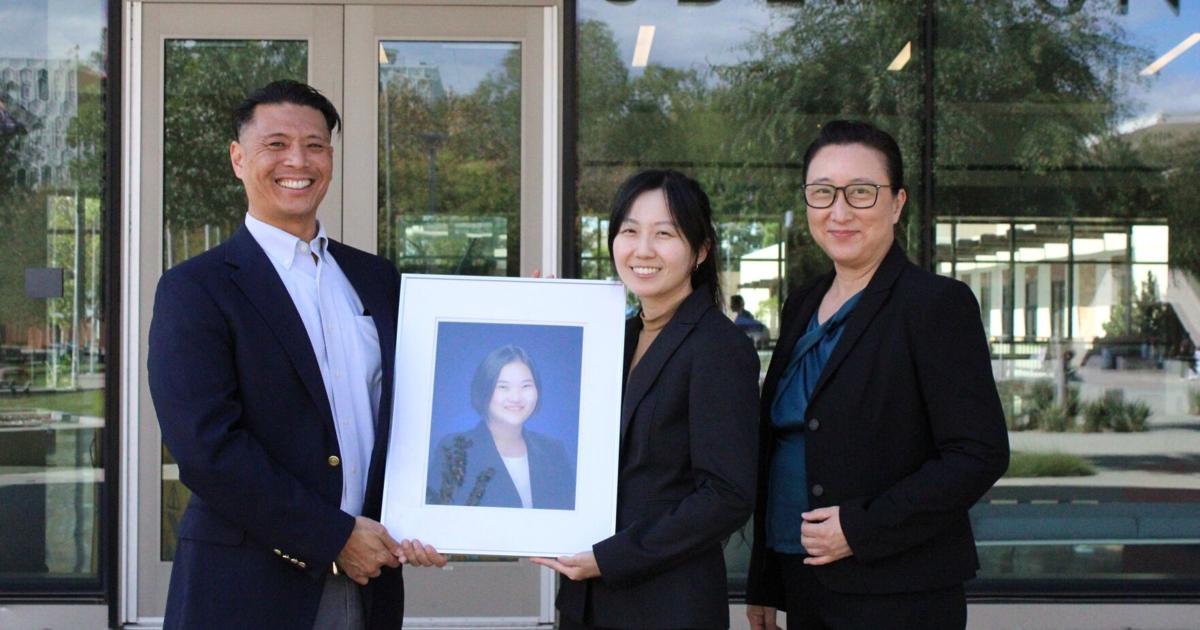
Cal State Fullerton was awarded a $2.7 million, three-year research grant to the College of Education through the United States Department of Education’s Mutual Education and Cultural Exchange (MECE) Program, making it one of four universities nationwide to receive the funding.
According to the Department of Education’s website, the MECE Program advances foreign language training by providing educators with opportunities to study abroad, enhance language skills and deepen cultural understanding.
The grant funding is being used for the university’s Global Opportunities and Academic Leadership (GOAL) Fellowship, which aims to expand Asian language learning among multilingual teachers.
“It’s a multi-institution project,” said Dr. Theodore Chao, the grant’s director and principal investigator and associate professor of elementary and bilingual education at CSUF. Along with CSUF, the program is also partnering with Cal State Los Angeles, Cal State Dominguez Hills, Cal State San Bernardino and the University of Alabama at Birmingham.
The GOAL Fellowship plans to send about 40 teachers annually to participate in language and cultural learning opportunities in various Asian countries, with a total of 120 teachers expected to participate over three years.
While all three destinations have not been announced, as the project is in its planning stages, Taiwan has been selected as the first destination, with travel planned for fall 2027.
The Taiwan Immersive Institute will include a two-week program for 40 pre-service and in-service educators, preceded by a 10-week virtual course focused on Taiwanese and U.S. educational policies and practices.
“Each fellowship recipient will come back with an action research plan, a personal narrative and a curriculum unit,” said Ames Kim, one of the GOAL Fellowship program managers. “Each scholar will come back with lesson materials to use for their own classrooms here.”
The Department of Education sent out application information for the grant in June of this year, with the deadline set for mid-July.
Chao, along with Kim, Program Coordinator Christine Lu and Dr. Yewon Sung from the University of Alabama, crafted the 62-page grant proposal, accompanied by 38 letters of support, including bipartisan support from members of Congress.
“There were differing perspectives, and not everyone initially believed we could even win the grant, or supported the effort from the beginning in the College of Education,” Kim said. “Despite that, our team of four stayed the course, we stayed committed, we worked together and I’m just really glad to say we made it happen.”
As part of the application process, eligible applicants for the MECE Program were required to be nonprofit educational institutions, including public and private universities, state education departments and eligible educational organizations.
Other grant recipients included Cal State LA, which received $2.1 million; the Trustees of the University of Pennsylvania, which received $2.2 million; and the University of Pittsburgh, which received $3 million. Each institution was awarded funding in different languages of focus.
“Here in Orange County, we are a very strong space for Asian languages,” Chao said. “So there’s a need not only from the community, but a need for the schools to produce more teachers to support these programs.”
According to Asian Americans Advancing Justice’s 2020 A Community of Contrasts report, Asian Americans made up 25% of Orange County’s population, making it the third largest Asian American population center in the U.S.
This included 116,534 Korean Americans, 138,463 Chinese Americans excluding Taiwanese Americans and 241,557 Vietnamese Americans, representing the largest Vietnamese American population in the country.
This grant comes amid concerns from educators and institutions regarding funding cuts to education, including the loss of previously allocated federal funding for CSUF’s National Resource Center for Asian Languages.
According to Kim, the center was denied its fourth year of funding, prompting the team to seek additional support to continue its work with students and teachers.
Lu said the project holds personal significance as she was one of the federal workers laid off from service last year after 31 years with three agencies, including the Food and Drug Administration.
For now, Chao said that the hope of the GOAL Fellowship is for educators to not only become better teachers, but to be able to inspire a new generation of students on how to deeply engage in the language and the value of cultural exchange.
Eligible educators must be U.S. citizens or permanent residents, with those who served in the military receiving priority in the selection process.