
On Oct. 12, for Indigenous Peoples Day, some of us Berkeley Natives slept for barely an hour, hopped on an early morning bus and rode it all the way to Alcatraz Island for the annual Sunrise Gathering. The ceremony is a sacred time to come together in community and honor Indigenous struggles and movements, past and present — from our ancestors who occupied Alcatraz to our relatives fighting for Palestinian liberation. As a student, I find the responsibility entrusted to my community and me by our elders and community leaders both profoundly impactful and terrifying.
Just as daunting is the responsibility to confront injustices faced by Indigenous communities every day. While pursuing a quality education at the top public university in the nation, I also have to carry on my ancestors’ struggle against colonialism and genocide at UC Berkeley itself — a colonial institution built on ancestral Ohlone land.
As of April 2026, UC Berkeley’s own records show that thousands of Indigenous ancestral remains have yet to be repatriated. A 2025 California state audit found that the UC system continues to lack the accountability and urgency necessary to return Native American remains and cultural items promptly.
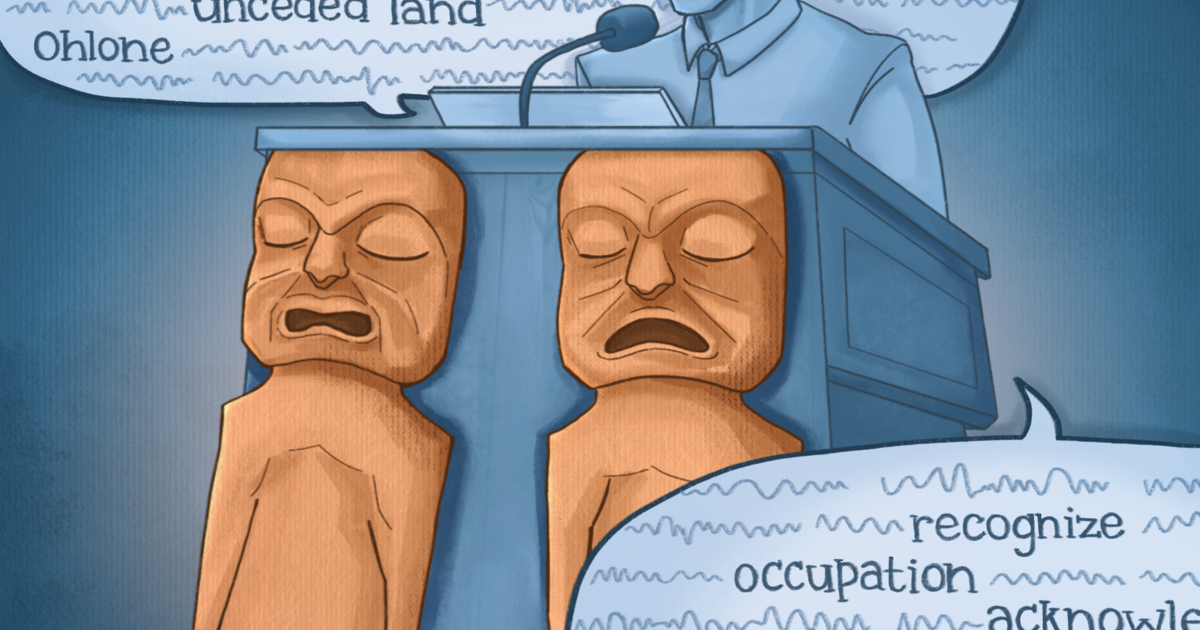
The same campus that refuses to pay back what it took as a land-grant institution — or more accurately, a land-grab institution — then offers a land acknowledgment which it then deems sufficient.
For many, the UC Berkeley land acknowledgment is their first engagement with Berkeley-Native presence and history. But for some within the Indigenous community, it’s a disappointing reminder of the disparity between campus’s words and actions.
According to the 2020 UC Land Grab forum, the establishment of UC Berkeley was made possible by the Morrill Act of 1862, which institutionalized the dispossession of Indigenous land as a foundation for higher education by granting states so-called “public land” for various uses. Since then, UC Berkeley has continued to contribute to the dispossession and erasure of Indigenous peoples, particularly in California. Suppression of Indigenous knowledge equates to colonialism, especially when land grants have present-day repercussions on how Indigenous nations are able to exercise their sovereignty.
Due to this history, the Indigenous community on campus is continuously failed by a perpetuated disregard for the violence embedded in this stolen land on which we live, study, work, eat and sleep. Meanwhile, our students and organizations must struggle to retain the resources we have and fight for our community here on campus.
Indigenous students make up roughly 0.6% of the UC Berkeley population. That’s between 200 and 300 students of the 45,000-student population. In the face of continued violence and erasure, I feel compelled to ask: What is the purpose of a land acknowledgement? As someone who grew up as a California Native and now works with Indigenous organizations on campus, I have seen what these acknowledgements accomplish and what they fail to do. But what do they mean to you? By familiarizing the general student population with a name, such as xučyun and Chochenyo Ohlone, they begin to serve as an introduction to local Native nations and their histories. But beyond this simple awareness, they fall short of granting the rights that are tied to recognition and sovereignty.
Everywhere we go is Indigenous land, and every part of Indigenous land carries generations of history. This should not be a revelation. As an educational institution built on stolen land, UC Berkeley bears a particular responsibility to California Native communities, especially the Ohlone peoples, to break the cycle of Indigenous erasure in academic spaces by centering Indigenous knowledge and cultures. With the barriers our peoples face today as a result of genocide, UC Berkeley has several opportunities to reinvest resources in Indigenous students and their communities.
Every day is Indigenous Peoples Day. It is not enough to honor us and our cultures for a single day. Meaningful Indigenous justice requires everyone to confront what it means for them to exist on stolen land, as well as how institutions such as UC Berkeley continue to perpetuate settler colonialism through a lack of education and attention to the original inhabitants. UC Berkeley must reckon with its historical and ongoing obligations to pay back its debts, both to the original inhabitants and the current communities of Indigenous students who continue to face systemic hardships, both on campus and in settler colonial society at large. This should extend beyond the symbolic acknowledgement. UC Berkeley should pursue sustained financial commitments and Indigenous-led land stewardship agreements by working with local Native communities. Acknowledging stolen land should mean more than naming its original inhabitants; it should entail returning resources, authority and, ultimately, land itself.
Every student of this campus needs to understand the histories of the land they occupy. This history is what propels students’ futures while this institution tries to silence ours. An institution cannot continue to benefit from Indigenous dispossession. A land acknowledgement is not restitution. If UC Berkeley intends to honor Indigenous sovereignty, it must demonstrate that commitment through action: returning ancestral remains and cultural items, investing in Indigenous students and communities and restoring Indigenous stewardship of the land. And campus has not acknowledged or accepted such a responsibility.