
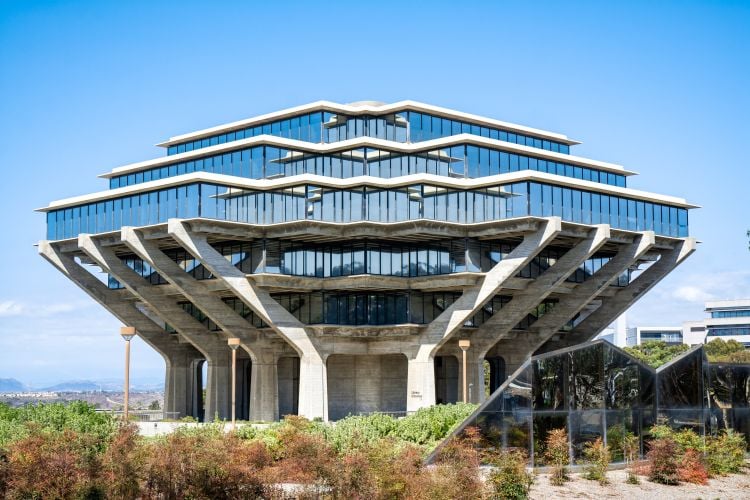
When professors at one of the nation’s top public universities start warning that their students can’t do middle-school math or write a coherent paragraph, the rest of us should pay attention. A new faculty report from the University of California–San Diego describes a “steep decline in the academic preparation” of entering freshmen.
Between 2020 and 2025, the number of UCSD students whose math skills fall below middle-school level increased nearly thirtyfold—from under 1 percent to roughly one in eight. The university has been forced to redesign remedial math to cover elementary-school material and create an entirely new course to reteach high-school algebra and geometry.
Not to put too fine a point on it, but…what did you expect?
Every force in American education has been working toward this moment. Covid was catastrophic, but the rot began long before. The UCSD report attributes the collapse to “the COVID-19 pandemic and its effects on education, the elimination of standardized testing, grade inflation, and the expansion of admissions from under-resourced high schools.” That last phrase is a euphemism for low-income, minority youths whose interest K–12 education’s love affair with “equity” is intended to serve. But the report exposes how intellectually bankrupt that impulse has become—as if we can get students to and through an elite university by force of will and noble sentiment rather than the hard, cumulative work of academic preparation.
The University of California’s “test-blind” experiment has been a disaster. When UC’s Board of Regents eliminated the SAT and ACT in 2020, it left admissions officers relying almost entirely on high-school grades, which were functionally meaningless. Among students placed into Math 2, UCSD’s most remedial course, one in four had earned a perfect 4.0 in high-school math. Grades told admissions officers next to nothing about whether an applicant could actually do the work.
At the same time, UCSD dramatically expanded enrollment from schools covered by California’s Local Control Funding Formula (LCFF)—public schools where more than 75 percent of students are low-income, English learners, or foster youth. By 2024, a third of UCSD’s entering class came from LCFF schools—more than any other UC campus and roughly double the systemwide average. These students now make up more than half of those in remedial math courses, and in some years as much as 68 percent.
The UCSD faculty report is admirably blunt: “Admitting large numbers of underprepared students risks harming those students and straining limited instructional resources.” The professors who wrote this report deserve enormous credit for saying aloud what the broader education establishment will not: we are setting students up to fail.
And UC San Diego is hardly alone. Even Harvard University—the world’s most selective college—recently opened remedial math and writing classes. When Harvard must reteach algebra and composition, it tells you how deep the rot runs.
National Assessment of Educational Progress scores show reading and math achievement at their lowest levels in decades. The students now struggling in college were in middle school when classrooms shut down. Those who missed their foundational years—the ones who never mastered basic literacy or numeracy—are still in middle school today. The worst is yet to come.
Economist Eric Hanushek estimates that the learning loss suffered by this generation will cost the United States more than $90 trillion in future economic output—about six percent of GDP every year for the rest of the century. The average student will earn eight percent less in lifetime income than peers who graduated just a decade ago. This is not merely an educational failure; it is an economic calamity and a civic one.
But the deeper crisis is moral. We have persuaded ourselves that to pursue excellence is to perpetuate inequity, that holding students to high standards is unfair, that success can be achieved by adjusting expectations rather than meeting them. The UCSD report exposes the folly of that thinking. “Equity” without preparation is cruelty disguised as compassion. It delivers opportunity in name only, while denying students the knowledge and skills they need to thrive.
No one should take pleasure in UCSD’s predicament. The faculty are doing what they can—expanding tutoring, creating bridge programs, and building early interventions—but the scale of the problem dwarfs their capacity to fix it. As the report puts it, “our capacity is not limitless. We can only help so many students, and only when the gaps they need to overcome are within reach.” That is not an abdication of equity. It is an acknowledgment of reality.
The reckoning is here. The UC San Diego report is a warning about the consequences of a decade of magical thinking in education policy and practice. We replaced rigor with rhetoric, and the bill has come due.