
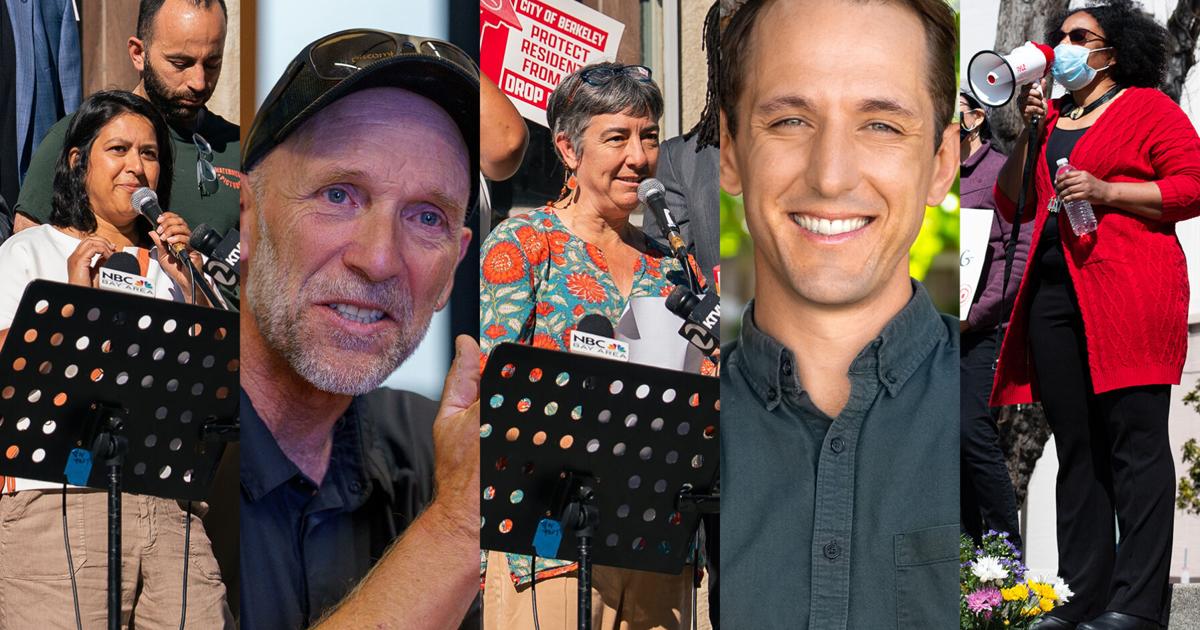
With a packed ballot of five candidates in an open seat election,District 1 is shaping up to be Berkeley’s most competitive City Council race this November.
On the ballot are Laura Babitt, an auditor and operations director; Ross Bernet, an environmental program manager at Microsoft; Moni Gangopadhyay, a consumer protection investigator; Steve Kromer, an energy efficiency engineer; and Daria Wrubel, a youth therapist.
Located in Northwest Berkeley, District 1 sits at the heart of many of the city’s most pressing issues. It’s home to the site of the former Eighth and Harrison streets encampment, as well as part of Hopkins Street, where the city plans to add hotly contested bike lanes. District 1 has also seen a spate of plans for new housing developments, especially near the North Berkeley BART Station and San Pablo Avenue.
The seat is currently held by Councilmember Rashi Kesarwani, who is not seeking another term.Kesarwani has provoked controversy for supporting police surveillance tools such as Flock Safety, loosening restrictions on the Berkeley Police Department’s use of K-9 units and helicopters and attempting to remove a ban on BPD’s use of tear gas.
Kesarwani has thrown her weight behind Bernet, who said in an interview that he’s “very aligned” with Kesarwani on the issues of housing, walkable neighborhoods and street infrastructure.
Still, Bernet was quick to clarify he’s his own man.
“I’m not Rashi. We’re different people,” he said. He added that Kesarwani was “a bit divisive at times.”
Bernet identified the homelessness crisis as the largest issue facing District 1, saying he supports the creation of more emergency shelters and beds for the short-term as well as “housing abundance” in the long term. He called himself “the candidate that is strongest on housing at all income levels.”
He also supports the Hopkins Street bike lane plans and believes the city needs to focus on paving the road there to make it safer.
On the issue of police surveillance, Bernet said he thinks automated license plate readers help “bring justice” and catch criminals, such as in helping in the arrest of a driver that injured an elderly couple from Spain in a hit-and-run Oct. 7.
But Bernet believes Flock has “broken a lot of trust,” and that the city should search for a different vendor.
As for Kesarwani’s unsuccessful push to reinstate tear gas use for BPD, Bernet said there needs to be “a real temperature check” before easing restrictions.
“Timing with this is everything,” Bernet said. “There’s a lot of lack of trust in the federal government at the moment. And so I do not support bringing back tear gas right now.”
The next District 1 council member will also help carry on the council’s work in addressing the city’s budget practices.
Babitt, an auditor and operations director who said she had to make “tough financial decisions” as a former Berkeley School board director, believes she is poised to tackle this challenge.
“I would not approach a structural deficit with sweeping, across-the-board cuts,” Babitt said in an email. “Cutting essential services such as fire protection at the same rate as administrative functions may balance numbers on paper, but it does not reflect the community’s priorities.”
Babitt also cited the deficit as a reason she would not support the proposals for police deregulation that Kesarwani has championed. She questioned whether tear gas, K-9 units and helicopters would be “the best use of limited public-safety dollars” given the city’s budget deficit and violent crime rate.
Babitt has, however, cited resident safety as a concern in justifying why she supports removing the city’s homeless encampments.
“(We) cannot allow people to remain indefinitely in unsafe and unhealthy conditions,” Babitt said in her campaign newsletter. “What we are seeing on some West Berkeley streets and in our parks presents serious health and safety concerns for people experiencing homelessness, nearby residents, small businesses, and the broader community.”
She has called for Berkeley to establish a “no-camping” ordinance for public spaces and to clear encampments in line with the City of Grants Pass, Oregon v. Johnson ruling.
Not everyone agrees with that approach — particularly Gangopadhyay and Wrubel, the race’s most progressive candidates.
The two candidates have expressed support for the city establishing alternative housing sites where people experiencing homelessness can live in tents and vehicles with running water, trash and other services.
“We already have homeless in our neighborhood, so the least we can do is to take care of them,” Wrubel said.
Both Gangopadhyay and Wrubel have aligned themselves with Berkeley Against Mass Surveillance, an organization that opposes the city’s use of Flock cameras. Along with five other council candidates, they represent an anti-Flock bloc that has called on City Council to oppose all forms of mass surveillance technology.
Wrubel said President Donald Trump’s reinauguration inspired her to get involved with local organizing. She cofacilitates a Bay Resistance Action Pod, serves on the Berkeley Sanctuary City Task Force and coordinates ICE Watch foot patrols for Berkeley High School.
She was motivated to run for elected office after Kesarwani put forward proposals for removing the ban on BPD’s use of tear gas and loosening restrictions on police use of helicopters and attack dogs.
“I realized that running for Berkeley City Council could be a very immediate, local, direct way to fight the authoritarian overreach that I was feeling somewhat powerless against on a national level,” Wrubel said. “Here was a local way that I could fight back and contribute to a more civil society.”
Gangopadhyay has served on the California Public Utilities Commission, and she touted her “record of success” designing clean energy initiatives and investigating utility companies for fraud.
“I would like to see a City Council Member who listens, who has nuanced policy and budgetary skills, and who values substance over rhetoric, people over outside monied interest,” Gangopadhyay said in an email. “These are the attributes and skills I bring as a decades-long public servant.”
The most conservative candidate in the race is Kromer, the energy efficiency engineer who has positioned himself as a political outsider. He noted in an interview that he is the oldest candidate, which he says enables him to “bring some wisdom.”
Kromer cleans every day at his local park, which he said has given him a sense of belonging in his community.
“I think one thing you notice is that a lot of people wonder if they’re ‘Berkeley’ enough to be here sometimes, or if they really belong, or where,” Kromer said. “And my pitch would be, everyone belongs, man. Everyone’s got a place here. We can work this stuff out.”
In an interview with The Daily Californian, Kromer referred to the city’s homeless people as the “quote, unquote homeless population.”
When asked for clarification on what he meant, Kromer explained, “Sometimes one word can actually confuse an issue more than it helps solve it.” He added that the term “homeless” puts many different people “under one umbrella.”
Kromer said he wants the city of Berkeley to ban homeless encampments.
He said some people get “very emotional” about whether programs for homeless people are meeting their needs. He advocated instead for a logic-based approach to determining whether the money going toward city programs is working effectively.
He also stated he’s “open to surveillance technology,”but believes the City Council’s contract with Flock Safety lacked transparency.
Kromer declined to take a stance on whether BPD should be allowed to use tear gas. He said because he did not stay for the entire council meeting on the issue, he does not have enough information to make up his mind.