
On October 22, with voting in a tightly contested midterm election already underway, a dozen Catholic bishops and archbishops gathered in the Oval Office. There, they surrounded President Donald Trump and prayed for him. The moment was recorded by a staffer inside the White House and posted by the White House on social media, making it appear to many observers like an implicit statement of approval of the administration’s policies so shortly before Election Day.
Oakland’s Bishop, Michael C. Barber, can be seen on the left side of the video as James Golka, the archbishop of Denver, leads the prayer, placing his hands on Trump, just days after another allegation of sexual assault emerged against him.
According to the Pillar, a Catholic news organization, the meeting was organized by Mario Enzler of the Heritage Foundation, a conservative think tank. Enzler worked to invite Bishops to the prayer for weeks, with some declining because of perceived optics close to an election.
“ Thank you for the gift of our beautiful nation,” Golka says in the video. “Thank you for the gift of our government. Thank you for the gift of this office of presidency. We lift up our president and ask your blessing upon him.”
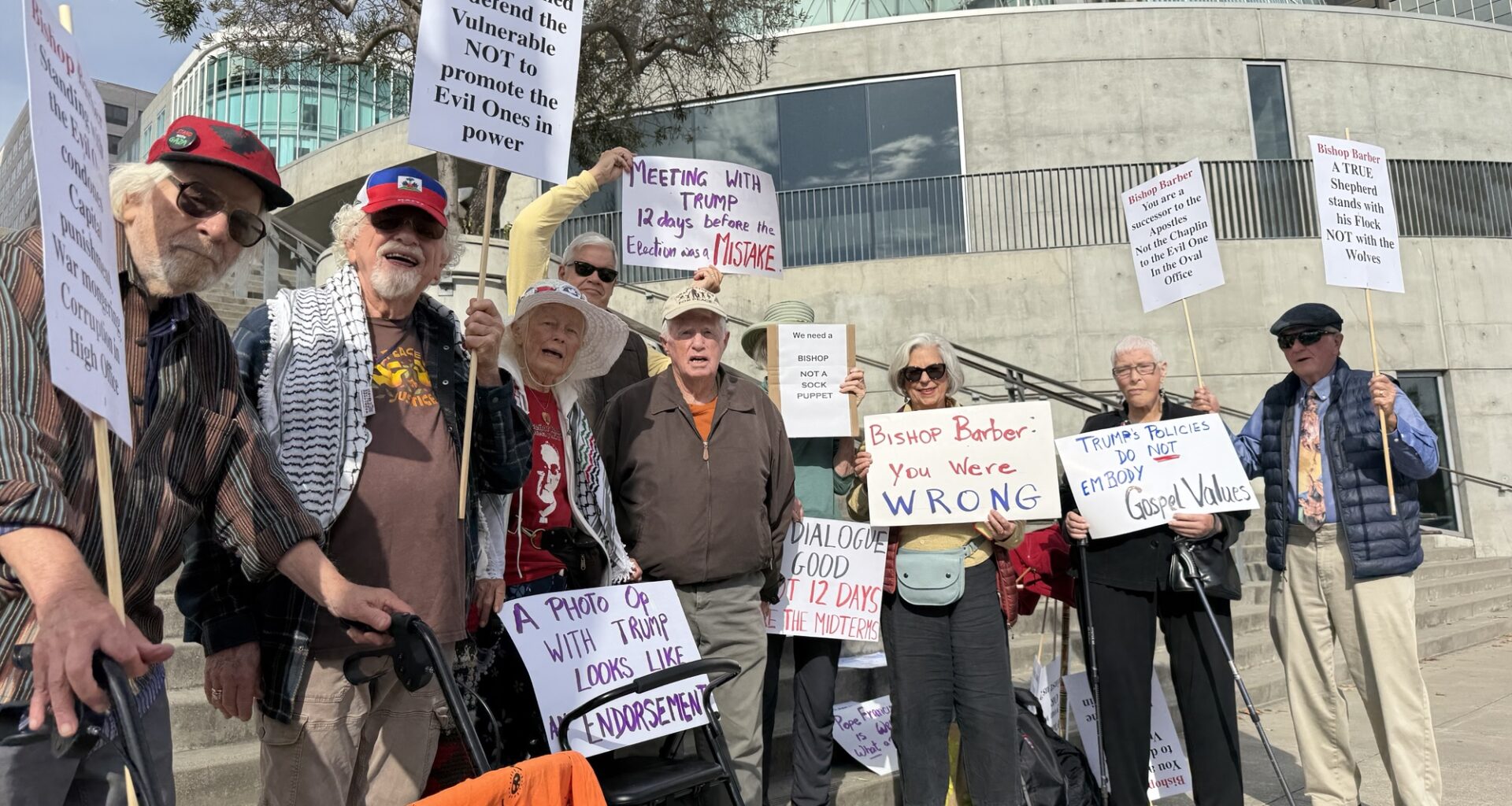
The National Council of Catholic Bishops has said it did not sanction the event, and at least two bishops who participated have issued public statements of regret, with one decrying “those who exploited our meeting for partisan political purposes.” And here in Oakland, next to Lake Merritt, Barber’s parishioners gathered in protest on the steps leading up to the Cathedral of Christ the Light, which is the official seat of the bishop, the head of the Oakland diocese. There, several members of his flock pushed hard against Barber’s decision to participate in the prayer service, saying they were distressed by his actions and lack of apology.
Claire Broome told The Oaklandside that she felt like the prayer service was being used by the administration “to assert that the US Catholic bishops endorse this administration,” adding that the administration’s harsh treatment of immigrants and refugees called for forceful opposition instead of an apparent collaboration. Broome and other protesters said as Catholics they also disapproved of the president’s decision to resume federal executions in his first term, which they said defied Catholic teachings that oppose capital punishment.
A protester named Jim told us that he thought Barber had been a good bishop in the past, upholding Catholic values, but that he had sensed a shift in him. “ We want Bishop Barber to know that we think he should correct his mistake,’ he said. “Going to the White House, it seems to us, it was a mistake.”
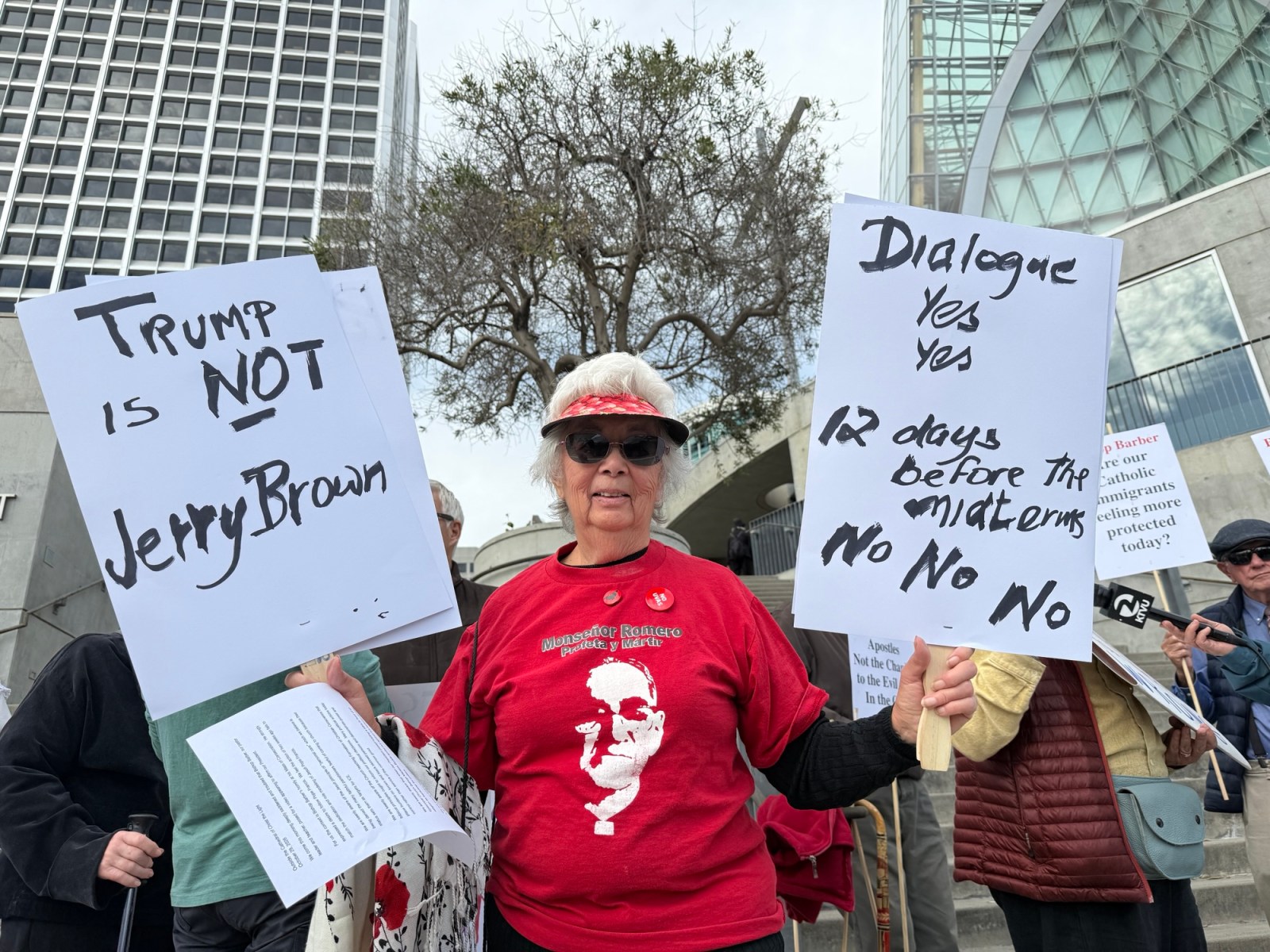 Roberta McLaughlin organized the protest against Bishop Michael C. Barber in Oakland on Thursday, Oct. 28, 2026. Credit: Jose Fermoso/The Oaklandside
Archbishop Jeffrey Grob, who runs the Milwaukee diocese, said in an online statement that the bishops were told the meeting would be a private discussion, “that several Catholic members of the cabinet might make an appearance, and that there could be an opportunity to pray privately with the president.” He claimed he did not think the administration would publicize the event.
After meeting with White House staff for 90 minutes, Grob said, the priests were moved into the Oval Office. After Trump greeted them and gave them commemorative coins, they were directed to stand behind him and pray, followed by the taking of pictures.
“Unbeknownst to the group of bishops a video was also taken,” he continued. “I feel a heavy sadness, not only over the pain I caused, but also for the fact that something so sacred to a group of religious leaders, prayer to our Heavenly Father, would be manipulated in that way. We came in good faith to try to work for the betterment of our fellow human beings, to ease their suffering, to build up the common good, and to pray with a president, not to pose for a political photo opportunity to benefit the few.”
Bishop William Joensen of Des Moines, the other bishop to make a public statement of regret, said he had frequently been called “upon to engage people whose positions and actions are not aligned with the Church’s teachings,” and he had hoped that the prayer breakfast would help God guide Trump’s heart and “impel him to lead in a way consistent with the dignity of his office.” He suggested that he was naive about what would happen. “I pray I am more prudent and wise going forward,” he said.
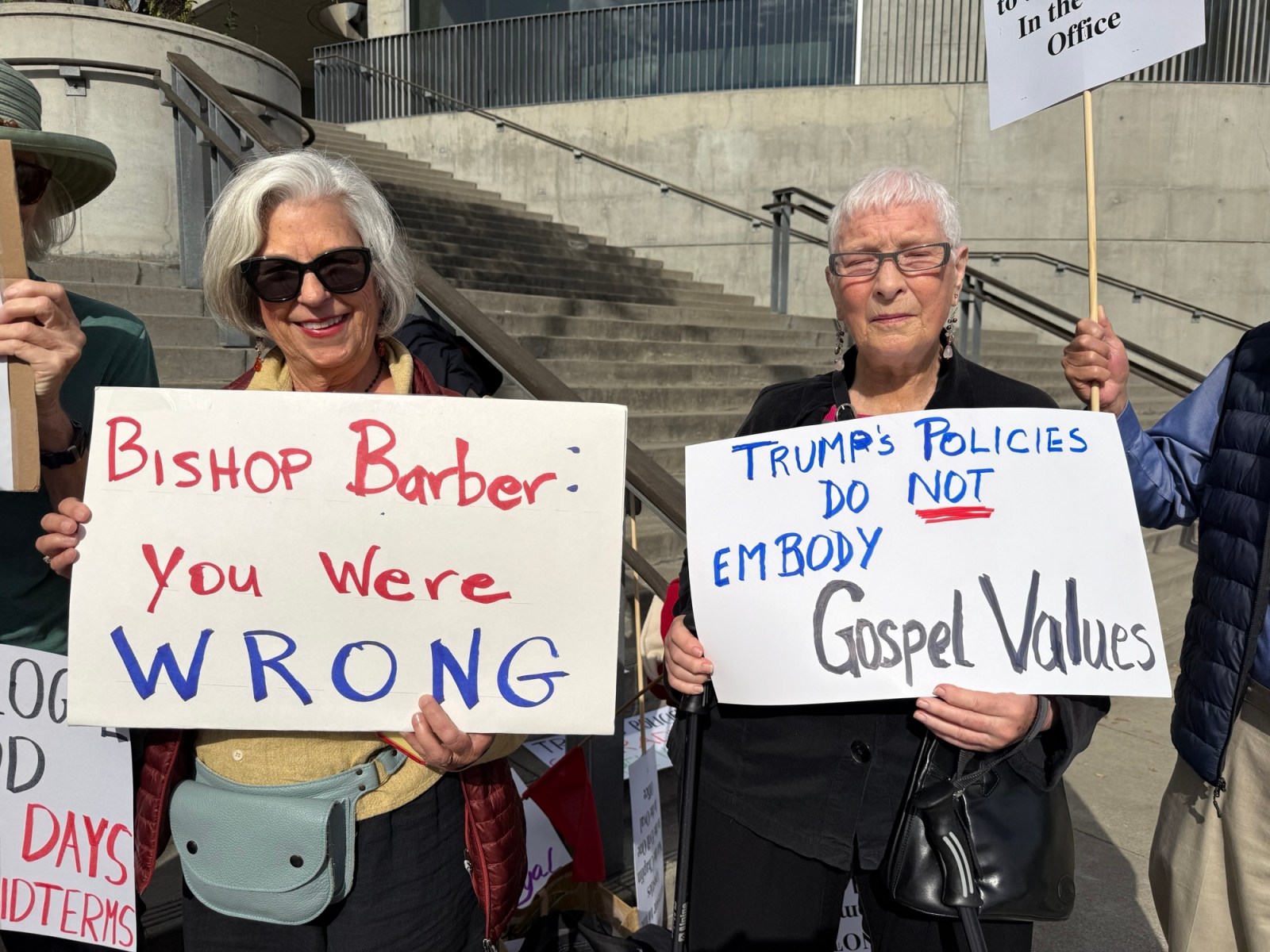 Catholic seniors said they were offended by Oakland Bishop Barber’s participation in a prayer session with President Donald Trump. Credit: Jose Fermoso/The Oaklandside.
In a statement published on Wednesday on the diocese website, Bishop Barber did not apologize for participating but said that he did so to advocate for his community.
Barber said the group of clergy spoke with administration officials about “abortion and in-vitro fertilization, fear in our community over deportations and arrests; the need for visas for our international priests; scholarship tax credits for our Catholic schools,” and more. He also said that he had previously met with other elected officials, including Jerry Brown while he was governor, intimating that the church was above taking political sides.
“There are significant points of disagreement on matters of faith and morals between the Catholic Church and the Democratic and Republican parties,” he said. “It is urgent, therefore, that we communicate with one another and participate as faithful citizens.”
The protesters at Cathedral of Christ the Light on Thursday told The Oaklandside that they found Barber’s statement weak or even offensive.
Roberta McLaughlin, who was the main organizer of the protest, told us that she agreed with Barber that it was important to have dialogue with elected officials but that the timing was wrong so close to the election, and given Trump’s actions, particularly against civil rights.
“This is 12 days before the midterm and that’s very dangerous because it says things that maybe you didn’t intend to say,” she said. “For the public, your flock, you are our shepherd, we expected more of you.”
McLaughlin told us she’d like to see Barber say he wouldn’t attend a prayer service again that could be so easily understood as political. ”Because then we could expect him to be used again by the Trump administration when it’s convenient for them,” she said. “He represents us and it was a slap in the face.”
Protester Tim Pawlak said that for Barber to go see Trump at this time risked signaling that he was aligning himself with a president who has hurt the most vulnerable.
“One of the most important things for us as Catholics is that we speak for the least among us, who have less than us, the poor, the hungry, the unhoused,” Pawlak said. “ If they’re not speaking for the least among us, for the most troubled, they’re just, I guess, sucking up to power.”
“*” indicates required fields