
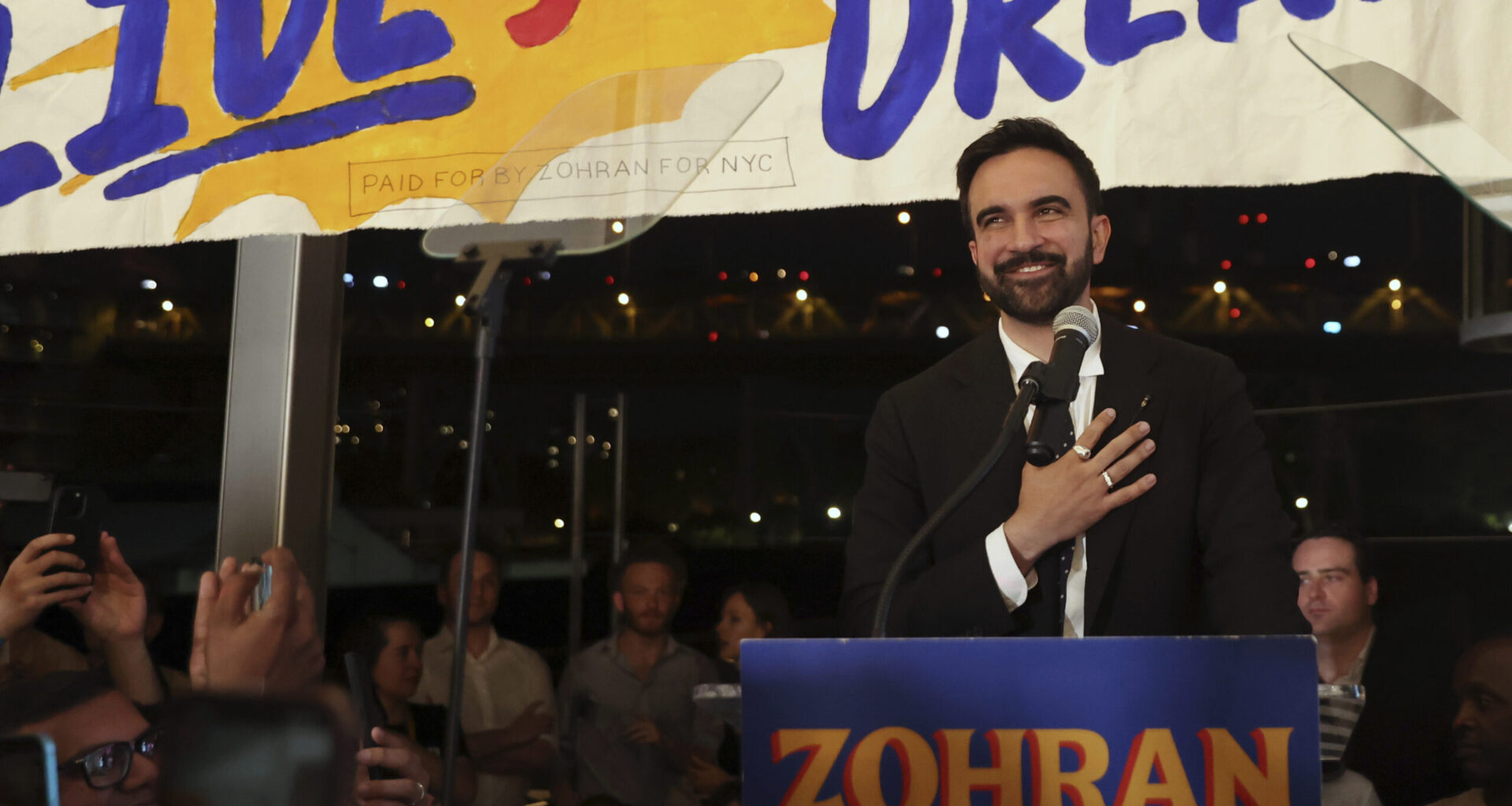
Mayor-elect Zohran Mamdani is promising free transit, rent freezes, and community led policing; but Los Angeles already tried some of this playbook, and critics say it ended with blown budgets, empty promises, and streets full of tents
New York City mayor-elect Zohran Mamdani is promising a historic progressive reset that has some constituents excited, and some fleeing to Florida. He’s proposed a rent freeze, 200,000 new permanently affordable homes, and a more “community-led” approach to public safety. Community-led? Yikes.
Some supporters view this as a long-overdue response to a brutal housing market. Other critics see something else: a replay of experiments Los Angeles has already tried under Mayor Karen Bass, with mixed results and stubborn crime problems that have never fully gone away.
Congratulations to Mayor-Elect Zohran Mamdani! pic.twitter.com/h7D4nHmPgH
— Mayor Karen Bass (@MayorOfLA) November 5, 2025
On the campaign trail, Mamdani made housing the centerpiece of his platform. He pledged a citywide rent freeze for roughly 1 million rent-stabilized apartments and a plan to build or preserve 200,000 permanently affordable, rent-stabilized homes over a 10-year period. This, of course, would be backed by higher taxes on the wealthy (mainly the 1%) and city borrowing through city municipal bonds, activating city-owned land, and of course, defunding the NYPD and DOE, though Zohran would indicate he’s just moving some budgets around. He has framed the platform as a European-style social contract: free MTA transit, expanded childcare, municipal grocery stores and aggressive tenant protections that many European cities treat as normal. Free bus fare, free childcare and 200,000 new rent-stabilized homes? What could go wrong?
LA Mayor Karen Bass ran on similar themes in Los Angeles in 2022 that included declaring a homelessness state of emergency, launching the “Inside Safe” program (which moves people from encampments into hotels as interim housing) and backing what’s often called the “mansion tax” to fund housing and services.
Several years in, results suggest the outcomes are more complicated than the slogans implied. For example, Bass’ Inside Safe did move thousands into hotel or interim placements, but it was found that less than 1 % of the city’s estimated unhoused population had been permanently housed through it as of early 2024. The fact that thousands remain homeless and the encampments continue to run rampant on the streets of LA, permanent housing remains weak. Similarly, critics have said the mansion tax may not yet have translated into the promised housing scale. Former New York City Mayor Eric Adams’ immigration hotel program was flawed as well, as it wasn’t a cost-effective solution to decrease revenue across high-profile hotels, like The Roosevelt.
Mamdani’s signature promise is a multi-year rent “freeze” on rent-stabilized apartments, enforced through appointments to the city’s Rent Guidelines Board and backed by stronger “good cause” protections against eviction. He also wants to address the housing shortages by constructing 200,000 new units over the next 10 years. He says these units will be “permanently affordable, union-built, rent-stabilized homes.”
Property owners or landlords, however, warn that pairing a freeze with already strict housing rules could lock thousands of old and deteriorating units out of the market. Landlords say they would not be able to afford major repairs at frozen or stabilized rents. That means at a certain point, the majority of renters would most likely be living with rats, cold water, and noisy heaters (if the heat works at all).
Scroll to continue reading
Los Angeles offered a preview of those concerns: the city has long had rent-stabilization rules, and in 2025, the Los Angeles City Council approved changes that limit annual rent hikes on many units to roughly 1 % to 4 % depending on inflation. LA landlords warned that this combination of stricter rent caps (and the city’s broader tax/tariff environment) might push owners to convert or remove units instead of reinvesting in older buildings.
In 2022, Los Angeles voters approved Measure ULA, a “mansion tax” that added a 4% tax to property sales over $5 million and a 5.5% tax to sales over $10 million. It was expected to raise $600 million to $1 billion a year for housing and homelessness programs. The tax has not achieved those annual figures so far; as of December 2024, the measure had raised roughly $480 million, clearly under the low end of the $600 million projection (per UCLA research).
But according to the UCLA Lewis Center, high-end property sales dropped sharply once the tax took effect. Their analysis found that the chances of a property selling above the ULA tax threshold fell by up to 50%, especially for multifamily buildings and commercial properties. Because fewer expensive properties were selling, the city collected far less revenue than originally predicted.
At the same time, the Los Angeles city controller reported that the city failed to spend at least $500 million of its record $1.3 billion homelessness budget in the 2023–24 fiscal year, leaving major programs underutilized. Will NYC mirror LA when Mamdani’s housing and tax policies go into effect?
It also seems Mamdani and Bass are experimenting with “alternative public safety.” New York City and Los Angeles have historically faced similar crime patterns; although major felonies have dropped from pandemic highs, but remain elevated compared with pre-2020. NYPD data found that as of mid-2025, overall major crimes were still about 30% higher than in 2019, however, murders and shootings stayed near historic lows. At the same time, Los Angeles has seen improvement from its peak pandemic crime levels as well. According to 2024 year-end LAPD data, homicides fell 14%, shootings dropped 19%, and total violent and property crimes declined compared with 2023. Problems still persist: neighborhoods like Downtown and South LA continue to see concentrated violence and theft.
Both cities have also experimented with “alternative public safety” models that have drawn mixed reactions. In New York, Zohran Mamdani has supported initiatives like the Brownsville Safety Alliance, which temporarily routes certain low-level calls to community groups instead of NYPD officers. As Senator John Kennedy once stated in an ad, “The next time you get in trouble, call a crack head.”
I say if you hate law enforcement so much that you’d riot and throw rocks and Molotov cocktails at cop cars, next time you get in trouble, call a crackhead.
See how that works out for you. pic.twitter.com/yePLWLt6RI
— John Neely Kennedy (@JohnKennedyLA) June 12, 2025