
 article
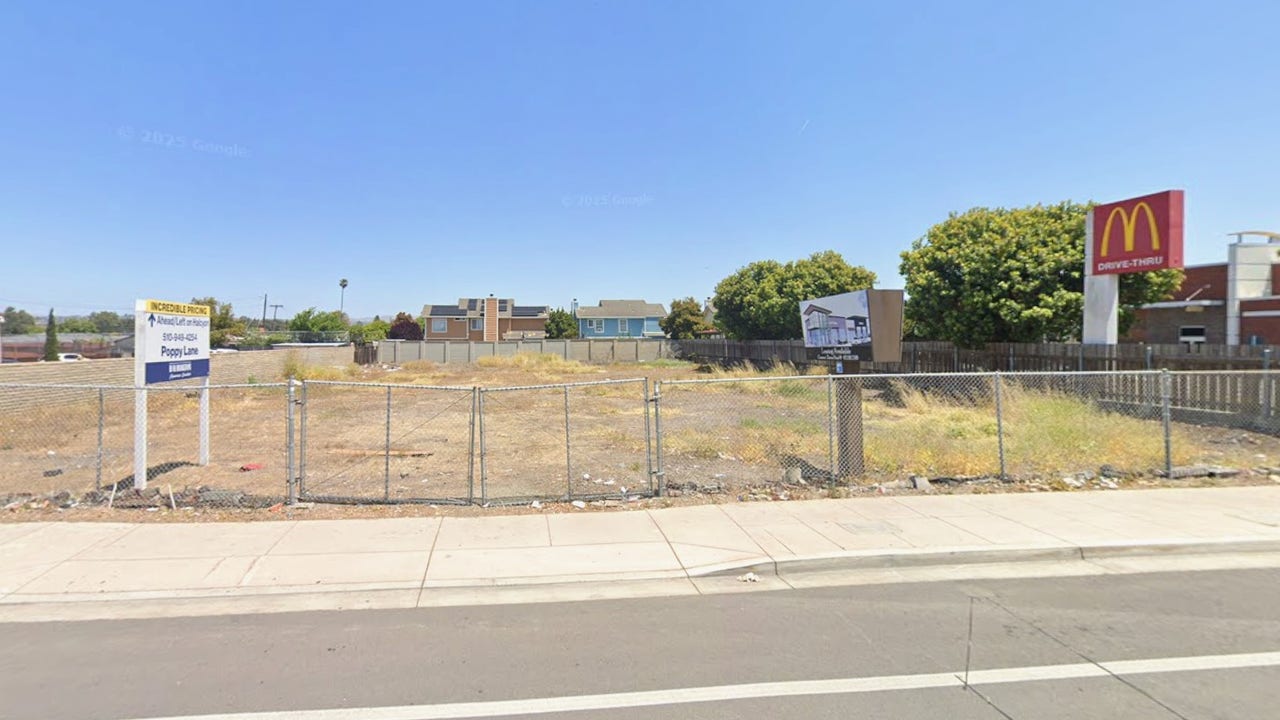
UNDATED PHOTO: The first hearing focused on the property at 18600 Hesperian Boulevard in San Lorenzo. Photo: Google Street View
SAN LORENZO, Calif. – New drive-thru restaurants have not been allowed along parts of Hesperian Boulevard for nearly 30 years, and on Thursday, Alameda County supervisors undid that ban.
Board vote on drive-thru ban
The board voted 4-0 on lifting a 1999 drive-thru prohibition, after more than a year of study by the county’s Community Development Agency, which recommended a change in zoning policy to allow a maximum of five drive-thru restaurants to inhabit a stretch of Hesperian Boulevard.
There were no supporters or critics who voiced opinions at the board hearing.
Technically, the area in question is Hesperian Boulevard bordered by Bockman Road, the city of Hayward to the south, and three properties to the north. The stretch of road is north of Hayward and is about 3.5 blocks long by 1.5 blocks wide.
There is already an operational McDonald’s there, and a closed Sam’s Super Burger.
If Sam’s reopens, then three more drive-thrus could open up to reach the maximum capacity along this strip of road, according to Aubrey Rose, the lead county planner on the issue.
Several other drive-thrus already exist nearby further down on Hesperian Boulevard including Wendy’s, Popeye’s, Jack in the Box, KFC and Taqueria El Mezcal. But they are north of the proposed zoning change area.
“The area has some vacant parcels that haven’t been developed, and we thought that there might be an opportunity for some drive-thrus,” Rose said. “It’s important because anything that is affecting the area is important to the citizens and the merchants and the landowners there.”
‘Negative impacts’ of drive-thrus
Rose didn’t name a particular person who was pushing the idea, but said the drive-thru proposal came from a property owner of a vacant lot, a broker for a landowner and a developer or two. The first county hearing on the subject was over a vacant lot at 18600 Hesperian Boulevard, which sits next to the McDonald’s, in June 2024.
Drive-thrus have been banned in the Ashland, Cherryland and San Lorenzo of Alameda County since Feb. 4, 1999.
That’s because at the time, the county wanted to regulate “negative on and off-site impacts sometimes associated with fast-food restaurants,” according to Rose’s 81-page staff report.
The report doesn’t specifically name those impacts, but addresses traffic, garbage, noise and smells in the area as common critiques.
The report assumes that at the time, there was likely an “over-concentration” of drive-thrus along Hesperian Boulevard, and [the county] put the ban into place to “avoid certain undesirable outcomes.”
In 2023, the Sacramento Bee noted that several cities and counties in California were issuing bans on drive-thrus over traffic, health and environmental concerns.
And even earlier than that, Sebastopol in Sonoma County, permanently banned new drive-thrus in the city in 2015, citing “greenhouse gases and works against pedestrian-oriented development,” the Press Democrat reported.
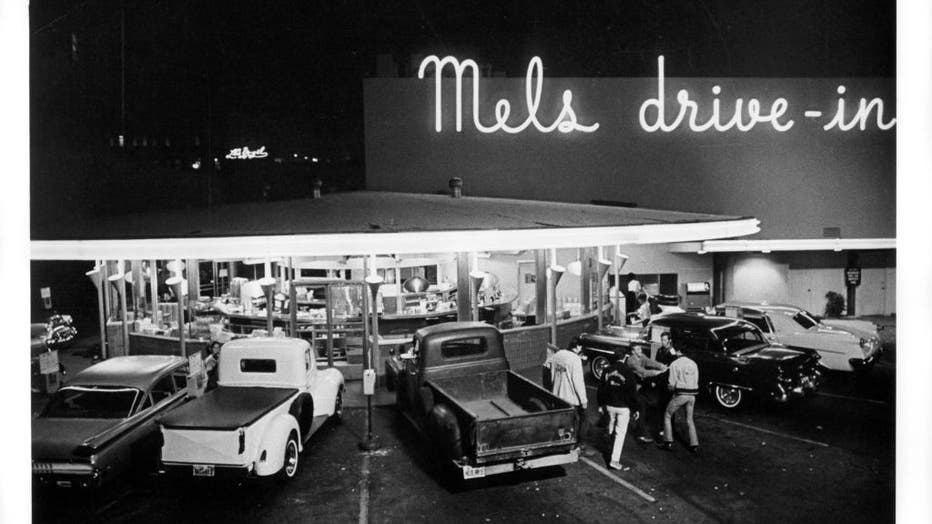
View of ‘Mel’s Drive-In’ restaurant from the film ‘American Graffiti’, 1973. (Photo by Universal Pictures/Getty Images)
Drive-thru resurgence during COVID-19 pandemic
The COVID-19 pandemic began to change society’s desire for drive-thrus.
That’s the finding of Dwight Merriam, a land use lawyer in Connecticut, who wrote a paper called, “Making Drive-Thrus a Boon, Not a Bane.”
Drive-thrus, he noted, have long been part of American history. Think: The 1973 movie, American Graffiti, which featured Mel’s Drive-In on South Van Ness Avenue in San Francisco.
Merriam noted that the ability to order food without getting out of your car, and coming in contact with people and germs, had a resurgence during the pandemic.
He said that Wendy’s restaurants reported that 90% of its sales were drive-thrus in March 2020.
Separately, the National Restaurant Association has argued in favor of drive-thrus, however, saying they help communities access food more easily and contribute to the local economy.
Early criticism prompted drive-thru rules
In the early stages, Rose acknowledged there was some early skepticism about allowing more of these restaurants.
“The cons could be a proliferation of drive-thrus, which would be mitigated by the cap that’s being proposed,” he said, reiterating that only a total of five drive-thrus could be allowed in total in that area.
And in his opinion, the new policy would also address other potential concerns: Truck deliveries and garbage collection must be scheduled during non-commute hours, buildings should be secured during closed hours to discourage loitering, noise levels at the property line can’t be louder than 65 decibels and “no undesirable odors shall be generated on site.” Also, if a drive-thru abuts a residential area, the business has to close by 10 p.m. on weeknights and midnight on weekends.
At a hearing July 8, the county report indicates four members of the public spoke, two were in favor and none were opposed to the proposal.
Rose’s report also notes that one of the stakeholders commented that if anything, the drive-thru opening hours – no earlier than 8 a.m. – preclude any coffee companies or breakfast restaurants, which residents have been clamoring for.
Finally, Rose pointed out, this vote doesn’t establish any new drive-thrus; it merely changes a policy to pave the way for a drive-thru if a developer wants to apply for a conditional use permit before moving into the area.
Another, separate vote would have to be held for each individual drive-thru that wanted to set up shop on that stretch of Hesperian.
“So should this go through and should an application be submitted for a conditional use permit for a drive-in restaurant, the public process would begin again,” he said. “And any affected neighbors would have an opportunity at that time as well.”