
Just ahead of midterm election day, Orange County officials have outlined election protection measures amid federal defunding of national cybersecurity organizations and an uptick in reported sightings of U.S. Immigration and Customs Enforcement (ICE) in California.
Local officials outline cybersecurity infrastructure and ballot retrieval processes
The United States’ election system is largely decentralized, with administration primarily carried out at the state and local levels.
At the federal level, however, the Department of Homeland Security (DHS) plays a significant role in election administration and security efforts in the U.S., including the Cybersecurity and Infrastructure Security Agency (CISA), a component of DHS that identifies and manages risks to U.S. cyber and physical infrastructure.
Following DHS’ designation of election facilities as “critical infrastructure” in January 2017, CISA was created in 2018 during President Donald Trump’s first term and works with state and local officials, as well as federal and private partners, to provide election resources.
Despite its establishment during Trump’s first term, CISA has seen major layoffs in Trump’s second term, according to a recent ProPublica article, with over 1,000 employees let go, reducing its size by approximately one-third.
The Trump administration released the annual U.S. budget proposal for fiscal year 2027 in April, which further cuts the agency by $707 million, potentially resulting in an additional 900 layoffs.
CISA also faces growing distrust among state officials, according to ProPublica.
Reports of lost confidence in the agency followed the Trump administration’s declassification of records containing sensitive data that state officials had provided under strict confidentiality agreements.
Though CISA released its 2026 election infrastructure security plan in September, which outlines an overview of the current election threat landscape and available election resources, concerns about the agency’s integrity remain.
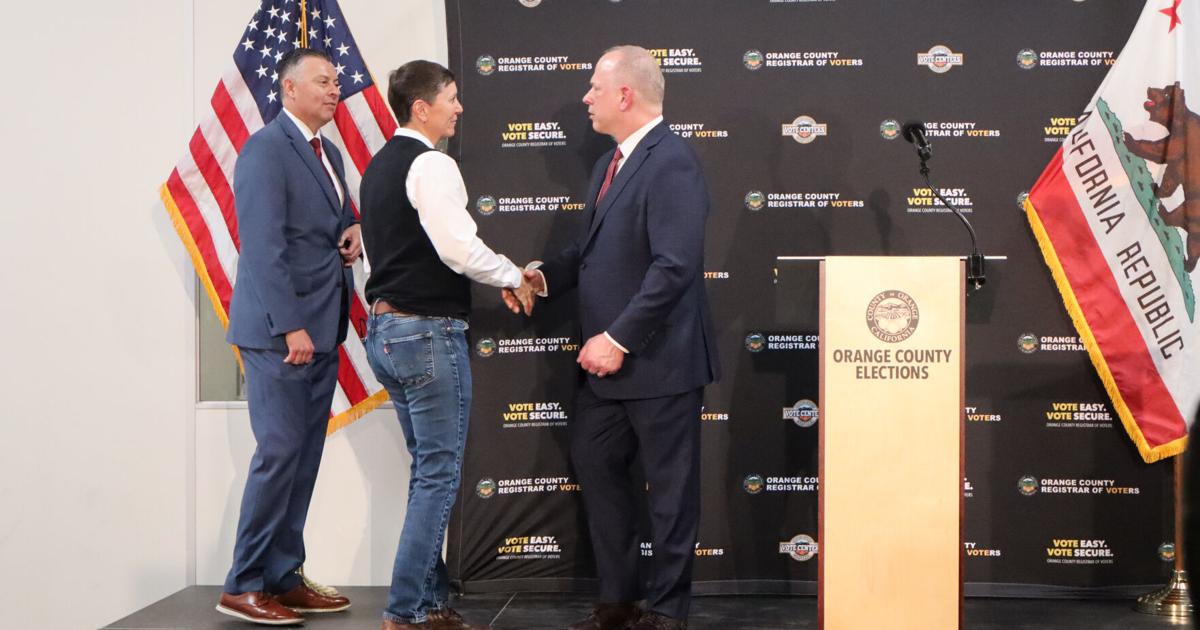
During a press conference held at the Orange County Registrar of Voters facility on Oct. 28, Caroline Thomas Jacobs, director of the California Governor’s Office of Emergency Services (Cal OES), said the office leads the Election Security Task Force, which strengthens coordination with local officials to ensure partner safety and cybersecurity at the state level.
Thomas Jacobs also highlighted the California State Threat Assessment Center, which serves as the state’s primary information clearinghouse for potential criminal and security risks.
“The state supports cybersecurity information sharing and preparedness efforts to help protect election-related infrastructure,” Thomas Jacobs said. “This coordination helps us and our public safety agencies identify, assess and work to prevent or disrupt the potential threats before they impact communities.”
Orange County implements more than 125 election-integrity processes, including technical controls such as software system imaging and archiving of electronic election data.
OC Registrar of Voters’ Bob Page discussed the office’s ongoing interactions with the Center for Internet Security, which provided the county with an Albert sensor designed to monitor internet traffic and identify potential attempts to access its public-facing systems.
The office is also using a new automated signature verification software to review signatures ahead of Tuesday, funded in part by $3.2 million in one-time state funding.
Page said that the software compares signatures on ballot return envelopes with the most recent samples on file, accepting approximately 27% to 30% of signatures that meet its 60-point confidence threshold. While the software does not automatically check or reject ballots that cannot be verified, it flags them for manual review by a team.
Of the more than 380,000 ballots the office has received as of Oct. 27, approximately 70% of signatures are being manually reviewed on-site.
During the ballot retrieval process, two-person teams are sent to each of the county’s 128 ballot boxes, secure them with numbered zip-tie seals and record them on paper. Once the boxes enter the facility, staff log the tag numbers and check the seals to ensure ballots have not been tampered with during transit.
“They have to take a photo showing that they’ve closed the door, and that they put a numbered seal across the gap between the door and the box,” Page said. “We also have a photo that shows there’s a new empty bag inside, and the fire suppression canister that’s hanging from the top is still intact.”
Page said that three-person teams are assigned to monitor the process through a survey app that reviews submitted photographs and authorizes them to proceed to their next stop.
According to the OC Registrar of Voters, nearly 13,500 verification photos were submitted by ballot-collection teams, 28,000 voting seals were recorded and 1.1 million signatures were compared and verified by trained staff during the 2024 election.

Orange County Registrar of Voters employees process midterm election ballots. (Kristina Hayrapet / Daily Titan)
Orange County prepares polling site protections against potential ICE activity amid state legal disputes
The Trump administration and California have faced several legal battles following attempts by the federal administration to block 20,000 California ballots, claiming they may have been cast by noncitizens.
Although the attempt was blocked by a federal judge, subpoena requests have continued to be issued, with the most recent sent to Orange County on Oct. 29.
According to a CalMatters report, the DHS subpoena sought unredacted voting records for 60 people, three of whose names were provided in previous voter-subpoena attempts against the county, Page said.
This comes following a letter from Bilal Essayli, assistant U.S. attorney for the Central District of California, that was hand-delivered to the county on Oct. 26, alleging that approximately 1,750 noncitizens were listed on county voter rolls.
“From the Registrar of Voters’ stance, our understanding of federal law is that federal agents and troops; it’s illegal for them to be at voting locations while voting is occurring,” Page answered when asked about the presence of ICE officials at polling locations. “If that were to happen, we’ve got a sheriff’s sergeant who is embedded in our command center in the office.”
Page said the office encourages voting center staff and California voters to report any concerning activity so officials can respond and keep voters safe.
Through coordination by the State Threat Assessment Center, regional fusion centers and public safety partners, Thomas Jacobs said this network ensures timely responses to potential threats during the election process.
“We want to make sure that our vote centers are operating properly,” Page said. “If there is an issue going on that’s not being properly addressed, we want to respond as quickly as possible as an office.”