
“Because I honestly believe every vote matters. And because I matter. And, I guess, because you matter, too.”
That’s Elaina Sanchez, standing outside Cal State Fullerton’s vote center on Tuesday, Nov. 3, explaining why she’d just cast a ballot – her first ever.
“Also, my parents would be, like, super (irate) if I didn’t.”
If Sanchez’s rationale sounds sweetly naive or maybe overtly “West Wing”-ish, consider this: At 18, she’s grown up in an era when the electoral process has become, as one young voter told me Tuesday, “freaking suss.”
It’s a hard argument to refute. If children of the 20th century grew up being told that American-style democracy was a well-oiled (if sometimes greasy) machine, children in this century have heard – and seen – that message’s flip side.

CSUF student Ariana Cuevas, 19, shows off her “I voted” sticker after voting for the first time, while her boyfriend photographs the moment. “As college students, we really think our votes matter,” she said at the university in Fullerton on Tuesday, November 3, 2026. (Photo by Mindy Schauer, Orange County Register/SCNG)

Students trickle into the voting center at CSUF in Fullerton on Tuesday, November 3, 2026. Outside, the nonprofit group “DJ At the Polls” provided background music to pump up turnout. (Photo by Mindy Schauer, Orange County Register/SCNG)

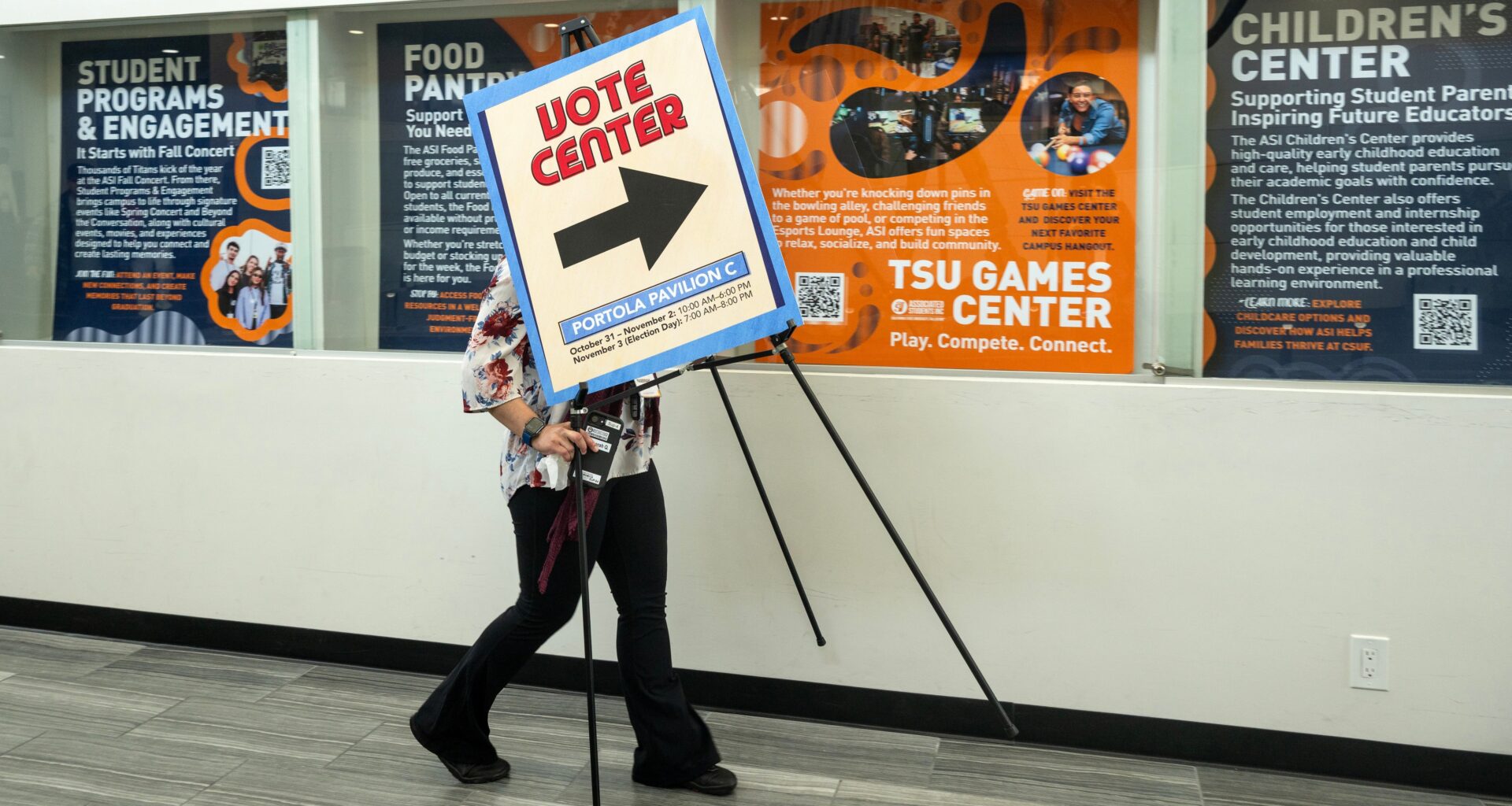
The CSUF polling center at the Student Union directs voters inside on Tuesday, November 3, 2026. Outside, the nonprofit group “DJ At the Polls” provided background music to pump up turnout. (Photo by Mindy Schauer, Orange County Register/SCNG)

Edith Gage leaves CSUF on Tuesday, November 3, 2026, after casting her vote. (Photo by Mindy Schauer, Orange County Register/SCNG)

CSUF students, including Gisel Herrera, 20, center, check their phones before voting at the university’s polling center on Tuesday, November 3, 2026. The psychology major says, “I vote because my parents can’t.” (Photo by Mindy Schauer, Orange County Register/SCNG)

Abraham Huerta, with the nonprofit group “DJ At the Polls,” provides background music to pump up turnout at CSUF on Tuesday, November 3, 2026. (Photo by Mindy Schauer, Orange County Register/SCNG)

Students trickle into the voting center at CSUF in Fullerton on Tuesday, November 3, 2026. Outside, the nonprofit group “DJ At the Polls” provided background music to pump up turnout. (Photo by Mindy Schauer, Orange County Register/SCNG)

A worker at the CSUF polling center in Fullerton adjusts a sign inside the Student Union on Tuesday, November 3, 2026. (Photo by Mindy Schauer, Orange County Register/SCNG)
Show Caption
1 of 8
CSUF student Ariana Cuevas, 19, shows off her “I voted” sticker after voting for the first time, while her boyfriend photographs the moment. “As college students, we really think our votes matter,” she said at the university in Fullerton on Tuesday, November 3, 2026. (Photo by Mindy Schauer, Orange County Register/SCNG)
Think of what Sanchez and voters in their 20s have seen over their few years:
Denialism – claiming fraud after any election your side doesn’t win – is now a routine political tool.
Two presidential elections (2000 and 2016) have ended in a presidency awarded – thanks to the Electoral College – to the candidate who got the second-most votes, and a third (2020) that led to an insurrection.
At least one major news outlet (Fox) has paid a breathtakingly expensive libel settlement after being caught knowingly spreading false stories about, wait for it, election machinery.
And politicians of both sides (mostly Republicans but, yes, following the 2004 election, Democrats as well) have argued against certified election results.
In other words, Sanchez and most other first- and second-time voters have come of age being given every reason to believe that elections are lame and voting is a fool’s errand.
Yet…
“I vote because my parents can’t,” said Annabelle Santos, who said her parents are green card holders from the Philippines.
“I’m a history major. And one of the things I’m studying is what it’s like in countries when people can’t vote,” said another new voter, James, who declined to let me use his last name.
Even James’ desire for anonymity carried political overtones.
“I live in a house with a bunch of guys who don’t agree with my politics,” he said. “They probably aren’t going to vote this cycle, and I’m not positive that they’re still into the stuff they used to be into (politically speaking). But they really don’t like how I think, politically, and I’d rather not deal with their drama.”
At least one young voter, Alex, who also said he didn’t want to divulge his last name, said if younger people are finding value in voting, it might be precisely because the process has been trashed as much as it has by their elders.
“I think people my age are getting used to the idea of making do with less, and with figuring out how to turn old stuff into something good or cool. Voting is sort of like that, I think, only it’s more important.”
Indeed, his “Vote or Die” T-shirt suggested at least somebody thinks the stakes are high.
Another student said she’s voting because it’s one of the few things in her life that isn’t observed by a camera or tracked on a computer or otherwise monitored.
“It’s something you can do that can’t be controlled or bought,” said second-time voter Katrina Choy.
“It’s like telling a secret.”
A few young voters told me democracy exists because of sacrifice. But none mentioned the American Revolution or World War II or the Civil Rights era. Instead, they talked about activists who protested at Tiananmen Square in 1989 and Hungarian voters who ousted Viktor Orbán earlier this year, and Brazilians who backed the 80-something lefty, Lula (Luiz Inàcio Lula da Silva) just last month.
“I don’t remember what it’s called, exactly, but there is a theory in political science that efforts to make it harder for people to vote sometimes result in even more voting by those people. It sort of blows up in everybody’s face,” said history major James.
“I think that’s what’s happening right now in the United States. A lot of young people, in particular, are voting because they’re being told they shouldn’t bother.”
Look, I know that an early morning voter sample at Cal State Fullerton is going to be skewed in favor of optimism and brains. Young people willing to vote in person, pre-coffee, before their first class – with DJ Abraham Huerta spinning ’70s disco hits in the background – are probably more politically interested and organized than others in their (or any) age group.
And no matter what I found in Fullerton, young people are less likely to vote than are older people. Even in the high-turnout political era we’ve seen over the past decade, voters between ages 18 and 29 have been the least likely participants. In fact, the so-called youth vote has cracked 50% only twice in the past five national elections (presidential votes in 2016 and ’20) and has dipped below 1 in 3 in the past two midterms (2018 and ’22). Other age groups generally have voted at a much higher (60% or more) clip.
That’s not likely to change this time, either.
But Sanchez, among others, thinks a change might not be far off.
“There aren’t a lot of good options, right? Voting is what we’ve got. I think young people know that, probably. Or if they don’t, if we don’t, I mean, we’ll figure it out.”
And her mindset seemed to be catching.
“I never miss a vote,” said Edith Gage, a 67-year-old from Fullerton. She said added that she was voting at the school because it’s close to her house – mostly.
“But do I enjoy seeing that all these kids – these young adults, I should say – are voting? Of course I do. It’s beautiful.
“And I mean that in a lot of ways.”