
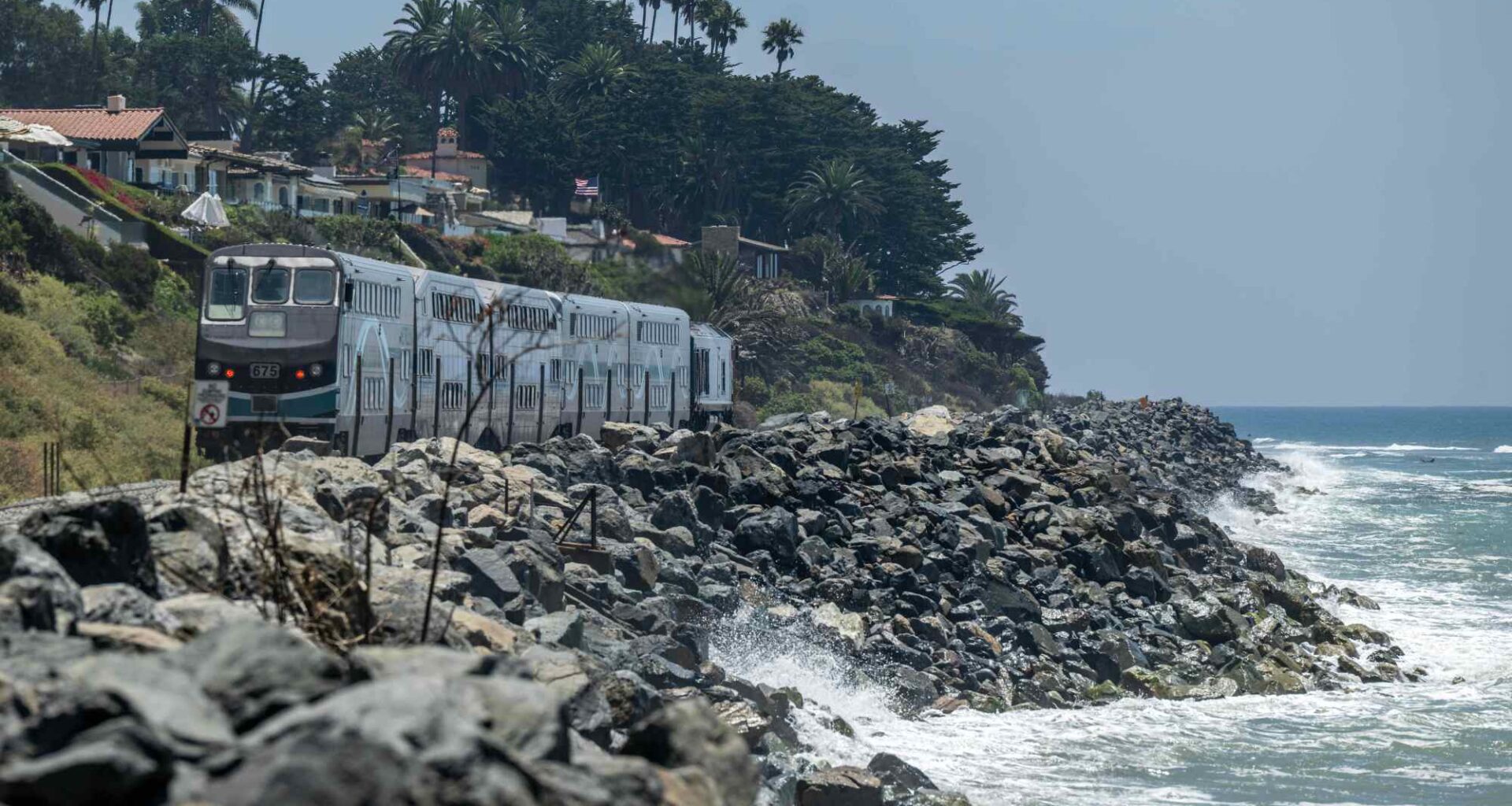
A controversial plan to protect the coastal rail line from the sea where it runs beachfront in south San Clemente is being presented to the California Coastal Commission this week.
The Orange County Transportation Authority is asking the California Coastal Commission on Thursday, Nov. 5, to approve plans to retain 48,463 tons of riprap along the beachside rail line and add 2,100 tons of new riprap, build a 1,223-foot-long seawall on the seaward side of the tracks and add 220 tiebacks to secure the bluff along the same vulnerable stretch of coast.
Critics worry the additional hard armoring will have negative impacts on the already-eroded beach.
While the plan also includes adding 690,000 cubic yards of sand — about 240,000 cubic yards just north of the pier and 450,000 cubic yards at the southern end of the city that would make up the largest sand replenishment project in the city’s history — environmentalists have battled against the armoring plan because the rock revetments can worsen erosion and take up valuable beach space.
The OCTA and the Southern California Regional Rail Authority are attempting to address a troubled stretch along the LOSSAN rail corridor, which spans 351 miles from San Diego to San Luis Obispo, a line used for both passenger and freight trains. In recent years, travel between San Diego and Orange County has been halted multiple times because of damage in this stretch.
The application also asks for a maintenance program that would allow riprap to be placed throughout all of San Clemente’s coastline when needed, if sand doesn’t offer proper protection, but “the applicants failed to provide specifics relating to this program, such as maximum volume of riprap,” a report from staff to the commissioners said.
Commission staff is recommending approval for a 10-year period, with amendments such as creating public access improvements and an evaluation of the performance of the shoreline protection, sand placement and mitigation program.
“This approach attempts to balance the protection of the railroad with the preservation of public access and other coastal resources,” staffers said.
OCTA is asking that the approval be extended to 30 years, citing funding for long-term planning that could be in jeopardy.
Just a few weeks ago, OCTA completed a large wall to mitigate landslide risks where the Mariposa Bridge was knocked down two years ago from a slipping slope. The project included a new section of beach path, together costing nearly $93 million.
At times during higher tides, the ocean hits directly onto rocks and the tracks in areas of San Clemente, making some of the town’s beaches impassable. Commission staff said in a southern section, sand has eroded from 200 feet to less than 80 feet in less than 10 years.
One environmental group, Orange County Coastkeeper, urging the commission to deny or amend the application, is calling the request the largest, or one of the largest, potential encroachments the commission has ever considered in a single conditional use permit application.
There’s no evidence, Coastkeeper officials argue, that the hard armoring will actually protect the rail line.
“The staff report is void of any information or estimate of how long the proposed armoring is expected to protect the railroad, if at all,” a letter to the Coastal Commission said.
The project also does not eliminate or begin to mitigate its shoreline impacts, the Coastkeeper letter argues. “It is difficult to quantify what the tremendous loss of beach will cost to the ecosystem, the local economy, and to the people of California that use and enjoy this treasured stretch of coastline.”
The Coastal Commission staff is recommending a 10-point mitigation program and a long-term railroad adaptation study, to be completed by Nov. 2030, to fully address the impacts of retained and new shoreline protective devices.
Under the mitigation program, at least 690,000 cubic yards of sand would be put in place, and unnecessary rock should be removed to open up beach space and public access improvements.
Sand would be sourced from either offshore borrow sites and brought by dredger, or delivered by truck from Prado Dam, where a stockpile of sand is currently sitting and needs to be removed, with the hope of starting the sand portion of the project by next February, the commission report said.
OCTA has incorporated mitigations and has committed about $100 million, nearly one-third of the overall project budget, to restoring a critical coastal trail connection and placing approximately 690,000 cubic yards of beach-compatible sand, OCTA Chair Jamey M. Federico said in a letter to the commission.
“These investments provide significant coastal resources and public access benefits and directly advance key objectives of the commission,” he said.
The south end of San Clemente has historically been a direct connection to San Onofre State Beach, which includes several world-class surf breaks and beaches untouched by development. The continued beach erosion — and rocks and revetments covering more and more of the sand space — pinches off access to that area.
Coastal Commission staffers are recommending monitoring and reporting on sand movement, including impacts on nearby kelp and reef habitat, with a final report in 10 years.
Sand monitoring should not just be required, but there should also be a requirement to replace a loss of beach, Coastkeeper argued in its letter. “Monitoring without action is not mitigation.”
Advocacy group Save Our Beaches, which formed in recent years to advocate for sand over riprap, argues that approving the permit not only would retroactively authorize OCTA’s coastal activities over the past five years, along with new developments that include a vertical seawall at San Clemente State Beach, but also would allow future dumping of up to 15,000 tons of riprap on any beach in San Clemente on an “as-needed basis under a poorly-defined maintenance program.”
“While the commission’s staff report documents OCTA’s failure to comply with past agreements and permit conditions, repeated unauthorized rock dumping, and reluctance to provide full transparency regarding its engineering plans,” Save Our Beaches said in a letter, “the report also notes the permit would result in the largest single loss of beach to armoring in the last 50 years.”
While Save Our Beaches sees the proposal as progress, it’s not enough and “significant concerns remain,” the group said.
There should be a smaller footprint at State Beach, and while a seawall size and scope was reduced, there’s concern that a vertical seawall “could generate even greater turbulence and scour than the sloped and irregular revetment,” Save Our Beaches argued, noting the seawall could be placed as close as 15 feet from the tracks instead of encroaching on the sand.
The group also said OCTA should be subject to continuing beach-performance requirements, rather than a one-time sand placement.
“The Coastal Commission has documented years of unauthorized armoring, failed commitments and substantial destruction of public beaches, yet its proposed permit still does not require OCTA to maintain a sandy beach, restore continuous public access or demonstrate lasting mitigation for the damage it has caused,” the group said.
OCTA should be required to maintain an 80-foot beach in front of all coastal armoring for the duration of the permit, the group added.
“Our beaches are a public resource, central to San Clemente’s identity and quality of life,” the group wrote in its letter to the commission. “The Coastal Commission must ensure that any authorization for coastal armoring includes meaningful, enforceable protections for the beaches and public access that would otherwise be lost.”
State Parks’ Orange Coast District also weighed in on the portion that could impact San Clemente State Beach, expressing concern that protecting the railroad corridor through shoreline armoring “will come at a substantial cost to public beaches, coastal resources, and recreational opportunities that make this stretch of coast so valuable” Riley Pratt, senior environmental scientist for State Parks, said in a letter to the commission.
The State Parks’ Sea Level Rise Strategy identifies nature-based solutions, with the preferred alternative being sand nourishment without hard armoring, or a seawall over rock revetment, which has a “substantially larger footprint.”
The California Coastal Commission meeting starts at 9 a.m. on Thursday, Nov. 5; find out more at coastal.ca.gov.