
The tiny turtle eggs are being kept cozy and warm, but soon they may have to leave their makeshift nest.
Several times a day, caretakers at the Aquarium of the Pacific in Long Beach check in to see if sand covering the 204 olive ridley turtle eggs has moved, which will be the first clue that eggs are hatching. A live stream video is set up in the incubator, to keep careful watch at all hours of the day and night.
Any day now, the eggs laid in September by two turtle mams who crawled out of the ocean and up the sand in Huntington Beach and Seal Beach could hatch, and the hope is — with just a little helping hand from humans — the baby turtles will be released in coming days or weeks.
Their anticipated arrival comes as news of a third nesting was found in the sand near the Ventura Pier this week, signalling that even more olive ridley turtles may be finding a new home far from the tropics where the species is typically found.

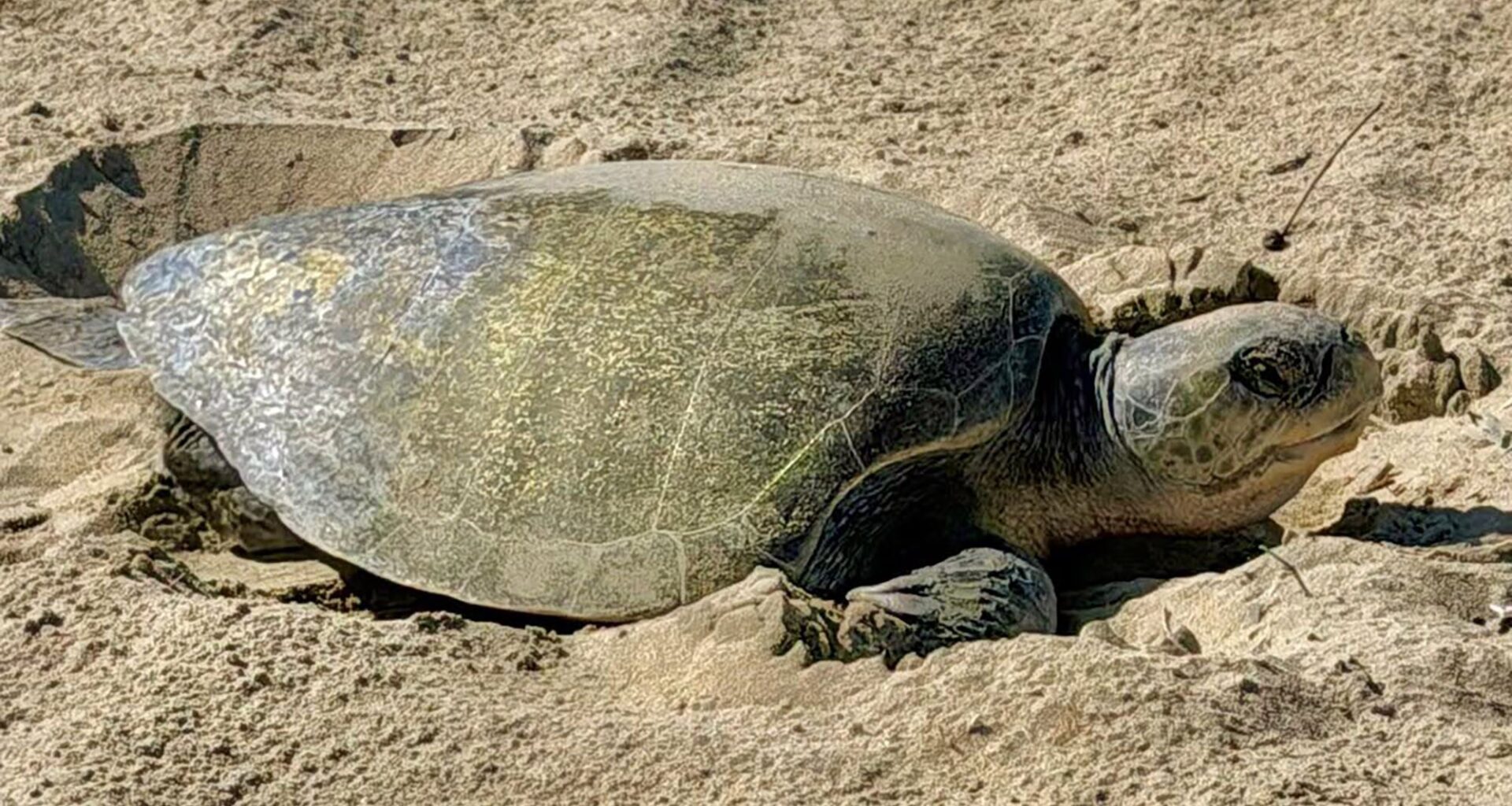
Federal biologists moved more than 200 olive ridley sea turtle eggs from Orange County beaches to the Aquarium of the Pacific in effort to save them. The hope is that they will hatch any day. (City of Huntington Beach/TNS)

An olive ridley sea turtle was observed on the beach near the pier in Huntington Beach, California, and also in Seal Beach. Now in the care of the Aquarium of the Pacific in Long Beach, they are expected to start hatching any day. (City of Huntington Beach/TNS)
Show Caption
1 of 2
Federal biologists moved more than 200 olive ridley sea turtle eggs from Orange County beaches to the Aquarium of the Pacific in effort to save them. The hope is that they will hatch any day. (City of Huntington Beach/TNS)
The first two nests of ping-pong-sized eggs – 100 from Huntington Beach and 104 from Seal Beach – are thought to be the first-ever confirmed recording of one of the turtles nesting on the mainland West Coast of the United States.
Based on photos, the two nests are thought to be from two different olive ridley turtles. Morning beachgoers noticed both and flagged authorities who quickly stepped in to pretect the nests in the sand.
But when a big hurricane swell and high tides entered the forecast, officials made the decision on Sept. 25 to move the eggs and care for them at the Aquarium of the Pacific.
Aquarium of the Pacific Veterinarian Dr. Lance Adams talked about their care in recent weeks, calling it “simple.”
They were initially kept in a consistent room temperature of about 82 degrees, which was recently nudged up to about 85 degrees, as recommended by partners at the National Oceanic and Atmospheric Administration and the US Department of Fish and Wildlife, Adams said.
Humidity also matters, and has to be kept anywhere from 90% to 100%, he said. If humidity gets low, water is misted into the incubator, where sand covers the eggs in the clear-lid coolers.
“There’s more monitoring and caring than the first 40 days,” Adams said of current efforts. “We haven’t really had any hiccups; everything is going smoothly. I suspect, if any eggs were viable, they’d continue to develop properly. We won’t know until they hatch, or if we pass the period, or if they need more time — or if none of them are developed.”
Aquarium staff make regular in-person checks about five times a day — a live camera feed allows Adams and others to check in from home at any hour.
If an egg hatches, the clue will be a depression in the sand, sinking because eggs are no longer taking up that space, he said.
“It’s really exciting to be part of something so novel and unique, something that hasn’t happened before and to work with wildlife experts is exciting and rewarding,” Adams said. “I think I’m going to be happy when we find out if there will be hatchlings … that will be the fun part. But right now, there’s a lot of anticipation.”
“Are we going to be able to transfer them back to their beaches where they were nested and do that successfully, and will they be able to swim off successfully?” are questions Adams said he and many others are wondering.
The olive ridley sea turtles are one of seven turtle species found worldwide. They’re recognized as the most abundant species, but are still considered endangered. Typically, they are found in tropical waters of the Pacific, Indian and Atlantic oceans, with major Pacific nesting populations spanning Costa Rica, Mexico, Nicaragua and Panama.
Experts believe water temperatures, currents and prey are factors that could have brought the turtles to local shores.
The ideal ocean temperature for a release on nesting beaches is above 68 degrees.
If temperatures and conditions fall outside the ideal range, the interagency team will explore other strategies, such as releasing directly in the ocean from a boat or releasing hatchlings in a different location where the ocean temperature will best support the new turtles’ survival and dispersal, Fish and Wildlife officials said in an email.
“If water temperatures and beach conditions are appropriate at the time of release, hatchlings will be placed just landward of the surf zone and allowed to crawl the short distance to the water on their own,” they said.
Ocean temperatures are starting to decline, as they typically do in fall. But even with the seasonal change, NOAA Fisheries estimates the water off Southern California will remain about 5.4 to 7.2 degrees higher than normal into next year due to El Niño conditions.
If and when the hatchlings make their way back to the water, Adams said they will typically float around for a while and wait until they can find a place to stay put for a while and grow.
Olive ridley sea turtles reach maturity around 14 years of age, so it is too soon to tell whether the hatchlings will nest on Southern California beaches, officials said.
Because the nesting is so unprecedented, there also wasn’t time to make a request for permits to do satellite tagging, Adams noted.
When the turtles hatch, it will be a quick, swift move to the beach, something that can not be planned, he said.
And because of the worry that crowds could impact the turtles’ behavior — even flash camera lighting could negatively affect their journey back to the sea — details will not be made public until after their release.
“It’s just better to not have large observation groups of people,” Adams said. “People are so excited.”
That’s something he worries about, he said, disappointment if the eggs do not hatch.
“I don’t want them to be disappointed,” Adams said. “But we have to prepare for that.”
If anyone observes baby sea turtles or strandings after the release, they should contact NOAA’s West Coast Stranding Hotline at 562-506-4315 or local lifeguards who can document or help if needed.