
You’ve surely heard about the Lucas Museum of Narrative Art. In Los Angeles’ Exposition Park, the museum houses the personal collection of George Lucas, who funded its $1 billion cost out of his own sofa cushions.
I don’t need to tell you who George Lucas is, right? He made his billions via the popular science fiction series that redefined the genre: “Star Trek.”
Or possibly “Star Wars.” Well, one of those.
(Just kidding! He created the inferior one, “Star Wars.”)
The art museum opened Sept. 22 and it’s a smash. Most dates are sold out in advance through November.
I knew I would go at some point. Then a Claremont friend and neighbor who’d bought a $140 membership, and can bring a guest for free, invited me to join him last Sunday.
We took public transit: Metrolink to Union Station, the subway to Seventh Street and then the E Line light rail, which offers a stop a block from the museum.
I’m not saying that’s the stop we took. We got off one stop early, a mistake we corrected on the way back.
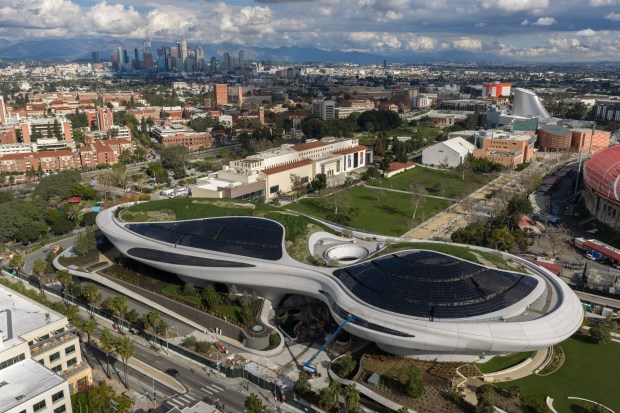 The Lucas Museum of Narrative Art, seen on Jan. 5, instantly became one of Los Angeles’ most striking pieces of architecture. (Sean M. Haffey/Getty Images/TNS)
The 300,000-square-foot Lucas building, five stories tall at its highest point, is among the most striking in Los Angeles, and that’s saying something. Its shape has been compared to an enormous, tile-clad sneaker or, more to the point, a spaceship, complete with an oculus.
Inside, glass elevators a la Bunker Hill’s Westin Bonaventure Hotel whisk you up to the fourth floor, where 33 galleries across 100,000 square feet display some 130,000 objects.
What is “narrative art,” the museum’s focus? Whatever Lucas says it is, really, but it’s art — including comics, movie concept pieces and magazine illustrations — that tries to tell a story, even in one image.
Galleries have such wholesome themes as “family,” “motherhood” and “school” or are devoted to individual artists like Maxfield Parrish and N.C. Wyeth.
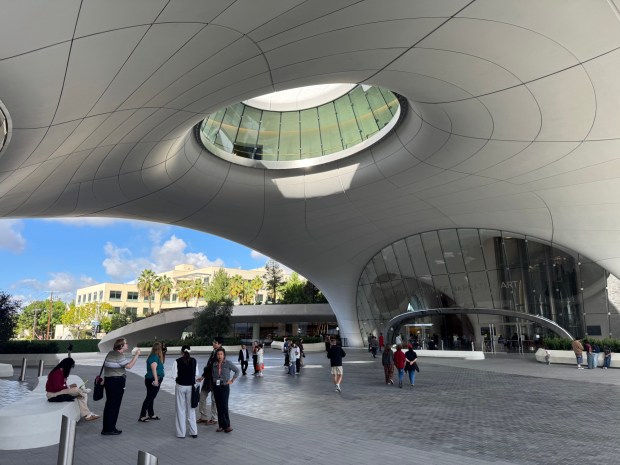 The breezeway of the Lucas Museum of Narrative Art has a futuristic look, as does the rest of the museum. It’s located in Exposition Park near the Natural History Museum of Los Angeles County. (Photo by David Allen, Inland Valley Daily Bulletin/SCNG)
The setting is glorious. The art inhabiting the space is, uh, different.
To offer a bit of personal background, I am a lifelong comics and science fiction fan, one who also seeks out art museums, either here or on vacation. Am I a snob? I wouldn’t think so. But it’s possible I am when it comes to museums.
The first gallery I entered was devoted to fantasy artist Frank Frazetta, whose work — often depicting sword and sorcery characters like Conan, or giant lizards slithering toward scantily clad princesses — I tend to like.
Do paintings created for paperback covers belong in a museum, though?
The fantasy galleries tend toward art of giant spiders descending on shrieking blondes with well-turned ankles. Two paintings have a (literally) deathless subject: Vampirella, the space vampire from comics who wears a sort of red swimsuit. People examined these paintings thoughtfully, especially the men.
I got a cheesy thrill out of a few 1950s science fiction magazine covers, like the moon of Jupiter scene “Night on Titan” by Morris Scott Dollens. Original art for some Marvel comics, and a half-dozen pages from Hal Foster’s “Prince Valiant,” both keen interests of mine, were a treat.
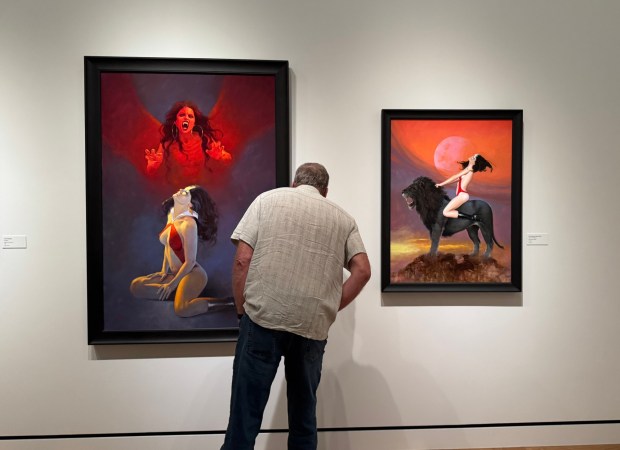 A visitor examines two paintings featuring the comic book character Vampirella at the Lucas Museum of Narrative Art on Nov. 1. Most of the museum’s art was produced for commercial reasons, not as fine art. (Photo by David Allen, Inland Valley Daily Bulletin/SCNG)
Illustrations for mainstream 20th century magazines like the Saturday Evening Post fill many galleries. John Philip Falter is represented in depth.
His scenes include a couple comically jolted awake in their bedroom by their pajama-clad son blowing a bugle in the doorway; a father and son, having just shoveled their walk, holding out their palms and looking upward with quizzical expressions at a few fresh flakes, a work titled “Snow Again?”; and a young boy seeking shelter from the rain under the blue jacket of a cheerful traffic-directing cop in an intersection.
Sure, OK.
Then there are the kewpie illustrations by Rose O’Neill, Jazz Age cartoons by John Held Jr. and the often-corny paintings by Norman Rockwell of a yawning student or a prim teacher on the first day of school.
Intermingled with these populist works are, jarringly, paintings or drawings by Picasso, Renoir, Van Gogh and Cassatt, very minor pieces by very major artists that give the whiff of having been bought merely to check boxes.
More promisingly, there are several pieces by Diego Rivera and two by Frida Kahlo. Paces away, though, is “A Pat Hand.”
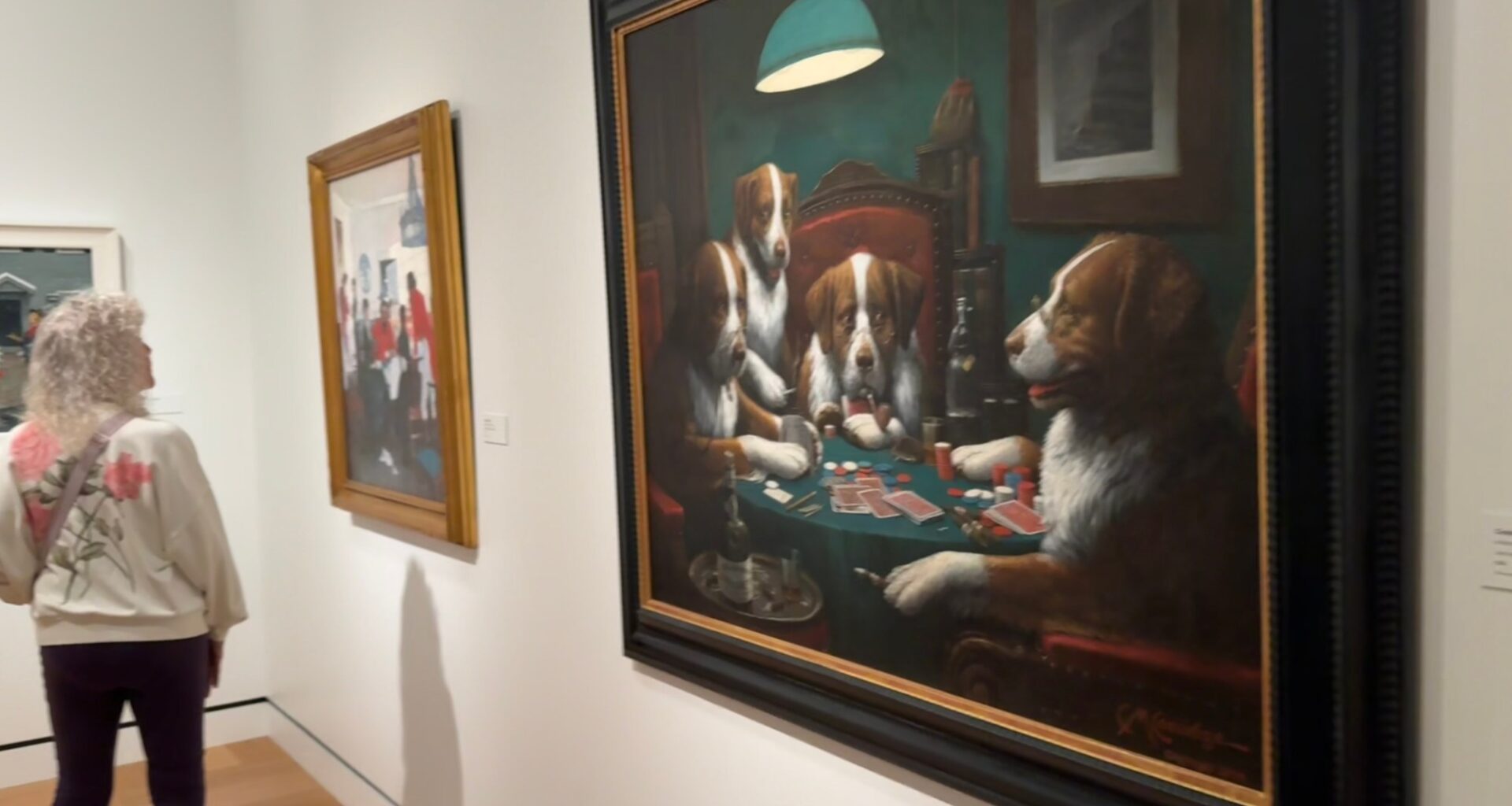
This is the 1894 work by Cassius Marcellus Coolidge that founded the beloved art genre of “dogs playing poker.” It is not on black velvet. And then, around a corner, stands Christian Bale’s Batman suit.
This museum is absolutely bonkers.
My friend likes it for precisely that reason. As he put it later: “You definitely see one person’s fingerprints all over this museum.”
Some visitors, maybe many visitors, recognize how bananas the Lucas is. A middle-aged couple strolled past me, the woman telling her husband dryly, “We haven’t seen ‘dogs playing poker.’ We’ve seen Frida Kahlo; now we have to see ‘dogs playing poker.’”
Occasionally there is a bright spot. You’ll pass much of the above, eyes glazing over, then stumble across two of the provocative cut-paper artworks by contemporary Black artist Kara Walker. (Those are said to have been among the collecting choices of Mellody Hobson, Lucas’ wife, and good for her.)
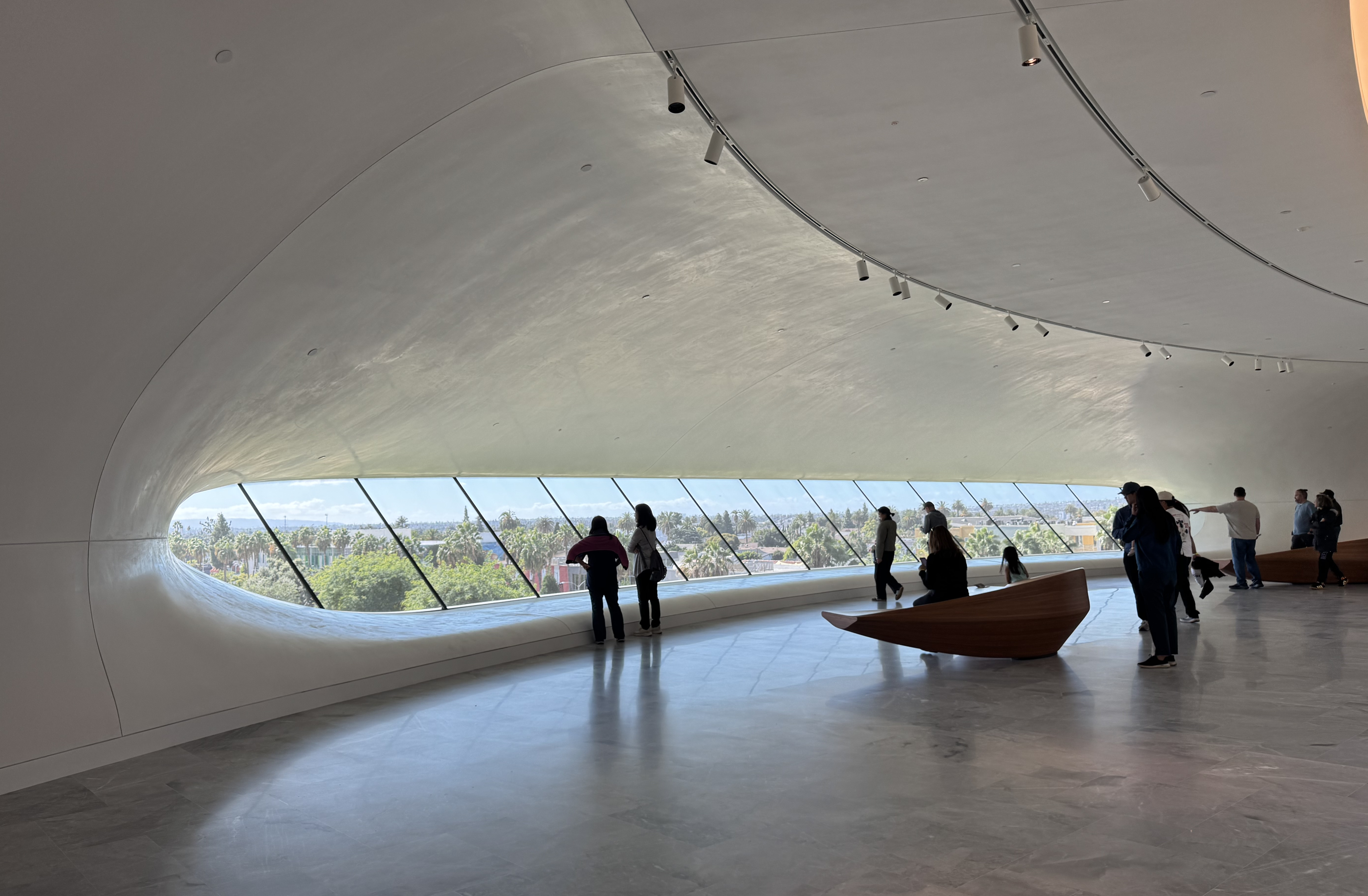 Visitors gaze out the south viewpoint windows of the Lucas Museum of Narrative Art on Nov. 1. (Photo by David Allen, Inland Valley Daily Bulletin/SCNG)
For me, the problem is that the art is all surface-level. It is absolutely clear and straightforward, without ambiguity.
No one will stand in front of Mort Kuntsler’s “My Death Run Through Headhunter Country,” a men’s-sweat magazine cover painting, and stroke their chin in contemplation.
To paraphrase Freud, sometimes a cigar is just a cigar, and sometimes a terrified couple hiding in the reeds to elude a troop of cannibals is exactly that.
Is there an Inland Empire angle at the Lucas? Of course there is.
Three large, eye-catching paintings are by Kadir Nelson, a well-regarded contemporary painter who lives in Riverside and owns a gallery there. One painting, “Black Gothic,” riffs on Grant Wood’s “American Gothic” by substituting a cheerful Black family. Good stuff.
For the record, only 7% of the Lucas is devoted to “Star Wars.” Most of that is housed in a special room, which I avoided.
To be fair, the Lucas is popular for a reason. I imagine it is attracting folks who would never venture into a traditional art museum because they would feel intimidated. The museum proudly presents what Lucas calls “the people’s art.”
“The people,” of course, tend to have rotten taste.
David Allen writes Friday, Sunday and Wednesday, rottenly. Email dallen@scng.com, phone 909-483-9339, and follow davidallencolumnist on Facebook or Instagram, @davidallen909 on X or @davidallen909.bsky.social on Bluesky.