
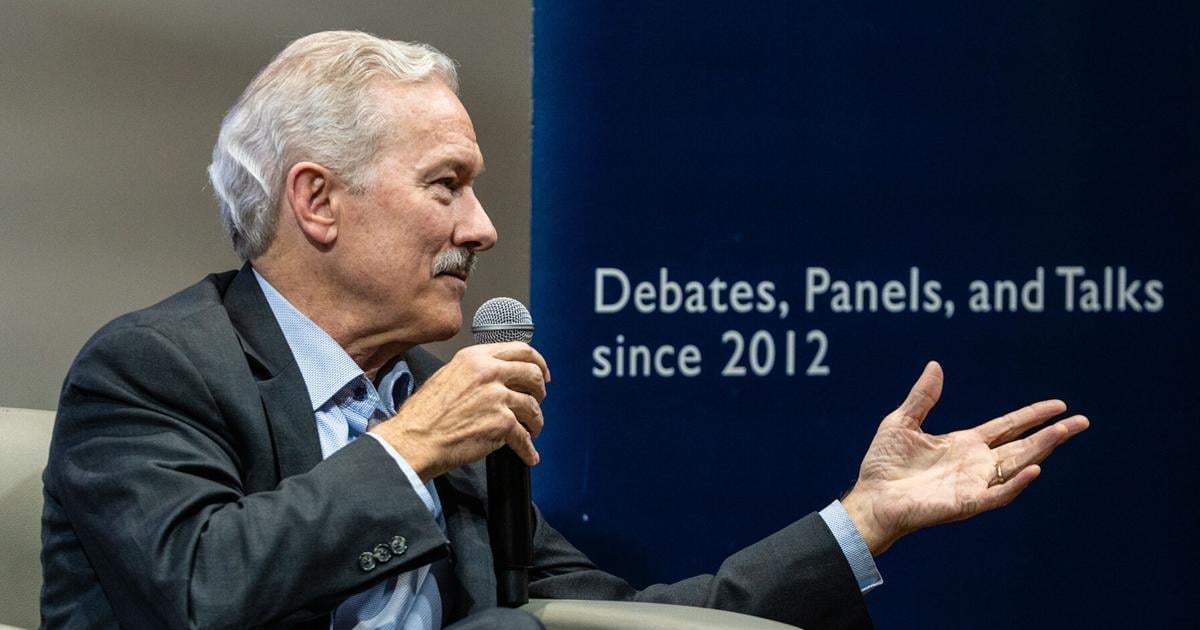
At a town hall Tuesday night in Banatao Auditorium, UC Berkeley Chancellor Rich Lyons answered students’ questions on issues ranging from accountability and AI to free speech and Israel.
About 70 people attended the town hall, organized by The Berkeley Forum. The conversation, moderated by UC Berkeley student Josie McCartney, featured both questions posed by The Berkeley Forum and submitted by students in advance.
Regarding accountability, Lyons highlighted students’ right to access his communications through the Public Records Act. However, he also stressed that decisions are often made with information that cannot be shared with the campus community.
“If you had the information I had, you might not agree with it, but you might understand it a little bit better. But there’s certain things I just can’t share with you, because they are confidential,” Lyons said.
He addressed a question regarding how UC Berkeley will respond to pressure from the Trump administration by pointing to legal support being provided for a student detained by ICE last week. “We’ve spent an awful lot of time trying to support her,” he said.
When asked about AI’s role in UC Berkeley’s future, Lyons spoke about the risks of the technology causing cognitive surrender but also its potential as a tool to produce stronger critical thinking.
He gave an example where he suggested students speak with AI agents trained on historic thinkers, which he said could “advance people’s ability to ask stronger questions.”
Answering a question about campus’s free speech rules, Lyons said the campus is committed to neutrality about enforcing time, place and manner rules, and encourages free speech. However, he said there is “no right to disrupt the free speech of others,” calling the blocking of entrances or preventing others from speaking “inimical to free speech.”
He said campus often defends the rights of speakers who have come at the invitation of registered student organizations in the past. He said campus’s efforts to defend visitors’ free speech are “so little recognized on campus” by students.
Speaking on a student’s question about Greek life on campus, Lyons acknowledged the “horrific events” at Cornell University that may have prompted the question, alluding to the recent allegations of gang rape at a fraternity at the university in Ithaca, New York.
He told the audience there currently are 14 Greek organizations at UC Berkeley that are no longer officially recognized due to various conduct violations.
“So we do police (Greek life),” Lyons said. “Do we police it enough? I guess people could debate, but most don’t realize that we actually do this with some frequency. And it’s quite significant when you’re taken off the rolls.”
McCartney said the website lead.berkeley.edu lists seven active fraternities as not having completed their annual sexual violence and sexual harassment training. Lyons promised he would look into the issue.
McCartney also asked about the April ASUC referendum calling for UC Berkeley’s divestment from companies producing military weapons and Berkeley’s new research partnership with Israel. Referring to how nearly 75% of voters approved the divestment referendum, McCartney asked, “How do you square current campus values with the formation of this new partnership?”
Lyons said global research and divestment were “distinct” elements. He said investment and divestment decisions were “not (his) decision,” pointing out that a UC Berkeley Foundation task force analyzing divestment from weapons manufacturers declined to divest in 2024.
Lyons also disagreed with cutting off research interactions with Israel, saying engagement at an academic level “isn’t an endorsement whatsoever of the politics and the political decisions of Israel.”
In a response to a question about budget cuts to PATH to Care and the Student Learning Center programs, Lyons pushed back against the characterization of SLC budget changes as cuts, calling it “misinformation.”
“The SLC budget was $4 million. The SLC asked for, I think, $4.8 million this year. The approved budget was $4.5 million a year. Everybody said, ‘you cut SLC by $300,000.’ We increased SLC from 4 million … to 4.5 million,” Lyons said. “SLC’s really important. But it is not correct that SLC’s budget was cut.”
According to Lyons, SLC had its budget increased by more than 10% this year, which was more than most other departments on campus.
When asked about his accomplishments and future goals, Lyons opted to end on a positive note, highlighting new campus buildings that have opened this year, the new two-year housing guarantee given to incoming freshmen for the first time in UC Berkeley history and UC Berkeley’s unique institutional culture. He also noted UC Berkeley’s status as an engine for socioeconomic mobility at “four to five times the scale of every top private university.”
Following the town hall, The Daily Californian asked Lyons how he felt about the event.
“It’s exciting to get a chance to interact with the students, obviously, get in front of them and hear what they’re thinking about. I personally would have appreciated a little bit more on the positive side of what we do,” Lyons said. “I would have preferred that we talked a little bit more about what makes us proud to be at Berkeley.”