
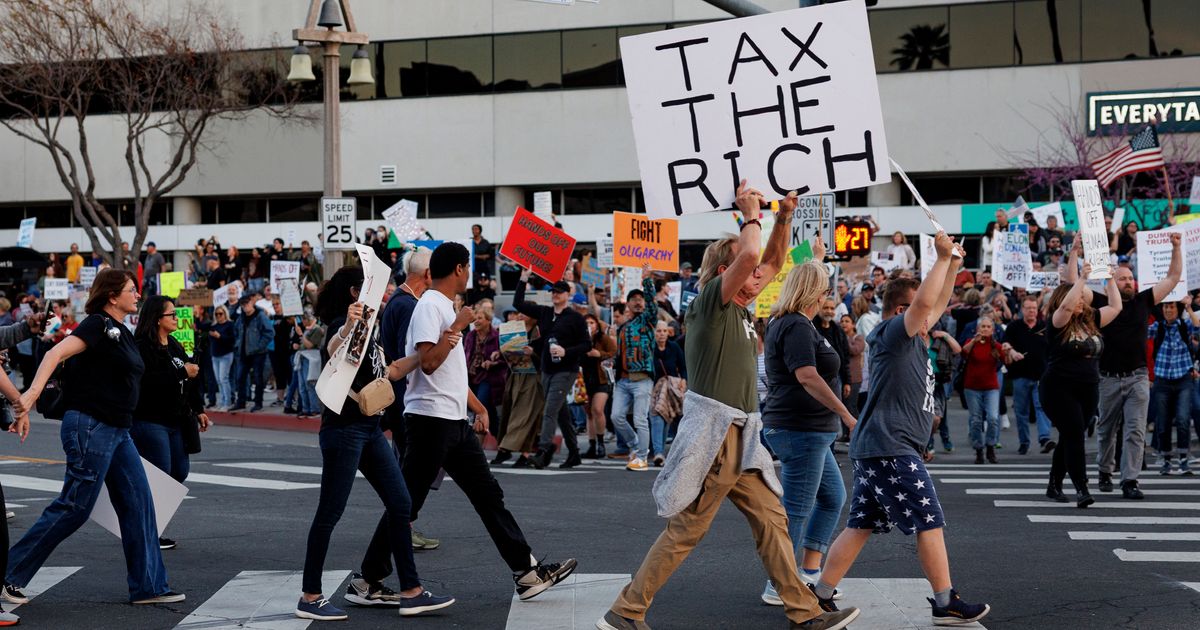
Photo: Gina Ferazzi/Los Angeles Times/Getty Images
At the tail end of a Tuesday press conference, Mayor Zohran Mamdani was asked if he’s worried that the recent defeat of California’s proposed billionaire tax would slow momentum in Albany to raise taxes on the very wealthy. “No,” he said simply, before exiting.
Mamdani may have reason to be confident. Not only did Democrats rout Republicans across the country, taking both the House and Senate in Washington, but they also secured a supermajority in both the Assembly and Senate in Albany, bolstering the party’s ability to enact a more progressive agenda. “I think our conference will flex its muscles in the budget negotiations,” Senator Shelley Mayer told the New York Public News Network.
A supermajority also gives Democrats the ability to override any potential veto from Governor Kathy Hochul. Andrea Stewart-Cousins, the state Senate majority leader, acknowledged this week in an interview with the New York Times that the veto is “obviously a tool in the tool chest,” though stressed “it’s not something that I’m going in there to to [sic] do.” In an interview with Politico, she suggested the midterms results signaled a desire for “progressive taxation,” though did not outline a plan. “We’ve always looked at the ability of those with extraordinary wealth to be able to pay more, do more,” she told the outlet. “That’s been something that our conference has talked about.”
Hochul has been largely resistant to raising taxes, though alongside Mamdani, she did support a pied-à-terre tax that would levy a surcharge on secondary residences in the city that remain largely unoccupied. (The tax, which had a bit of a bumpy rollout, had a recent court win as opponents continue to challenge the measure.) On Friday, she signaled an openness to raising taxes in targeted circumstances such as supporting her and the mayor’s shared goal of achieving universal child care statewide. “I will work hard to manage within our existing resources, but if we need more, we will find a path, as I’ve done before when there’s a particular need,” she said at the annual Somos conference in Puerto Rico on Friday, referencing previously raising the payroll mobility tax to support the MTA.
.@NYCMayor Zohran Mamdani (D) and @GovKathyHochul (D-NY) on taxing the wealthy:
Mamdani: “The fruits of this partnership was ones that they could feel in their wallets.”
Hochul: “When we have a severe need to do something extraordinary, I’m willing to do what has to happen.” pic.twitter.com/gGKZgTTelg
— CSPAN (@cspan) November 6, 2026
New York lawmakers haven’t proposed anything quite like California’s Proposition 40, a ballot measure that would’ve imposed a onetime 5 percent tax on Californians whose net worth exceeded $1 billion, the revenues slated to help offset federal cuts to health care in the state. The measure, which was opposed by Democratic governor Gavin Newsom and his soon-to-be successor, Xavier Becerra, faced hundreds of millions of dollars in spending against it. Voters ultimately rejected the tax; still, California voters supported Proposition 3, which made the tax rate on high incomes permanent.
In New York, a March poll found that 54 percent of registered voters said Albany should allow the city to tax residents making more than a million dollars. In an Emerson College poll published in April, 65 percent of registered city voters said they were in favor of a millionaires’ tax with 55 percent saying the state should raise taxes on the wealthy in order to help the city close its budget gap. More broadly, the The Nation found that 25 out of 32 campaign websites for Democratic U.S. Senate candidates this cycle made references to billionaires, which accounts for 78 percent of those running compared to 19 percent in 2024.
A public desire for taxes on the megarich, coupled with newly empowered Assembly and Senate leaders in Albany, could lead to tension with Hochul if she’s reluctant to raise taxes. Of course, Hochul comes to the table with considerable clout of her own after coasting to reelection and boasting the highest favorability rating among politicians in the state. Assembly Speaker Carl Heastie told the Times that the threat of a veto “means much more than the actual, practical use,” adding: “Just like the governor has things at her disposal, you would hope that, because the three of us work so well together, nobody ever has to use the nuclear option.”
Sign Up for the Intelligencer Newsletter
Daily news about the politics, business, and technology shaping our world.
Vox Media, LLC Terms and Privacy Notice