
A Historic Preservation Ordinance establishing a citywide framework for preserving Orange’s local, “old town” character is making its way through City Hall.
The proposed ordinance would be design guidelines for historic properties that are less about restricting modernization and more about proffering an opt-in guiding hand for managing the city’s historic districts, neighborhoods and resources, city staffers have said.
The City Council held a public hearing for the proposed ordinance this week, where several community members delivered their thoughts, generally in support of the law.
“I am cautiously optimistic that this ordinance is now something that will allow historic preservation activities in a positive manner without overreach or interference with private property rights,” Orange resident Reggie Mundekis said, though she added her hope would be ordinance language could be tweaked or improved upon in the future if necessary.
There are several Orange historic “resources” — examples include archaeological sites, artifacts, buildings, districts and structures — listed on the State and National Historic Register.
The list includes three Orange Eichler Historic Districts, picturesque residential tracts containing homes from the early 1960s, and the Old Towne Historic District, the largest historic district in the state with more than 1,300 vintage buildings. There are also scattered farmhouses across the city.

Mail carrier, Efren Anaya, of Corona, delivers mail to a historic home on Orange Ave. A historic preservation ordinance is making its way through Orange City Hall. If approved by the City Council, the ordinance would establish additional rules and regulations for homeowners whose properties are designated as historic. Photos taken Thursday, September 24, 2026.
(Photo by Karen Tapia, Orange County Register/SCNG)

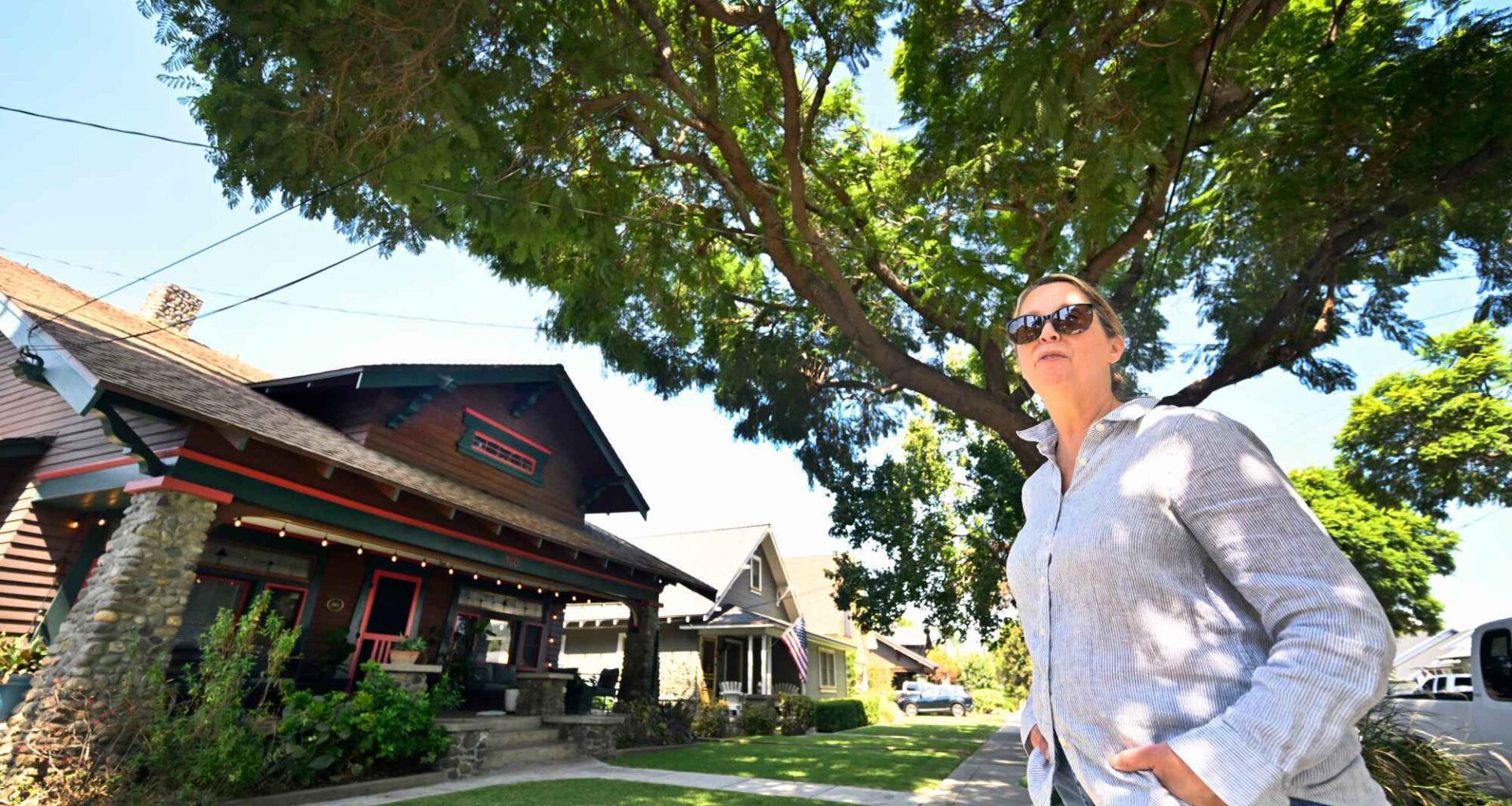
American flags adorn the front porches of homes along N. Center Street in Orange. A historic preservation ordinance is making its way through Orange City Hall. If approved by the City Council, the ordinance would establish additional rules and regulations for homeowners whose properties are designated as historic. Photos taken Thursday, September 24, 2026.
(Photo by Karen Tapia, Orange County Register/SCNG)

Jan Jenks, of Orange, sits on the front porch of her home on Maple Ave. A historic preservation ordinance is making its way through Orange City Hall. If approved by the City Council, the ordinance would establish additional rules and regulations for homeowners whose properties are designated as historic. Photos taken Thursday, September 24, 2026.
(Photo by Karen Tapia, Orange County Register/SCNG)
Show Caption
1 of 3
Mail carrier, Efren Anaya, of Corona, delivers mail to a historic home on Orange Ave. A historic preservation ordinance is making its way through Orange City Hall. If approved by the City Council, the ordinance would establish additional rules and regulations for homeowners whose properties are designated as historic. Photos taken Thursday, September 24, 2026.
(Photo by Karen Tapia, Orange County Register/SCNG)
Additionally, the city uses a local “Historic Resources Inventory,” developed through a series of windshield surveys conducted between 1982 and 2010, for tracking historic properties around the city and reviewing applications for alteration and demolition.
The proposed Historic Preservation Ordinance that councilmembers reviewed this week would create another local register that folds in already-designated historical resources but opens the door to applications by property owners around town to have their properties be historically designated and recognized.
If the city approves a property’s or resource’s historic designation, owners would be responsible for its upkeep and maintenance, such as by addressing “delamination, structural instability, or deformation caused by the deterioration of exterior stairs, porches, window and door frames, wall facings, or character-defining decorative elements,” according to the proposed ordinance’s verbiage.
There are a few incentives set in place for historic preservation, such as Mills Act contracts offering property tax reductions, to be reviewed annually by the council.
Mills Act contracts would span a minimum of 10 years, committing owners to “preservation, restoration, rehabilitation, and maintenance” as well as city access to assess compliance, according to the city’s proposed Mills Act program guidelines.
But there’s a cap on Mills Act contract approvals; council may approve “no more than eight new contracts” every calendar year.
Of Orange County’s 34 cities, about a fourth have mandatory historic preservation ordinances that mandate design guidelines to preserve historic structures from major changes, according to Preserve Orange County, a local nonprofit.
Orange could join a small list of cities, including Costa Mesa and Laguna Beach, with voluntary ordinances.
A second reading of the proposed Historic Preservation Ordinance and a council vote is expected Nov. 24. If councilmembers agree, the ordinance would go into effect Dec. 24.
The city’s existing Design Review Committee would be renamed the Heritage Commission with expanded authority to encompass duties including landmark and district designation and reviewing Mills Act contracts.