
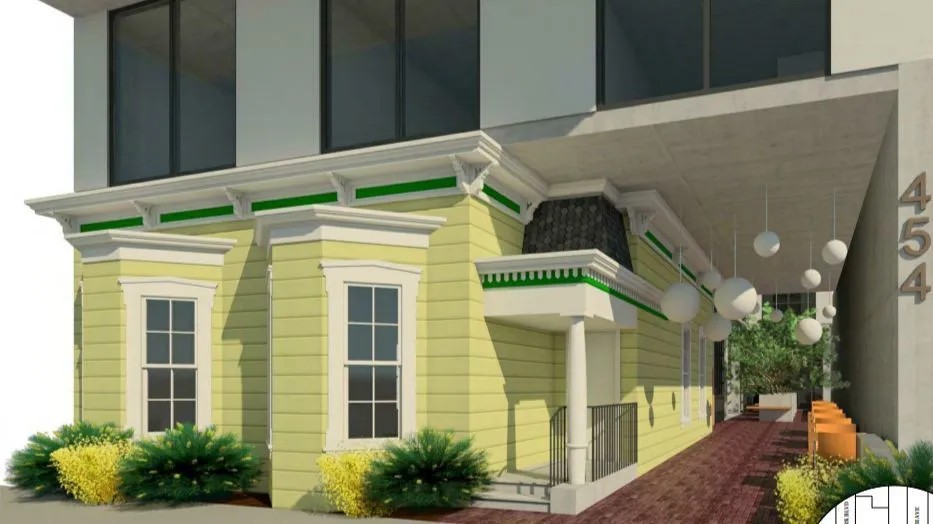
The San Diego Planning Commission unanimously approved a proposal recently to accelerate homebuilding in the city by softening historic preservation rules.
The change, which still needs to be voted on by the City Council in December, would give the governing body authority to overrule the city’s Historic Resources Board when the board designates a property historic.
Historic preservation has been a feature of San Diego for decades, halting the destruction of the California Theatre and countless other housing and development projects.
Preservationists argued the change politicizes what projects are deemed historic. But the local development and business communities praised the new policy as a welcome change.
Question: Should San Diego soften historic preservation rules?
Economists
Caroline Freund, UC San Diego School of Global Policy and Strategy
YES: Preserving history should not come with abandoned buildings and costs to future growth. The city should decide what it wants to preserve, taking available resources into account. There are trade-offs and hard decisions will have to be made. But unfunded preservation allows buildings to deteriorate and become dangerous. Some softening of rules is warranted.
Kelly Cunningham, San Diego Institute for Economic Research
YES: Preserving historically significant buildings needs balance and flexibility in determining such efforts. Designating something built more than 45 years ago versus something significant in the future is not simply defined. Preservation rules can create delays and add costs to new construction, exacerbating San Diego’s housing shortage and high cost of living. Clearer, more objective guidelines streamlining the approval process make outcomes more predictable. City Council designations may prevent preservation from being used to unnecessarily block development.
Alan Gin, University of San Diego
YES: San Diego desperately needs more housing, and historical preservation rules sometimes stymie housing development. There should be some rules, as the preservation of the city’s heritage is important. But there needs to be a balance between protecting history and providing badly needed housing. Those worried about the process being politicized should note that the Historical Resources Board’s members are currently appointed by the mayor and approved by the City Council, so there could be some politics involved there.
James Hamilton, UC San Diego
YES: Historic preservation and environmental protection are sometimes used as a weapon by people who oppose a project for entirely different reasons. The current state of the abandoned California Theatre downtown should be an embarrassment for everyone involved. Developers need more clarity about the rules and the ability to move forward with fewer delays. I nevertheless have some concerns about giving the City Council complete control over the review process.
Norm Miller, University of San Diego
YES: Unlike cities in Europe, the Middle East, or even the U.S. East Coast, we have very few truly old buildings. If a site holds genuine historical significance, it should be preserved. But preserving obsolete structures without merit is the same as codifying urban blight. Exceptional craftsmanship and materials will attract market-driven preservation naturally — especially if we modernize building codes to support flexible retrofits. Preservation should be purposeful, not regulatory inertia that blocks revitalization or adaptive reuse.
David Ely, San Diego State University
YES: Every city needs policies that protect and maintain historical buildings. However, in San Diego, where housing affordability is low and space suitable for development is scarce, allocating resources to expand the stock of housing should be the priority. The challenges in resolving the California Theatre site provide a clear example that reforms are needed. Shifting the balance away from historic preservation and toward homebuilding is a reasonable response to the current situation.
Ray Major, economist
YES: San Diego should relax the laws to help create more housing while still protecting truly significant landmarks. Many buildings over 45 years old, including the California Theatre, trigger time-consuming historic reviews, even though they have little architectural or cultural value. By tightening criteria for historic designation, streamlining approvals, and focusing protection on genuinely historic sites, San Diego could enable adaptive reuse and infill while balancing preservation with the city’s need to meet its housing goals.
Executives
Phil Blair, Manpower
YES: We need clearer guidelines on what is truly historic versus old and sentimental. Too often, historic preservation, environmentalists and unions tie up potential development using historic as the pretext. Meanwhile during expensive litigation, the site continues to deteriorate. The California Theatre is a perfect example.
Gary London, London Moeder Advisors
YES: The definition of what is historic is too broad. This has led to delay or prevention of the revitalization of communities, many of which are now ripe for upgrading, density and creative new development. We can preserve and incorporate the “best of the best” without a blanket commitment to old buildings and obscure architects. That seems to be where policymakers are now heading.
Bob Rauch, R.A. Rauch & Associates
YES: San Diego needs more housing, and overly rigid preservation rules can stall or kill infill projects. The reforms encourage preserving character while allowing modern uses, like converting old buildings into apartments. Housing supply, affordability, and urban growth will all benefit from softening the historic preservation rules. The price we will pay is not material; community input will continue to be valued as all San Diegans appreciate architectural heritage and neighborhood identity.
Austin Neudecker, Weave Growth
YES: Properties have abused historic designation for the substantial tax benefits. San Diego needs more housing and overly broad historic designations stall infill on well-located sites. Enabling the council to overrule the Historic Resources Board adds accountability and curbs misuse without compromising preservation. Seek to protect only truly meaningful sites with clear criteria, including timely reviews and public findings with impact analyses. Such rules will enable new housing near transit and jobs while safeguarding genuine landmarks.
Chris Van Gorder, Scripps Health
YES: Every government body should report to a higher level or the courts. While I appreciate the historical boards’ charge, sometimes they can go too far, limiting what owners want to do with their properties and what is best for society. Therefore, I’d support easing the preservation rules and giving the governing body authority to overrule.
Not participating this week:
Jamie Moraga, Franklin Revere
Have an idea for an Econometer question? Email me at phillip.molnar@sduniontribune.com. Follow me on Threads: @phillip020