
College can be one of the most transformative — and stressful — times in a young person’s life. Between balancing coursework, jobs, financial pressures and the growing challenges of mental health, today’s students are under more strain than ever. According to the American College Health Association and the Centers for Disease Control and Prevention, anxiety, depression and loneliness have reached historic highs among college-aged adults.
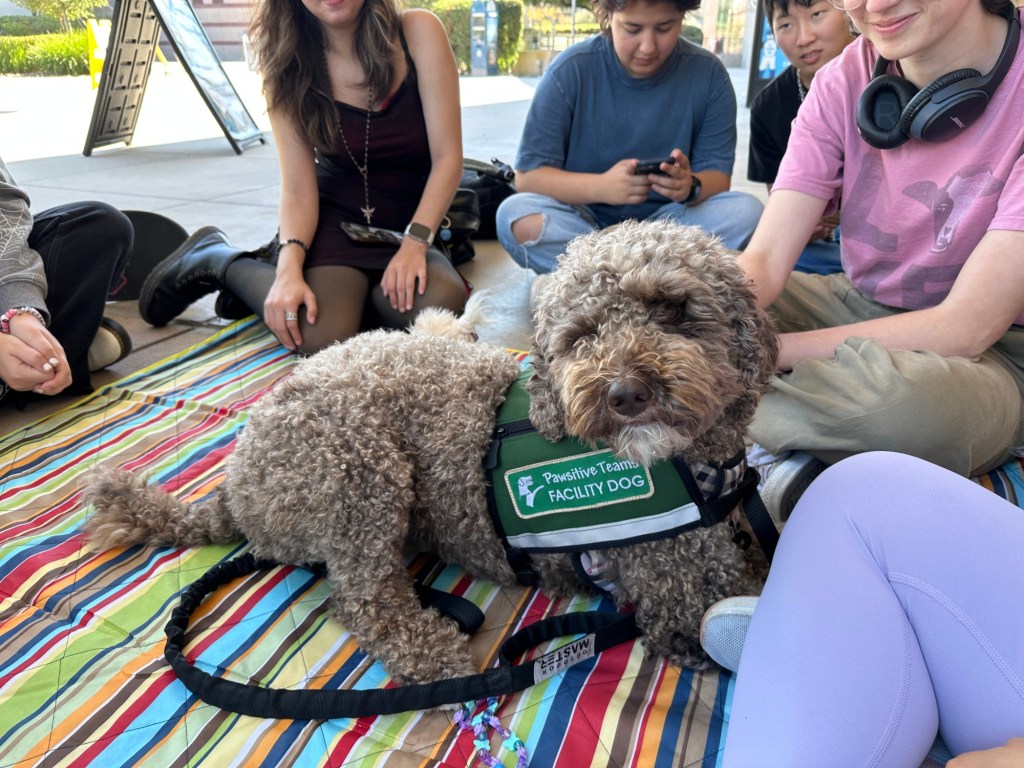
At California State University San Marcos, we decided to meet this challenge with a little creativity, and a lot of heart. Enter Frank, our first facility/therapy dog, a gentle Goldendoodle with a gift for connection. Frank joined our campus through the Cal State San Marcos Facility/Therapy Dog Program, a volunteer initiative I founded to support student mental health and well-being. What started as a vision to bring evidence-based, animal-assisted interventions into higher education has now become a model of compassion, inclusion and innovation.
The idea was born out of my earlier experience volunteering with therapy dogs at Rady Children’s Hospital, where I witnessed firsthand how a calm, friendly, trained dog could reduce anxiety, comfort families and create an atmosphere of healing. When I joined Cal State San Marcos as a lecturer in kinesiology and nutrition in 2012, I saw the same need among students, particularly after the pandemic, when isolation and anxiety became common barriers to success.
It took nearly a year of collaboration and careful planning to bring Frank’s program to life. From navigating risk management and insurance processes to developing safety and inclusion protocols, it was a true community effort. Thanks to the support of our administration, donors and dedicated campus partners — including the Center for Contemplative Practices, Cougar Care Network, Veterans Center, HOPE & Wellness Center, Athletics and Kellogg Library, the Cal State San Marcos Facility/Therapy Dog Program officially launched in 2024.
Frank is trained and certified as both a therapy dog and facility dog through Pawsitive Teams, a respected San Diego nonprofit that provides professionally trained service, facility and therapy dogs to support people and organizations across our region. Their rigorous certification process ensures that each dog-handler team meets high standards of safety, reliability and compassion, qualities that define Frank’s daily interactions on campus.
Frank’s weekly visits are now woven into the fabric of campus life. In his open-office hours three days per week (five-plus hours), you’ll find him greeting students at wellness pop-ups, joining mindfulness sessions, comforting students, faculty and staff in times of need, or providing quiet comfort. Each appearance sparks genuine smiles, laughter and moments of peace, the kind of human connection that can’t be replicated by any app or wellness campaign.
During spring 2025, Frank participated in more than 550 individual and group visits, and this fall, we’ve already surpassed 1,400 interactions across academic, athletic and wellness settings. While these numbers reflect reach, the real impact comes from the stories: the student who said Frank’s visits helped them feel safe enough to seek counseling; the veteran who hadn’t smiled in weeks until Frank sat beside them; the athlete who found calm before competition.
Research backs what we see every day. Studies show that interactions with therapy animals can reduce cortisol (a stress hormone), lower blood pressure, improve mood and enhance focus — all crucial for student success. Universities nationwide, including UC San Diego, UCLA and Harvard, have implemented therapy dog programs, but Cal State San Marcos’ approach is unique: Our program is fully volunteer-led and rooted in holistic wellness, integrating mindfulness, community engagement and mental health promotion across multiple departments.
As an educator, I’ve learned that learning cannot flourish without well-being. Frank’s presence reminds our students — and all of us — that compassion, connection and belonging are not extras; they are essentials. The Facility/Therapy Dog Program is more than a “feel-good” initiative. It’s a bridge between science and empathy, demonstrating how something as simple as a dog’s wagging tail can make a measurable difference in how students feel, connect and thrive.
San Diego has long been a hub for innovation in health, education and service. The Cal State San Marcos Facility/Therapy Dog Program is one small but mighty example of that spirit — rooted in research, powered by community, and led by one very good dog.
Sometimes, the path to healing doesn’t begin with words. It begins with a paw, a nudge and a reminder that we’re not alone.
Daly is a lecturer in the Department of Kinesiology and the program lead for the Facility/Therapy Dog Program at California State University San Marcos. She lives in Oceanside. Cal State San Marcos participates in a Giving Day campaign, on National Day of Giving, Dec. 2. To learn more, visit: connect.csusm.edu/g/giving-day-2025.