
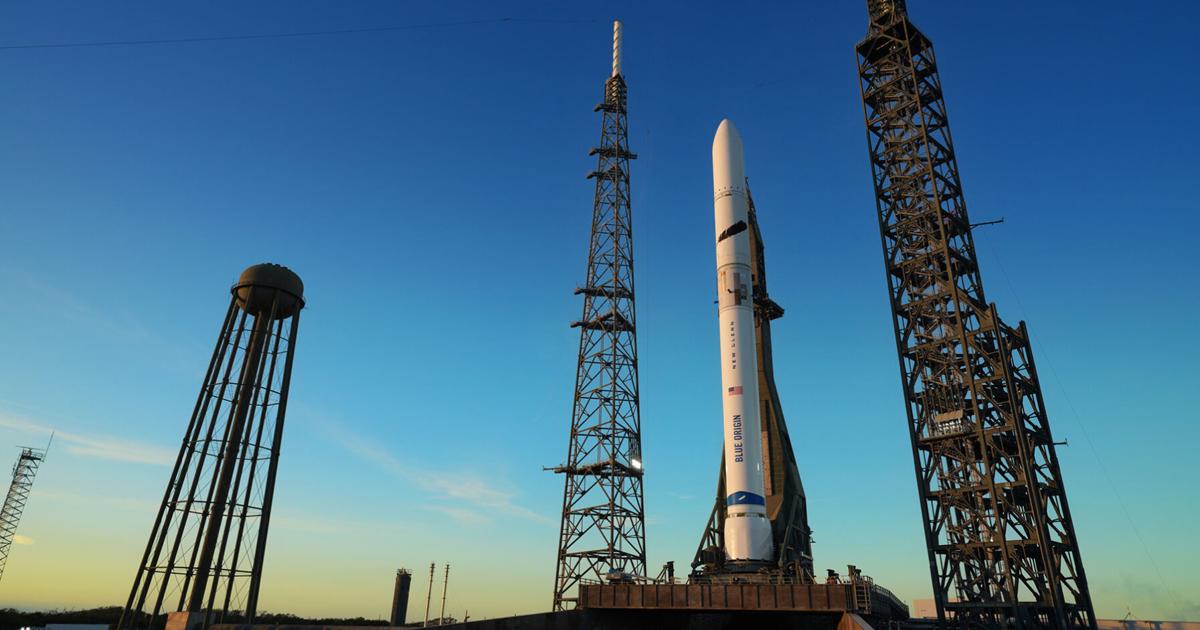
On Thursday 3:55 p.m. EST, NASA’s Escape and Plasma Acceleration and Dynamics Explorers, or ESCAPADE, mission, led by UC Berkeley researchers, lifted off from Cape Canaveral, Florida, en route to Mars. It is projected to arrive September 2027.
“We really really want to understand the interaction of the solar wind with Mars,” said ESCAPADE principal investigator Robert Lillis, associate director for planetary science at UC Berkeley. “We need to understand the space weather environment at Mars in order to better forecast space weather conditions that can cause hazards for future robotic and human explorers.”
According to Lillis, ESCAPADE launched outside the time window that all previous Mars missions had taken, which opens up every 26 months when Earth and Mars are aligned in orbit and closest to each other.
ESCAPADE’s unusual trajectory was intentionally chosen in order to test a novel approach, where the spacecraft waits in Earth’s orbit until the alignment point before actually heading to Mars.
“In the future, if we’d like to send hundreds of spacecraft at once (to Mars), it’d be difficult to do that from just the launchpads on Earth,” Lillis said. “But we could potentially queue up spacecraft with the approach ESCAPADE is pioneering. That’s exciting.”
Aboard the Blue Origin rocket are two satellites named Blue and Gold that were designed and built by Rocket Lab USA. They carry instruments invented by Florida’s Embry-Riddle Aeronautical University and the UC Berkeley Space Sciences Laboratory, or SSL. SSL is located in the hills above campus and is also where researchers will operate the instruments from.
Additionally, the mission included partnerships with NASA Goddard Space Flight Center and Advanced Space LLC.
“ESCAPADE is only about 1/10 of the typical cost of a NASA planetary mission,” Lillis said. “This is a radical experiment by NASA (to see) whether they can accept slightly higher risk and less oversight for lower cost. … It’s a pathfinder for a new way of doing space science missions … (with) significant savings for the taxpayer.”
While ESCAPADE was originally scheduled to launch Nov. 9, liftoff was canceled because of cloud conditions. The launch was then rescheduled to Nov. 12 but was canceled again because of geomagnetic storms that risked communications with mission control. The rocket successfully launched Nov. 13 to Mars.
The UC Berkeley instruments onboard include two electrostatic analyzers to measure particles that are escaping Mars, which NASA’s Mars Atmosphere and Volatile EvolutioN, or MAVEN, mission identified as how Mars’ atmosphere dissipated billions of years ago. More than half the instruments aboard MAVEN were built at UC Berkeley by SSL researchers.
“ESCAPADE is not the end of our journey to Mars, ” said Richard French, the Rocket Lab vice president of business development and strategy. “This mission is just the first step toward the Red Planet.”