
In his State of the City address 11 months ago, Mayor Todd Gloria said he would make creating middle-income housing a top priority this year.
About six months later, the issue gained renewed attention with a high-profile proposal for a different way to build homes for sale at prices affordable to people of modest means — a relatively barren area in the local real estate market between high-end homes and rentals.
Now the mayor said he hopes by the end of the year to launch a process to develop policies that encourage such housing.
“I’ve been working on a series of policy recommendations for the council’s consideration this year,” Gloria said in an interview last week. “I had hoped to release it sooner but a handful of issues popped up this year that were not on our radar and we needed to respond to. . . I would like to put something up for public review before the end of the year.”
He mentioned the City Council’s demand that San Diego’s permissive program allowing accessory dwelling units be reined in, which led to a complex reworking of that policy. He also noted the court ruling that struck down the voter-approved ballot measure to lift the 30-foot height limit in the Midway District threw a monkey wrench into plans to redevelop the city’s sports arena property and surrounding areas.
Life, as the saying goes, is what happens while you’re busy making other plans.
Regardless of whatever else has happened over many years, filling the elusive “missing middle” in housing has been a conundrum. That stretches back since before Gloria was elected mayor in 2020.
“When you look at it, what you see is a lot of market-rate housing and a fair amount of low-income housing — and really nothing in the middle and almost none of it for sale,” he said, adding that he has generally supported increased housing development at all levels.
Indeed, there has been a boomlet of apartment construction that experts say has helped stabilize rents after years of rapid increases. That’s a positive, though nobody would say rental housing on the whole is inexpensive in San Diego.
Meanwhile, San Diego home sale prices have flattened, but remain very high.
Gloria didn’t begin focusing on middle-income housing just this year. There have been a handful of moves in that direction during his administration. In 2021 there was the Neighborhood Homes for All of Us plan and the creation of the Middle-Income Housing Working Group. Last year, he launched the Small-Scale Neighborhood Homes Initiative.
In 2019, the council pursued a Middle-Income Density Bonus program. There have been other state and local programs with similar goals.
In the interview, the mayor was vague about where his next initiative is going, though it would seemingly build off of, or incorporate, the other efforts. He said the city can’t force people to sell rather than rent homes, but it can do things to encourage that.
“Before crafting specific policy proposals, we will conduct robust community and technical outreach this winter and present a policy package in the new year,” wrote Gloria spokesperson David Rolland, responding to follow-up emailed questions.
“. . . The goal remains to incentivize attainable for-sale housing types such as condominiums, townhomes, rowhomes, and community land trusts.”
Perhaps the most talked about idea in this realm recently is a proposal in June by housing advocates and development experts that the city do away with its minimum lot size of 5,000 square feet, a requirement across much of the city that has been on the books since 1923.
London Moeder Advisors, which assisted the group, provided research to show the feasibility of the proposal: cost plans for detached townhouses or two- to three-story single-family homes, tax benefits to the city and appealing to communities by offering a lighter form of density than larger apartment and condominium complexes, as Phillip Molnar of The San Diego Union-Tribune wrote.
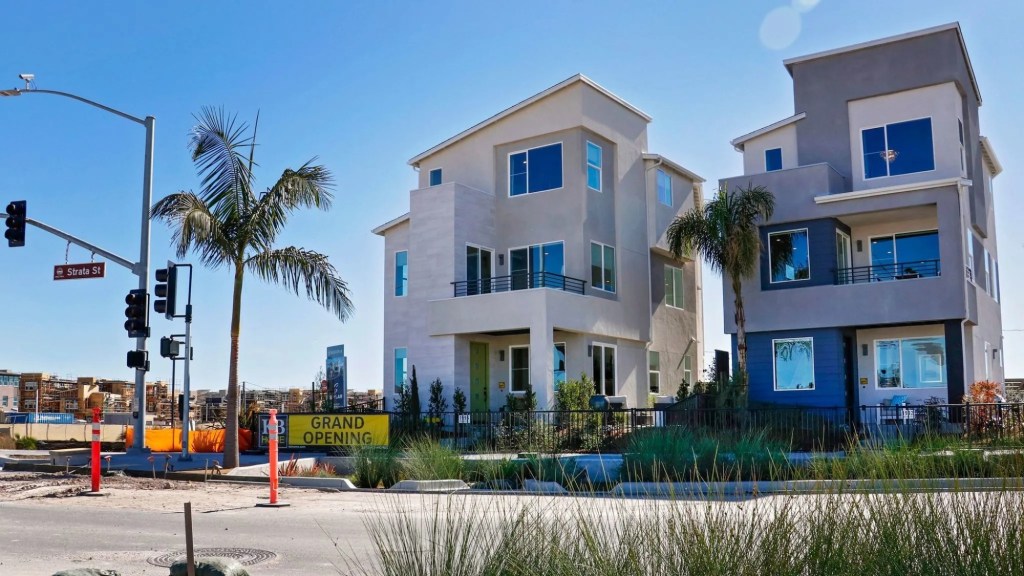
Their report said doing away with minimum lot size could reduce the price of housing by around 40 percent. They would be more vertical than traditional single-family homes with no yard space, and with three or four on the same lot.
Gloria generally had a positive view of the concept, but wouldn’t say whether it will be part of the emerging policies.
“I think this is one way to do it,” he said in the interview. “You would get homes that don’t look like your typical ’50s ranch-style house that are so common, like one I grew up in. It’s more of a rowhome, townhome kind of product that is actually perfect for first-time home ownership.”
The minimum lot-size proposal has some buzz going for it, though in October Gloria suggested during a conversation at the Politifest hosted by the Voice of San Diego that this approach should be somewhat limited, “close to transit, close to jobs, where there’s existing infrastructure. I think that’s where we need to focus.”
Whatever transpires, it would be a shock if there wasn’t some opposition. Almost anything that increases housing density has critics, particularly in single-family-home neighborhoods.
Gary London, the lead architect of the proposal, said he has been conversing with city officials and Gloria has planners working on the plan in “a very positive way.”
In an interview, London said he hoped the city would simply adopt the proposal “and just let it go and see what happens.”
Having said that, he expected some suggested changes that he hoped would be minimal, or at least not detrimental.
“There’s always a propensity of planners and (elected officials) to put requirements on,” he added. Insisting that guaranteed below market-rate homes be part of the equation likely would “kill the feasibility of the idea,” he added.
Critics of such conditions say the good intentions of requiring a certain number of units at below-market prices for lower income residents raise the cost of other units, sometimes putting those unrestricted homes out of range for prospective middle-income residents and making projects difficult to pencil out.
Gloria said the city needs to continue focusing on addressing homelessness and overall housing shortages. But he said for-sale market-rate homes are out of reach for too many people who may decide to live someplace where they aren’t, echoing a longtime regional concern.
“They’re not able to climb the housing ladder. That’s particularly true for anyone who wants to convert from a renter to an owner,” he said.
Gloria framed the problem as something of an existential crisis for the region. He talked about how San Diego is a “dynamic city” with a lot of good things happening and valuable people contributing to the local economy and society.
“Where I think that could be put at extreme risk is if those smart, hard-working people that make those businesses thrive decide they don’t see a future for themselves here and, generally speaking, I think how that would happen is because they can’t buy a home here,” he said.
“So we’ve got to figure this out.”