
What’s at stake?
The local bureaucracy in Fresno can feel like a “labyrinth” for residents to navigate, even the most civically engaged among them. But with help from a community organization breaking down how land use decision-making works in the city, one resident of the Homan Elementary neighborhood found a concrete way to fight for safer streets.
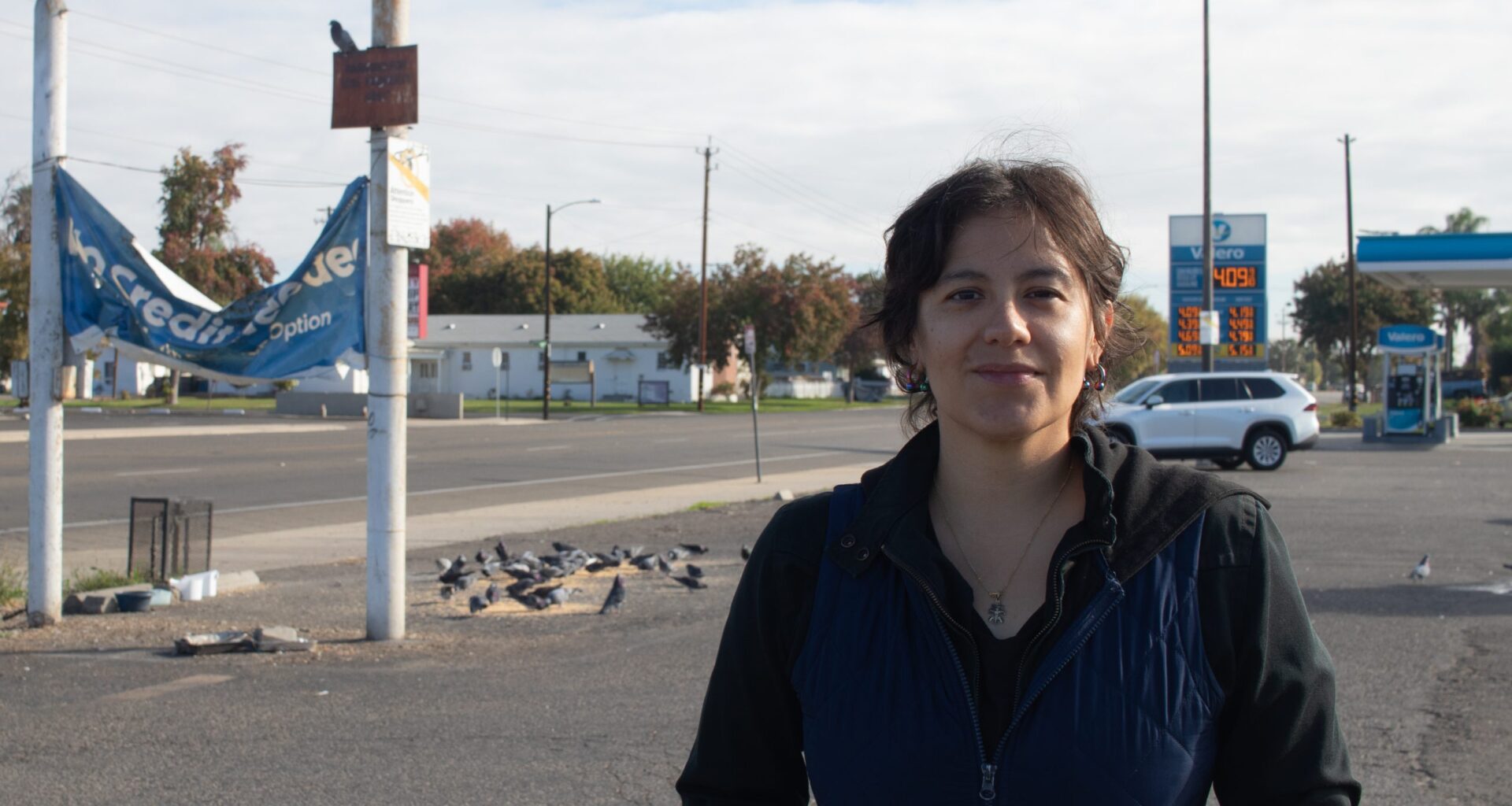
There’s a telephone pole at the intersection of Clinton and Warren Avenues in Fresno that Inez Zuniga can’t stop thinking about.
It’s easy to speed past it, and a lot of people do, Zuniga says.
But that intersection haunts Zuniga, who can’t drive down Clinton or Warren without thinking of the little boy who was hit and killed by drivers years ago at the location just minutes from Zuniga’s house.
A sixth grader at nearby Homan Elementary School was crossing the street one evening in October 2012 to meet his grandmother getting off the bus. That’s when two different cars struck and killed the 11-year-old. The telephone pole near that intersection was once decorated as a memorial to him.
“I think of him every time I drive by,” said Zuniga, who uses they/them pronouns. “I also think of the kids I see trying to use crosswalks on West Avenue while cars speed past them, often missing them by mere feet.”
Never miss the top stories in Fresno — sign up for our free, daily newsletter.
Pedestrian dangers threaten many of Fresno’s neighborhoods. But how do you tackle these in a city that’s been car-centric longer than residents like Zuniga have been alive?
A little over two years ago, Zuniga found a place to start: the Community Land Use Academy.
The Academy’s multiweek courses, run by Fresno nonprofit the Every Neighborhood Partnership, teach residents how to navigate the complicated channels of local bureaucracy to change their neighborhoods for the better.
No matter what’s happening in Sacramento or Washington, we will continue to do what we’ve always done: hold our local officials accountable and report the stories that shape daily life in Fresno.
Become a monthly member today during our crucial end-of-year campaign so that we can continue to tell hyperlocal stories you won’t find anywhere else. All donations are matched through December 31.
The courses specifically emphasize the importance of land-use decisions — like where cities allow parks, liquor stores, freeways, homes and other developments to be built — and how residents can take that power into their own hands.
“We go through a stem chart of what our local land use processes look like,” said Ivan Paz, project manager for the Community Land Use Academy, “with the city council, planning commission, and then the mayor and all of his departments.
“So they get familiar with that, and they realize: Okay, now I have a point of reference of where to start if I have a concern.”
For Zuniga, they came out of the course ready to take action to improve road safety in their neighborhood — specifically by campaigning for speed humps in front of their house on Harvard Avenue, across from Homan Elementary.
The speed humps, which the city installed after months of door-knocking and navigating bureaucratic forms from Zuniga, were one important step toward safer conditions for pedestrians.
But they hope to build on that success. And with their neighborhood’s proximity to the 99 and other busy roadways, there’s no shortage of next steps on the road safety front.
“I still have the addresses of all the people who we contacted,” Zuniga said.
“We have two schools,” including both Homan and Golden Charter Academy, they added, “so I think there’s a lot of potential to get some organizing going on around this neighborhood.”
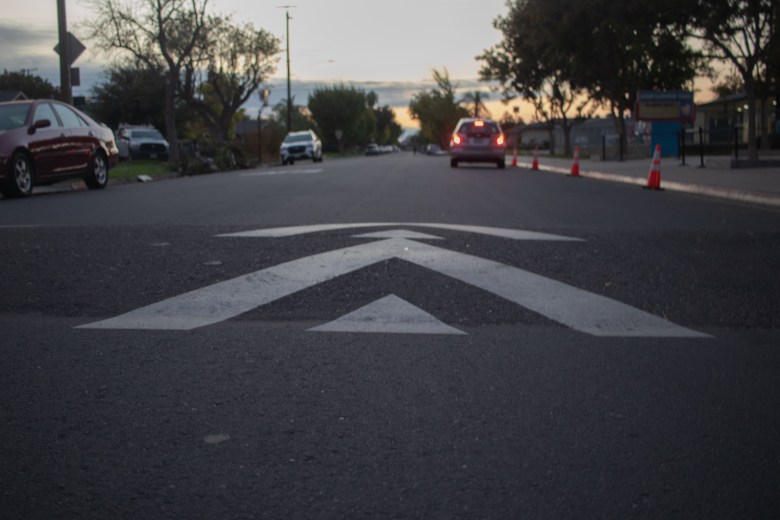 A resident of the Homan Elementary School neighborhood successfully campaigned for the city to install “speed humps” on Harvard Avenue, not far from where a student was killed crossing the street years ago. Julianna Morano | Fresnoland
What is the Community Land Use Academy?
Since its launch in 2023, the Community Land Use Academy has trained 11 cohorts and cumulatively over 100 residents.
The instructors lead eight-week bootcamps as well as 10-week, more in-depth “Planning & Development Academy.” They also offer the eight-week course entirely in Spanish and a three-week introductory session that’s online only.
On top of teaching enrollees how to navigate the city’s bureaucracy, some of the academy’s classes will walk residents through a real-world case study together, like how to address a vacant lot in a neighborhood, or how to push for better-connected bike lanes.
No matter what issue they’re looking at, everything Paz and his colleagues teach is through the lens of building on the existing strengths within a neighborhood.
“The solutions to a community’s problems are usually going to be found within the community,” Paz said. “That’s our philosophical starting point.”
Alumni of the program have taken what they’ve learned and used it to make changes to their neighborhoods, from fast-tracking the demolition of a blighted property in the Lowell area to adding much-needed green space near Webster Elementary School, according to Karl Gurney, who helps develop the Academy’s curriculum.
In the grand scheme of things, Paz and Gurney hope that helping residents push for better land use decisions can help solve more entrenched city issues, like crime.
“If you have an alley that connects to a liquor store, and then the streetlight goes out,” Paz said, “it’s going to attract the same type of crimes right there. Drug deals, fights, prostitution — things like that.
“If you advocate to get that light fixed, then it may not be the complete solution,” he added, “but it’ll reduce the amount of times that that type of crime happens.”
It’s all part of creating a neighborhood “that cares for itself,” he said.
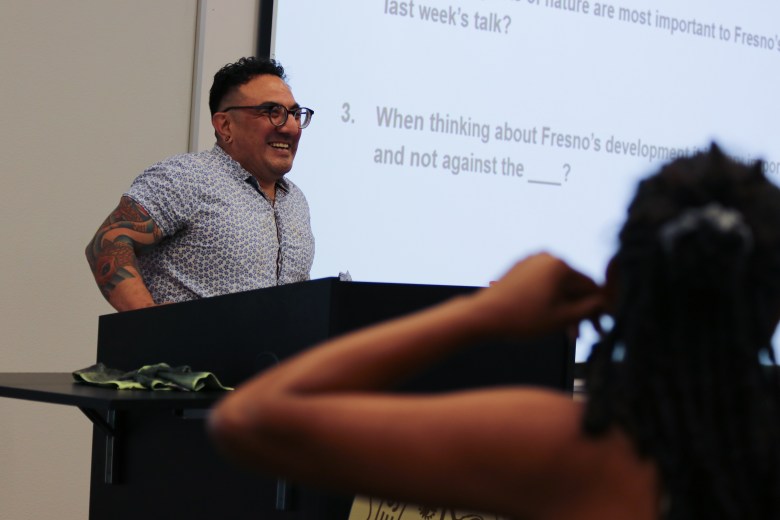 Ivan Paz, project manager for the Community Land Use Academy, pictured during a class session Wednesday, Sept. 17, 2025. Julianna Morano | Fresnoland
What’s next for Zuniga and the Homan neighborhood?
Zuniga enrolled in one of the first Community Land Use Academy cohorts.
Afterward, they found themself knocking on doors, not just collecting signatures but also connecting with more of their neighbors and discovering “new allies.”
As for whether there’s a difference in how people drive in the Homan neighborhood since the speed humps got installed in January of this year, Zuniga says “definitely.”
“I love when they’re driving too fast and their cars scrape,” they said. “That’s what you get.”
Although the speed humps were a win, Zuniga’s still worried about their neighborhood.
It’s not always a safe place to walk in, not just because of pedestrian danger.
Its proximity to the 99, a major north-south corridor for heavy duty trucks traversing the Golden State, and several unpaved diesel truck lots in the surrounding area leave it with abysmal air quality. It’s in the 96th percentile statewide in terms of the concentration of fine particulate matter, according to CalEnviroScreen.
Gas stations have also replaced some of the neighborhood’s much-needed third spaces — most recently, the Lucky’s Donut House on Shields and West avenues — and threaten to add to existing pollution from cars and trucks.
The consequences of those patterns of freeway and business development in their neighborhood are deeply personal for Zuniga.
Their mother is diabetic, and Zuniga is taking time off work to take care of her after a series of surgeries to prepare for dialysis. Zuniga said they see their mother and other family members’ struggle with diet-related illnesses “as a direct reflection of our environment.”
“People like to talk about personal responsibility,” they said, “but how much of that really matters when your neighborhood is filled with fast food, polluted air, and no safe place to walk?”
They envision a neighborhood where someday everyone can feel safe taking a walk outside for some exercise — and breathing the air outside when they do.
To that end, they’ve thought about trying to get mini roundabouts installed at more of the residential intersections around Homan. They’re also dreaming of a community garden.
But none of this is their full-time job. It’s going to take time.
“I don’t consider myself an activist, or anything like that. It’s just, I do what I can, when I can,” Zuniga said, “and when I find out.
“Being civically engaged is hard. It’s ‘work on top of work,’” they added, “and navigating the local bureaucracy often feels like a labyrinth.
“But I don’t want to see another memorial for a pedestrian on a telephone pole.”
How to join CLUA?
The Community Land Use Academy’s courses are free.
The instructors just wrapped up their most recent 10-week course earlier this month.
People interested in enrolling in a future course can fill out this online interest form, which is written in both English and Spanish.
Paz, the CLUA project manager, also encourages interested applicants to contact him via email at ivan@everyneighborhood.org.
Do you value Fresnoland’s coverage?
Every week we bring you deeply reported stories about the essential issues facing our region. Help us continue our work by becoming a monthly sustainer today.
Related