
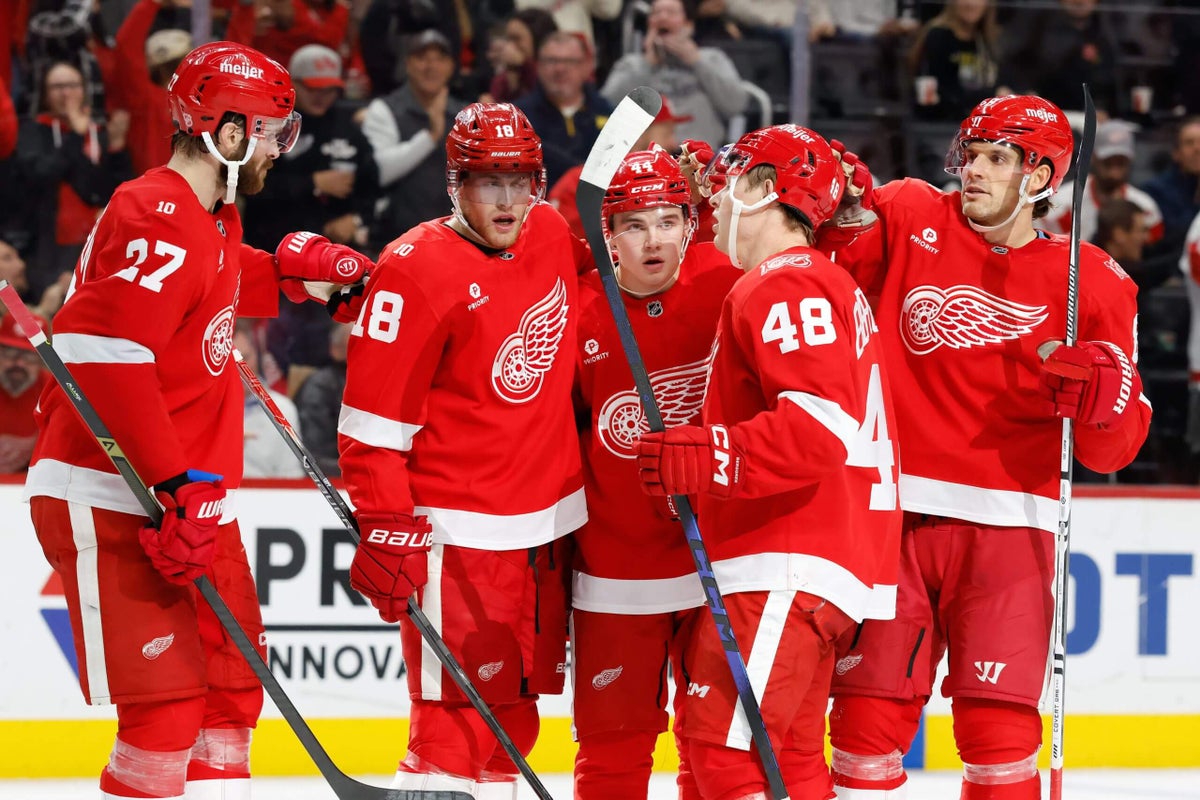
DETROIT — The Detroit Red Wings needed goal scoring. Any goal scoring.
After two combined goals in their previous three games (all losses), that was the clear objective for Detroit this week. With two full practice days before a Thursday night showdown against the high-flying Anaheim Ducks, the Red Wings reworked their lines. They (briefly) changed their power-play units. They emphasized getting traffic to the net.
And the result was as good as they could have hoped for: Detroit broke through its funk with a six-goal showing that featured just about every kind of goal a team can score in a 6-3 win over the Ducks.
The Red Wings scored on the rush. They scored through screens and on tips. They scored on the power play. They even tacked on an empty-netter, for good measure.
“If you’re in a race to three — which I think we are every night; we’ve discussed that before — you better have the ability to score in multiple ways,” coach Todd McLellan said. “Cycle, power play, shootouts, overtime, five-on-five, tips, deflections, screens. If you’re just a rush, two-on-one team, you’re going to have some long nights.”
The Red Wings needed a game like this, and Thursday, they got it. Here’s what stood out.
1. The variety of offense was certainly a big deal. But it was the traffic at the net that defined the night for Detroit. It had to be nice to see for McLellan, after emphasizing it so significantly throughout the week of practice.
The Red Wings’ first goal came off a Moritz Seider point shot, but it was really Alex DeBrincat’s flash screen to take away the eyes of Ducks goaltender Lukáš Dostál that made the play. It was the same story on their third goal, this time with Andrew Copp screening Dostal and Axel Sandin-Pellikka on the point shot.
Detroit’s fourth tally came off another Seider shot, this one a redirect at the net by DeBrincat, and it could easily have been redirected by Dylan Larkin in the slot as well.
Cat on the power play + Kaner’s 1350th career point. #LGRW pic.twitter.com/Jhmto9Hzys
— Detroit Red Wings (@DetroitRedWings) November 14, 2025
“That was a big point we talked about leading up to this game, and obviously, it’s fun to see when results are happening,” Seider said. “I’ve just got to put it in the right spots for the guys, and they have obviously tremendous talent to deflect those pucks and make it really hard for the opponent and the goaltender, and that’s what happened tonight.”
Rush offense hasn’t been a problem for the Red Wings in recent years — really, since DeBrincat’s arrival in 2023. But heavier (and, yes, uglier) offense has eluded them at times in recent seasons.
Some of that can be attributed to the smaller personnel in Detroit’s top six, but at the same time, DeBrincat — Detroit’s smallest player — was at the net twice Thursday, leading to two goals. It’s not always just about size, with timing and tactics every bit as important.
Obviously, the Red Wings would have preferred not to go so quiet over the previous week. But sometimes a dry spell can force teams to get back to the basics in looking for those simpler goals.
“Every team goes through one of these stretches,” Copp said earlier this week, “and I think we’re trying to get back to simple and not rely so much on our rush game. Because our rush game is good, but especially as you get later in the year, that can kind of get taken away quickly. So we’ve got to find a little bit of five-on-five offense, and a lot of the times, that’s from D getting pucks through to the net, forwards getting around the net, and just the general compete level to put some of those pucks home.”
That all came to fruition Thursday, which is a great sign.
2. As pleased as McLellan had to be, his focus immediately went to keeping that progress and not letting it slip away. As much as the net presence showed up Thursday, having it consistently is another matter that will likely require repeated attention.
“It is rewarding, but we can’t just take the lesson one day and forget about it next week,” McLellan said. “That lesson’s supposed to stay with us now.”
Still, you have to give the Red Wings credit for how quickly and thoroughly they responded to the emphasis from their head coach. And it’s not the first time that’s been the case this season.
A couple of weeks ago, Detroit spent two consecutive practices working on its defensive tracks and coverages before a five-game trip. It went on to have one of its better defensive showings of the season the next game in St. Louis (and again for 57 minutes in Los Angeles).
With the compressed NHL schedule this season due to the Olympics, it’s somewhat rare to have consecutive practice days, but McLellan and the Red Wings have gotten good results when they’ve had that chance.
3. There was one change McLellan made this week that lasted less than one period: the reworked power-play units.
After Detroit had gone flat with the man advantage of late, the head coach shook up the units somewhat dramatically coming into Thursday’s game.
But when a four-on-four expired and became a Red Wings power play late in the first, McLellan put the old first unit (with Seider, DeBrincat, Larkin, Lucas Raymond and Patrick Kane) out there.
“We’re going into the break, players are fresh, we put them back together,” McLellan said. “It looked dangerous then, so we decided to stay with it.”
And when Detroit got a power play early in the second period, it was that familiar top unit that capitalized quickly with Seider’s shot from the point. That same unit was on the ice when DeBrincat’s redirect added another power-play tally.
I’m not saying putting the group back together that quickly was the plan all along, but it’s hard to imagine Detroit wouldn’t have gone back to its usual top unit sooner or later with how good it was last year. Even if the power play had been struggling, that collection of players has shown too much together to abandon.
So whether it was a wake-up call that went according to plan or something else, it was nonetheless significant to see that unit get back on track.
4. Typically, Michael Rasmussen would be one of the players you’d look to for a screen or redirect, standing 6-foot-6 and able to get to the middle of the ice.
But it was actually a rush play that headlined his night, scoring one of the prettiest goals of his career after making a nice move on Ducks defender Jackson LaCombe and then sniping the top right corner.
Big Ras picks the corner. #LGRW pic.twitter.com/GsIP0Dko8Q
— Detroit Red Wings (@DetroitRedWings) November 14, 2025
“I thought Ras played his best game of the season today,” McLellan said. “For a lot of different reasons. One, the goal. But he looked confident, he looked big, strong, held on to pucks, was physical. So for him, that’s a real big confidence-booster. We’re happy for him. We’re glad that he did that. And we need that going forward, night after night, because he can play that way. He’s a pretty effective player when he does.”
5. Two storylines to watch coming out of Thursday: John Gibson and Sandin-Pellikka.
Gibson left the game after the second period and did not return. McLellan said it was an “upper-body issue” and that Gibson would be evaluated Thursday night. He also said he didn’t know when Gibson got hurt. The goaltender was knocked down at one point in the second period, but it’s unclear if that was the impetus.
Sandin-Pellikka, meanwhile, didn’t play in the final 15:56, which McLellan said was a coach’s decision. He was on the ice for one goal against (in which he was the lone defender back on a two-on-one) and logged 13:43 in total.
We’ll see if McLellan says anything more in the days to come, but after a season-low ice time, it’ll be interesting to see how Detroit proceeds. It could just be a one-game accountability measure that will be quickly forgotten. But it’s worth noting the Red Wings sent fellow rookie Michael Brandsegg-Nygård to AHL Grand Rapids after he opened the season in Detroit and could consider doing the same with Sandin-Pellikka if they believe it’s best for him and his development.
I don’t know which way this one will go, but it’s something to monitor.