
Despite opposition from Merced leaders, the head of California’s High-Speed Rail Authority says he will “of course” try to change state law so he can use money to build more profitable routes outside the required Merced-to-Bakersfield connection.
Rail Authority CEO Ian Choudri says being allowed to start building those routes, such as Madera-to-Gilroy, would help him more easily secure private investment to speed the project along. The current law, called SB 198, caps the agency’s spending at $500 million on work outside the Merced-to-Bakersfield route.
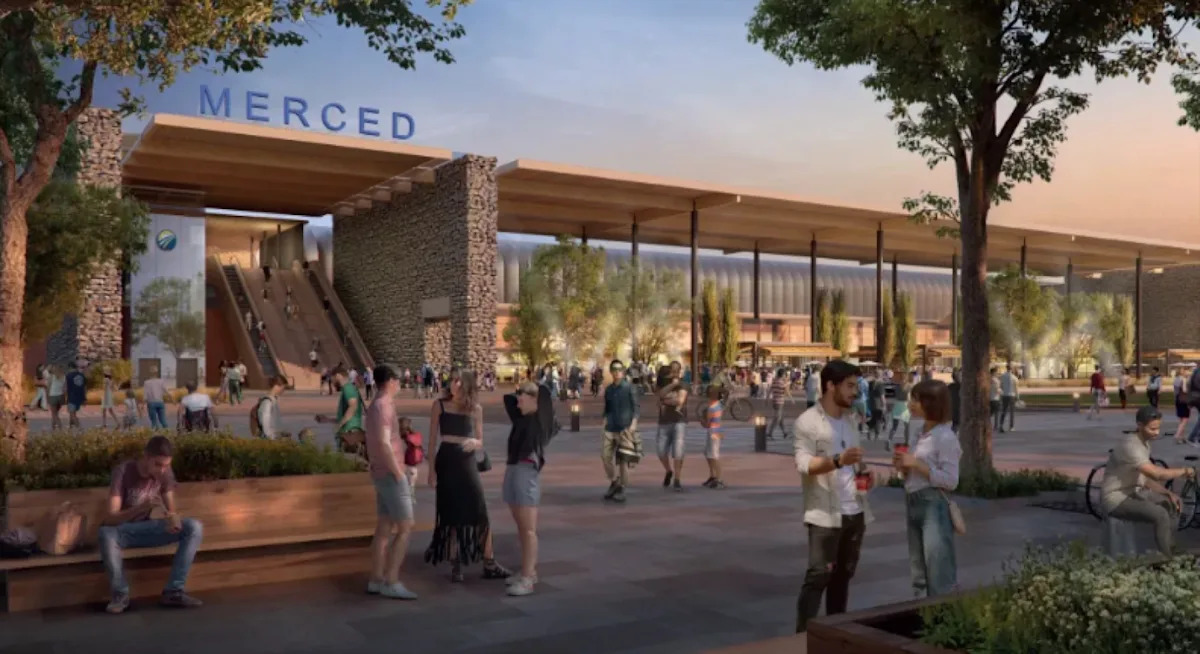
The agency first pitched dropping the rule in an August report that said it makes financial sense to delay rail construction to Merced in favor of first connecting Madera to Gilroy. The idea troubled Merced officials and business owners who say they’ve spent years planning for a downtown station that’s part of the train’s initial segment.
Choudri says the agency could secure a partnership with private firms by the middle of next year, but investors are likely to want to focus on rail segments with greater ridership predictions than Merced-Bakersfield.
“If you want innovation and to generate revenues out of the system, then they (the private sector) will have creative ideas,” Choudri said. “SB 198 stands right in the way of that.”
Changing SB 198, approved by the Legislature in 2022, does not mean the train will skip Merced. A Merced station is required by the 2008 bond measure that officially authorized the project via California voters’ approval.
It’s not yet clear how the rail authority will propose that the Legislature change the current law. In its August report, the agency said state lawmakers could “remove or adjust” the spending cap on work outside the Central Valley.
Merced Mayor Matthew Serratto told The Bee that removing the spending cap would be “a hard one for us to support.”
“Keeping Merced in the early operating segment is 100% a hill to die on for us,” he said.
Over the past year, the rail authority has pitched various changes intended to cut costs and speed up construction while battling the Trump administration in court for $4 billion it pulled from the project. The agency in September secured $20 billion from the state’s Cap-and-Invest program through 2045, which will be doled out at $1 billion per year.
The state guarantee provides security to private investors who could use their own money to build segments of the train in exchange for a percentage of future revenues. As Choudri works to get private investors on board with a financing plan, he said it doesn’t make sense to tell investors they can only build between Merced and Bakersfield.
“If you tell them, ‘Hey, just build this and don’t do more,’ they’re going to simply say, ‘Well, you’re kind of just borrowing money at that point, and you can go to a bank to do that,’” Choudri told The Bee.

High-Speed Rail CEO Ian Choudri speaks during a meeting hosted by the Maddy Institute in front of an audience at the Kodiak Club at Chukchansi Park in Fresno on Wednesday, Nov. 5, 2025. CRAIG KOHLRUSS
CEO says high-speed rail needs to be built in ‘right order’
The rail authority expects that the Merced-to-Bakersfield segment, projected to cost $36.75 billion to build, will operate at a loss.
The most affordable initial segment scenario that yields a profit is a Gilroy-to-Bakersfield route that bypasses Merced, which would cost about $54 billion to build, according to the agency’s August report.
When The Bee asked Choudri how he’d explain to people in Merced they might have to wait, he said he also has to explain to millions of people in the Bay Area and Los Angeles that they have to wait.
“We are not trying to convince anybody that we’re not going to Merced,” Choudri said. “We can get it done, but everything needs to be sequenced in the right order.”
He said that, if the state provides an even stronger financial commitment, private investors might be able to build multiple segments simultaneously, including Merced.
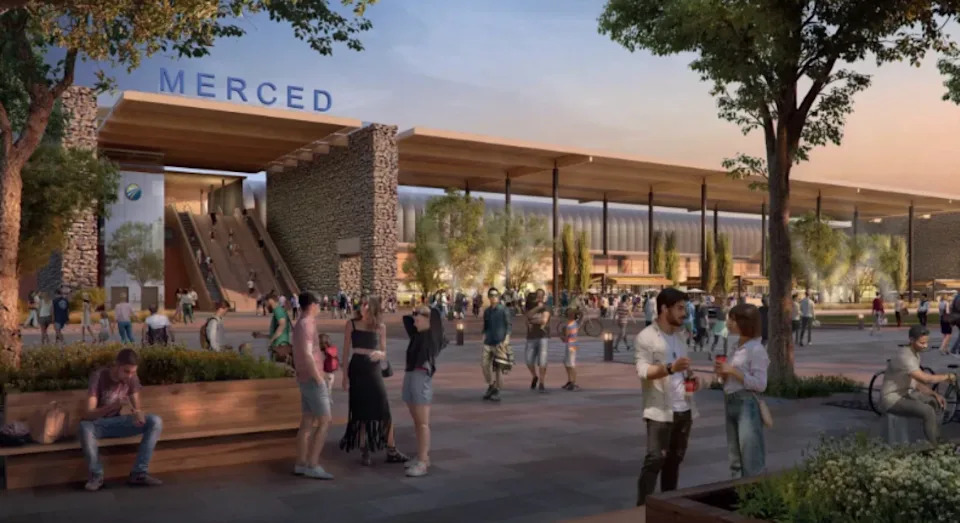
A drawing shows the proposed downtown Merced station for the California High-Speed Rail. California High-Speed Rail Authority