
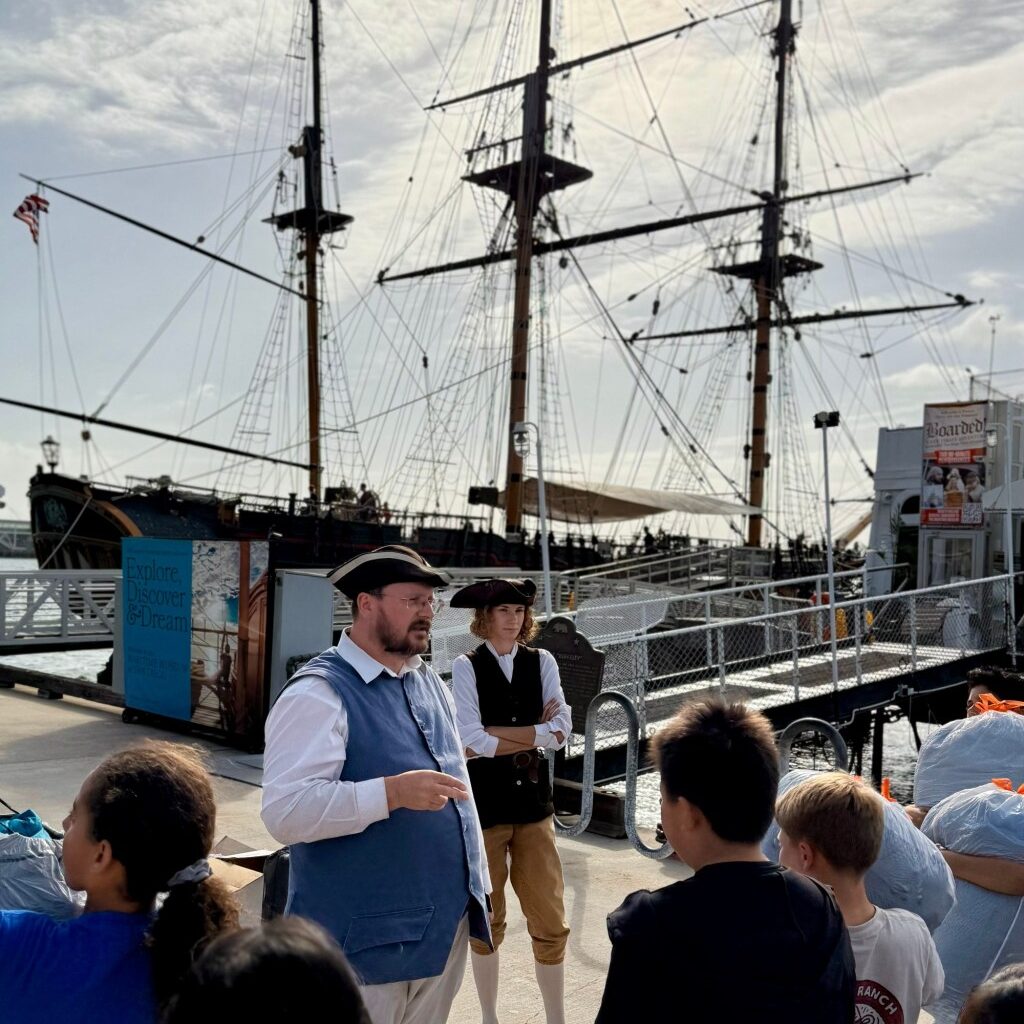
Students practice furling and unfurling the sail.
(Courtesy of Solana Beach School District)
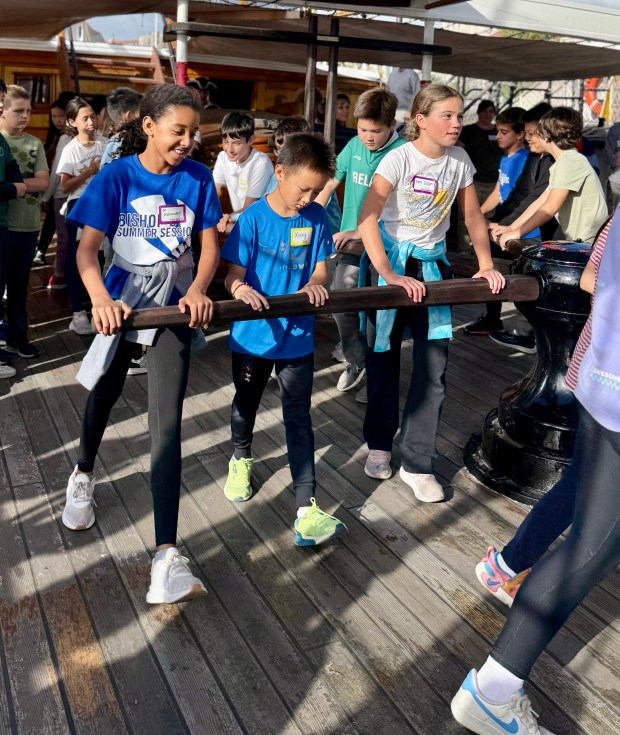
Solana Ranch students turning the capstan.
(Courtesy of Solana Beach School District)
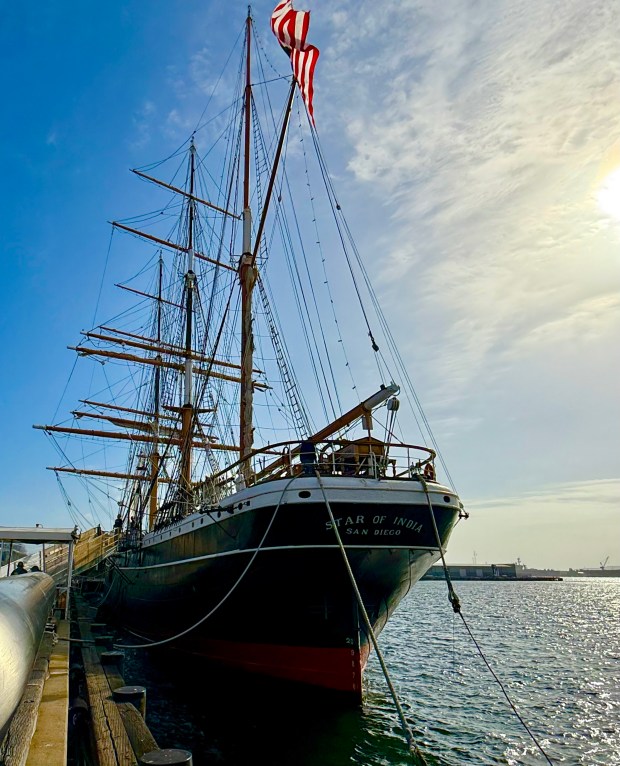
Star of India ship
(Courtesy of Solana Beach School District)
Show Caption
1 of 3
Students practice furling and unfurling the sail.
(Courtesy of Solana Beach School District)
The place is Boston Harbor, and the year is 1774, just after the Boston Tea Party. Your job as colonial sailors forced into service by the British is to serve on a merchant sailing ship.
Your ship carries salt cod from the colonies to trade for molasses in the Caribbean. The molasses is brought back to the colonies where it will be sold to distillers who refine it into rum which is then transported to England.
The ship is participating in one version of what’s known as the Triangular Trade.
But all is not well among the ship’s crew. The sailors witness dissension among the captain, first mate and second mate, who each have strong opinions on the burgeoning uprising in the colonies for independence from British rule and how best to make a profit in troubling times.
The captain is staunchly loyal to the British king, while the first mate sides with patriots who want freedom from British oppression. The second mate, though, is more focused on monetary aspects and how to maximize profits which might mean smuggling illicit goods. All three try to win the pressed sailors to their sides.
As a lowly sailor, what do you do when you learn that the second mate has stashed contraband aboard ship? Do you follow the first mate who embraces the colonialists’ desire for independence? Do you report these near-mutinous activities to the captain who is allied with the British?
Living History programs
The Maritime Museum of San Diego (MMSD) offers three remarkable Living History programs for elementary-age students that immerse them in simulations aligned with appropriate California state standards for social studies and history, all experienced on board the renowned Star of India tall ship docked in San Diego harbor at the MMSD.
Last month, fifth-grade students from Solana Beach School District’s Solana Ranch School participated in MMSD’s “Prelude to the American Revolution” program, stepping back in time for “hands-on learning and leadership challenges during this memorable living history simulation aboard San Diego’s iconic Star of India,” as described by SBSD.
“The California history and social science curriculum for fifth-grade students,” according to the district, “focuses on the political, religious, social and economic institutions that evolved in the colonial era as causes of the American revolution,” a focus brought to life through the Star of India program.
The other two MMSD programs are the California Gold Rush which is aligned with fourth-grade standards and the Voyage of Hope program which concentrates on the Star of India’s past as an emigrant ship.
“All these programs combine kinesthetic maritime-based activities, critical thinking and elements of theatrical role-play,” said Peter DiSimone, director of education for the MMSD, which has offered Living History programs for over 30 years with more than 10,000 students attending each school year.
“Prelude to the American Revolution” takes fifth-grade students into pre-revolutionary America through the eyes of the Maritime experience, with crew members dressed in period attire who represent differing political and economic viewpoints prominent at the time.
The purpose is for students to gain realistic understanding of complicated and competing perspectives centering on the events leading up to the American revolution. They also experience tasks that sailors at the time were required to know – such as navigation, mapping, astronomy, line-handling, knot-making, rigging, raising the sails, night watch, artillery lessons, safety precautions and galley work.
Rat stew
After the students’ gear was stowed, the first, second, third and fourth mates introduced themselves and explained their roles. This was followed by the cook, an indentured servant, who said the meal for the evening was the captain’s favorite: rat stew … eliciting lots of “ews” from the new recruits.
To warm up the sailors, the first mate led them in singing Yankee Doodle and Drunken Sailor. He then explained some basic deckhand rules and common nautical terms. Making conditions more real, he warned them that burial at sea was a consequence of touching without authorization any of the 192 lines on the ship.
The student sailors then separated into various rotations to learn the skills needed to operate a merchant ship. In the process, they heard differing perspectives on conditions at the time, and how British policies and specific acts led up to the American revolution.
By gaining first-hand knowledge (albeit simulated) of the Triangular Trade, the students could see how it generated wealth for the British and hindered economic development in the colonies. They could better understand why unfair British trading policies exploited the colonies and inspired resistance to British rule.
One of the more authentic aspects of the program is staying overnight aboard the Star of India, which DiSimone said “stays dockside as the students embark on an educational voyage of the imagination.”
Originally named Euterpe, the Star of India is an iron-hulled sailing ship built in 1863 that completed 21 round-the-world trips before being sold in 1926 to the Zoological Society of San Diego.
As the world’s oldest active sailing ship, the Star of India is still seaworthy and sails regularly. According to Wikipedia, the ship’s hull, cabins and equipment are nearly 100% original.
The ship is housed today at the MMSD, a nonprofit organization that invites visitors to experience 500 years of seafaring history.
Excited about learning
Solana Beach School District Superintendent Jennifer Burks said SBSD students have participated for many years in the program which provides “enrichment and experiences for our students by bringing history and learning to life.”
“It ties in with our mission and vision of inspiring wonder and discovery,” she said, calling it authentic learning and a way to spark curiosity.
“Those are the experiences we want kids to have,” she said, “to get excited about their learning and see it in a different way than what they’re seeing in a textbook.”
Solana Ranch Assistant Principal Tiffany Farnsworth said the Star of India experience is a highlight of learning for fifth-grade students. They become engaged in learning about experiences of mariners, conditions at the time and the opinions of people leading up to the Revolutionary War, she said.
“It’s role-playing not only by the leads but also by the children,” Farnsworth said. “Simulation is a well-researched way for children to codify their learning.”
California history standards for fifth grade include teaching about the 13 colonies, about the people who came and who were here, how they interacted, and the effects of commerce.
“Because of the long geographical coast line, shipping was a big part of the history of the United States,” Farnsworth said.
Relevant to today’s world where controversial viewpoints are heatedly debated, she said the program’s purpose is to teach foundational content knowledge and critical thinking skills “so they can make their own decisions as they grow up.”
Lived experiences
“Any time we can bring learning to life, it’s more impactful and it really elevates the student experience which is a focused part of the Solana Beach School District,” said Solana Ranch Principal Angela Tremble.
“It’s memorable for students. It’s something they come back to years later. It’s a social experience too, so they are learning together.”
Classroom activities after the program ask students to integrate what they’ve read, learned and experienced on the ship.
Teachers reviewing the program with students this year said it gave them “multiple perspectives of the political climate of the time and an opportunity to express their own choice. Simultaneously, they were learning what life was like as a sailor in 1774.”
Also, “They basically understand how good it is to live in America but they also learned that there are many perspectives to understand.”
SBSD fifth-grade teacher Nora Guseman said the Maritime Museum program offers “authentic hands-on learning that transforms textbook lessons into lived experiences, inspiring curiosity and discovery … strengthening collaboration, empathy and critical thinking.”
Because fifth-grade standards focus on the Age of Exploration and the American revolution, Guseman said “Prelude to the American Revolution” supplements and enriches the curriculum and generates “thoughtful reflection about history and its relevance today.”
When students experience this historical simulation aboard the Star of India, “they remember it for a lifetime,” Guseman said. “We are grateful to have this floating piece of history to help us learn, connect and imagine.”
250 years of freedom
As we approach the 250th anniversary of the founding of our nation next year, teaching children the foundations of this great American experiment in democracy is paramount.
Programs that immerse students in forms of project-based learning and live action role play (LARP) add another dimension to learning that can be deeper in ways beyond words read in a textbook.
The Maritime Museum’s Living History programs offer invaluable ways to make history come alive. These programs allow participants to understand more viscerally that real people did this and lived those lives, facing serious hardships and difficult conditions hard to imagine today.
We need to teach young people about the remarkable wisdom of our country’s founders who, despite differing political and experiential perspectives, came together to compromise and collaborate, resulting in the creation of astonishing documents that guaranteed the freedoms and liberties we now enjoy – which today some say we take for granted.
To help ensure that young people grow up to be informed, thoughtful citizens, comprehensive and engaging civics and American history education is vital to secure our country’s fundamental liberties for the future.
Marsha Sutton is an education writer and opinion columnist and can be reached at suttonmarsha@gmail.com.
Marsha Sutton is a columnist and presents her opinion. Column: Combines reporting, storytelling and commentary to make a point. Unlike reporters, columnists are allowed to include their opinions.