
Emily Leach is an assistant opinion editor of the Daily Titan. All opinions expressed in this article are those of the author and do not reflect the opinions of the Daily Titan as a whole.
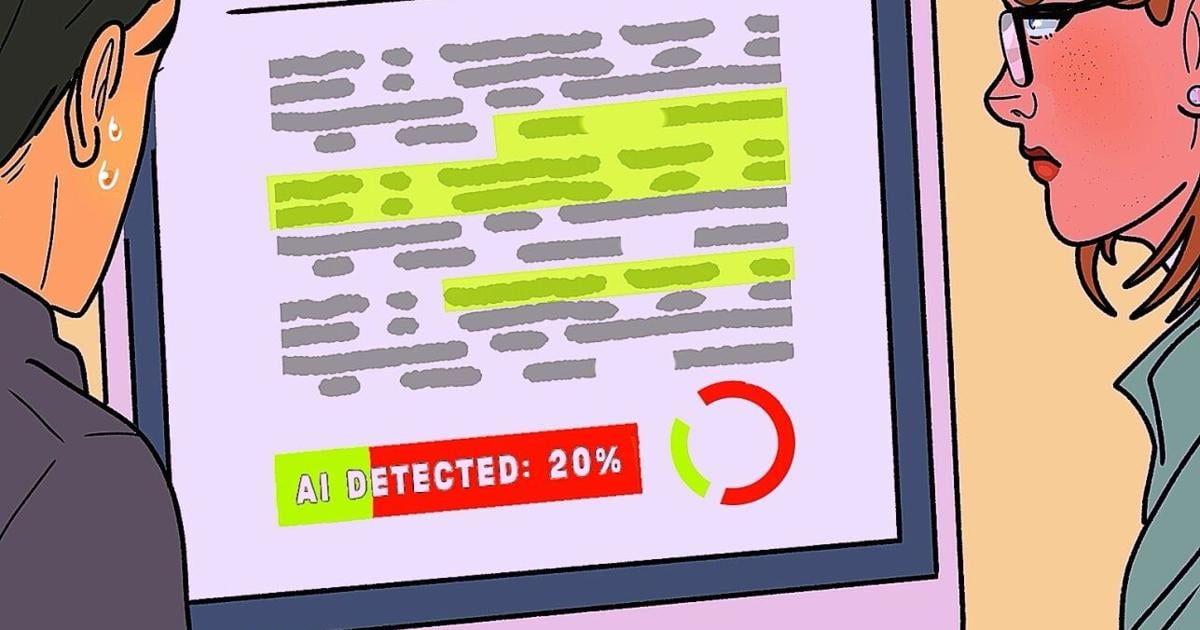
With the rise of artificial intelligence in the classroom, many “Artificial Intelligence-detection tools” have emerged to combat AI-generated writing. These tools utilize an artificial intelligence model that uses linguistic techniques and pattern recognition to predict whether a piece of work was completed using generative AI.
Though theoretically beneficial, AI check tools have proven to be largely unreliable, with concerning levels of inaccuracies prevalent in their algorithms. Using AI models to detect its own existence in student writing is not only ironic but counterproductive.
With student-teacher distrust already on the rise, it is pertinent that instructors combat AI in the classroom humanistically, prioritizing trust in their students’ integrity before trusting another form of generative technology.
False positives are the biggest concern regarding the reliability of detection tools. Turnitin, a popular plagiarism scanner, claims that its AI detection tool can miss up to 15 percent of AI-generated text, but has a false-positive rate of only one percent. However, studies testing the accuracy of these detection models suggest that these rates may be higher than companies report.
Washington Post’s Geoffrey Fowler used 16 different essays, including fully AI-written, fully student-written, and mixed writings, to test Turnitin’s AI detection software. Out of the 16 writings, Turnitin’s algorithm was only fully correct in identifying six of the pieces as AI-generated, and incorrectly labeled a student-written body of work as eight percent AI.
Research like Fowler’s provides a clear example of the ultimate fear that comes with the use of AI detectors: the increased likelihood of well-written student assignments being flagged as AI.
Olivia Barber, a second-year Psychology major, expressed her concern that good writing will soon be synonymous with AI.
“The use of AI detection software can corrupt the perspective that professors have of our work, because you can run a totally original essay through an AI detection software, and it’ll come out to twenty percent, and that’s just the baseline for running an essay through AI detection software,” Barber said. “It almost deprives the essay of the full scope of originality.”
False negatives, where AI is mislabeled as human-written, are another indicator of the unreliability of detection tools. A study conducted by the University of Maryland found that the detection of AI writing could be easily bypassed by rephrasing the generated content.
If students can effectively paraphrase a way out of this discerning software, then using detection intelligence models becomes useless. With the high unreliability of these tools, professors run the risk of either falsely accusing their students of academic dishonesty, which could taint their reputation as instructors, or failing in their efforts to combat the rise of AI if its use cannot be consistently identified.
Jon Bruschke, a Cal State Fullerton human communications professor and the department chair, expressed the importance of AI detection technology being on par with generative AI technology.
“Given the nature of AI technology, it has to be the case that the detectors can keep up with the illegitimate use of AI,” Bruschke said. “And if that’s not the case, we are all doomed.”
Another concern with the rise of these tools is the potential for biases in their intelligence models. When searching for the use of artificial intelligence in writing, detection tools were found to be more likely to flag writing by non-native English students as being AI-generated.
Stanford researchers found that while AI detectors had a high accuracy rate in essays written by native English-speaking eighth graders, they flagged 61.22% of essays written by non-native English speakers as AI.
“The danger of AI technology in exacerbating social inequalities is massive, real and important,” Bruschke said. “I am not unconcerned about AI detectors flagging certain styles of writing more than others… but I’m way more worried about AI doing that in the first place.”
Biases in detection software pose a risk that non-English speaking students may be disproportionately accused of academic dishonesty, which can be detrimental to their academic careers. For students at CSUF, being found academically dishonest can result in consequences varying from receiving a failing grade in a course to being disenrolled from the university.
AI cannot effectively combat its own technology. Detection tools for AI are too unreliable to be trusted by students and instructors, which ultimately increases stress and tension regarding AI in the classroom.
“When you’re scared of getting accused of using AI, you’re more paranoid about your essays, you’re less likely to go to a professor for help,” Barber said. “You’re less likely to write in your own writing voice because you’re afraid it’ll sound like AI.”
In this unprecedented era of technology, making hasty accusations of academic dishonesty based on disreputable detection models may further the divide between students and teachers, ultimately tarnishing the reputation of modern academia as a whole.
If AI detectors are unable to detect their own linguistic patterns, ultimately threatening student integrity, then the purpose of these detection systems becomes obsolete. Instructors utilizing unreliable technology, which they are actively attempting to combat, counteract the goal of reducing the use of artificial intelligence in education.