
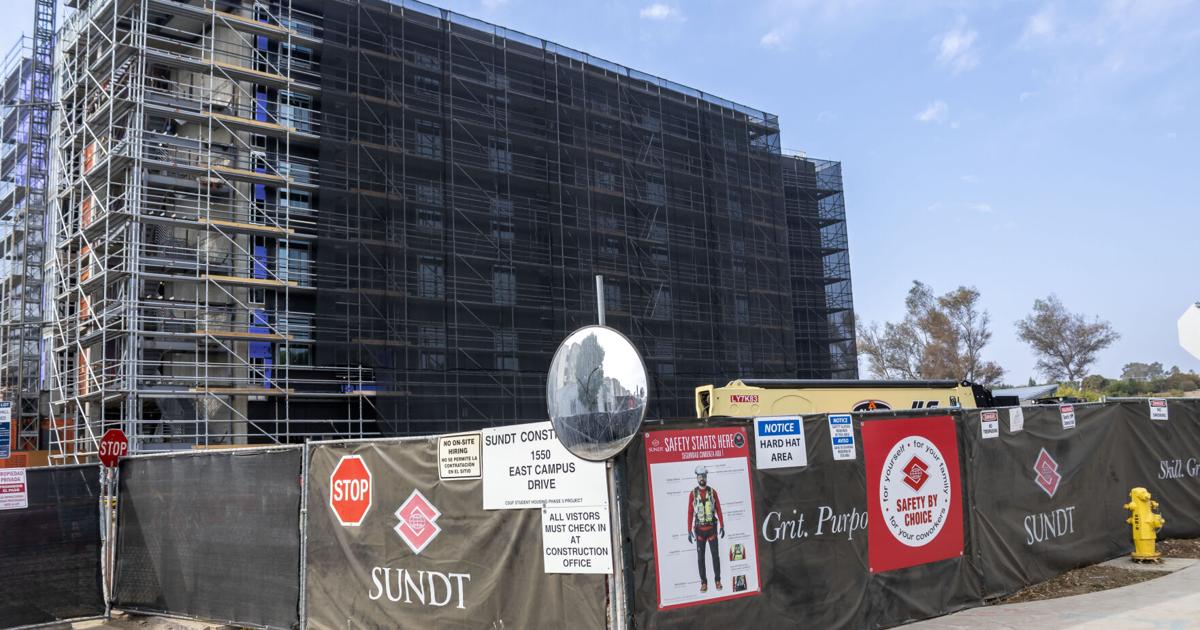
A trio of new assembly bills addressing student housing were recently signed by Governor Gavin Newsom, including Assembly Bill 893, which focuses on incentivizing affordable housing construction near college campus development zones and streamlining ministerial review of qualifying projects.
The bill, authored by Assemblymember Mike Fong, defines development zones as being located within half a mile of any UC, CSU and California Community College campus. AB 893 aims to create easier access to affordable housing for low-income students and staff, specifically for students who may not have previously qualified under the federal Low-Income Housing Tax Credit.
Chaptered into California Law on Oct. 10, it aims to ease the pressure on students due to the housing crisis, which the bill states is a result of unit shortages on college campuses.
Desen Lin, assistant professor in finance with a specialty in real estate, specified how this new assembly bill can be directly applicable to student housing at Cal State Fullerton.
“Even if you go outside of the campus within one mile basically you can only have access to around 1,100 beds, so that is not enough for our students,” Lin said. “So students may need more time to find affordable living options.”
Expanding on Assembly Bill 2011, the Affordable Housing and High Road Jobs Act, new guidelines can fast-track development of mixed-income housing in zones where commercial use, offices, retail and parking are normally permitted.
“There are a lot of things we do need to do to encourage or provide incentives to developers to come into the campus proximate market, and if they find it profitable they will move forward of course,” Lin said. “And I also think it is important because it does not just address the concern of students, it also includes the housing and affordability issue facing a lot of staff and faculty, especially in the CSU system.”
These future projects must meet specific criteria such as affordability, location and having a base number of units available for low-income students, staff and households.
Fullerton Mayor Pro Tem Shana Charles, who is also an associate professor of public health at CSUF, explained how she has seen the strain on the students and faculty within the city of Fullerton.
“I’m really excited about how the bill really specifically mentions carveouts for low income and very low income, both faculty and staff,” Charles said. “I mean that’s something that is a huge issue on campus for faculty recruitment even. Trying to get people to come to Cal State Fullerton, they can’t afford to buy a place in Orange County, so it’s difficult.”
With the cost of attendance at California’s higher education institutions consistently increasing, student housing has been identified as a significant portion of that cost. Students who are unable to find housing face a significant barrier in their education.
Those who were previously unable to qualify for affordable housing may now be eligible for income-restricted units by verifying their income status based on their Cal Grant, Pell Grant and Promise Grant eligibility.
“Even the rents for affordable (housing), are rents that 20 years ago would have been considered outrageous,” Charles said. “It’s crazy to me how high market rate is right now. I have heard students talk about how its hard to find a studio apartment for $1500, that’s impossible, studio apartments are going for $1800 and up now.”
Additionally, when developers meet the specified criteria, they can qualify for a streamlined ministerial review. This process can speed up the construction of affordable housing by exempting it from specific city processes and previous mandates under the California Environmental Quality Act.
“The city of Fullerton, we need another 10,000 units of housing before 2029-2030, so this is another tool we can use to do that,” Charles said. “The RHNA (Regional Housing Needs Assessment) number is about 13,000 and we have about 3,000 already either built or slated to be built, so we need another 10 (thousand).”
Opposition, such as the South Bay Cities Council of Governments, argued that there would be no one-size-fits-all approach to solving the problem of student housing, and that the state should look into investing in ways that make sense for individual communities, rather than a new process that disregards mandated planning processes.
Going forward, the Department of Housing and Community Development will be required to complete two studies on or before Jan. 1, 2027 and Jan. 1, 2031 on outcomes from this assembly bill. Projects developed under the newly defined campus development zone would also be reported on Jan. 1, 2031 in an outcomes report that will entail related findings and announcements.