
Drivers in the charming Marin County town of Larkspur enjoy the Bay Area’s smoothest streets, according to a new report from the Metropolitan Transportation Commission.
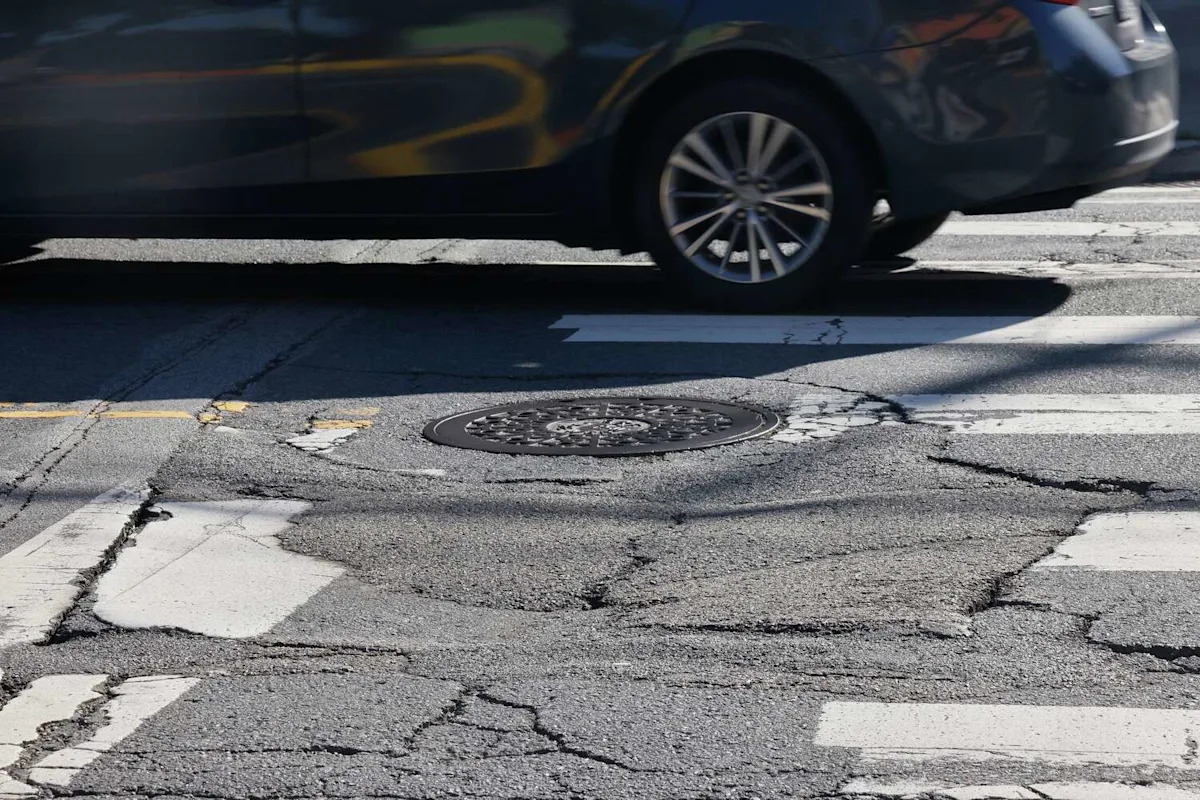
Meanwhile, motorists making their way through Vallejo experience the region’s bumpiest, most worn-out roads.
The annual report ranks each Bay Area city by its Pavement Condition Index, a measure of each road’s wear and tear. The scores range from 0 to 100 – 100 being a brand new or newly repaved road, and 0 being a street in complete disrepair. Each city’s score in the report is the three-year moving average ending in 2024. San Francisco actually scores better than the regional average on this metric.
The scores aim to help cities monitor and plan for road maintenance, with the idea being that cities can use lower cost preservation techniques on roads that are in decent condition before they deteriorate to the point where they require costly repairs, according to the MTC.
Altogether, Bay Area streets scored an average of 67 out of 100 – a score that put the region’s roads overall in the “fair” category. That number has been steady over the last decade, according to MTC officials: that means that while streets aren’t getting worse and falling into disrepair, they also aren’t getting any better.
“The sheer size of the Bay Area’s local streets and roads network makes this a hard needle to move,” MTC Chair Sue Noack said in a press release.
Larkspur, the highest scoring city, had a PCI of 87, which is 20 points higher than the regional average. And Vallejo had a score of just 44 – more than 20 points below average.
{ “__type”: “devHubFreeformEmbed”, “__id”: “Datawrapper”, “__fallbackImage”: “https://datawrapper.dwcdn.net/CHH4k/mobile.png”, “__data”: { “datawrapper_id”: “CHH4k” } }
Of the Bay Area cities with more than a thousand miles of roads – San Jose, San Francisco, Oakland, Santa Rosa and Fremont – San Francisco had the highest score. Oakland, on the other hand, had the lowest score of the bunch with 58, though that number is an improvement from two years ago, when the score was 54.
Unsurprisingly, cities with better street conditions tended to have higher median incomes, a Chronicle analysis found. But the relationship is imperfect. While wealthy cities like Palo Alto, Cupertino, Orinda and Hillsborough have among the highest scores in the region, so do some more middle-class cities like Daly City and Colma.
Meanwhile, some of the lowest-scoring cities aren’t particularly struggling. The tony city of Piedmont, for example, has a score of 62. And some touristy places like Sausalito and Pacifica do even worse.
{ “__type”: “devHubFreeformEmbed”, “__id”: “Datawrapper”, “__fallbackImage”: “https://datawrapper.dwcdn.net/6MXff/mobile.png”, “__data”: { “datawrapper_id”: “6MXff” } }
As for Larkspur’s success, MTC officials noted that, just eight years ago, the city posted scores in the “poor” range. But residents twice approved local sales tax measures focused on rehabilitating the city’s streets – a change that seems to have paid off. Since 2019, its score has gone up 35 points, according to the data.
Similarly, in San Francisco, pavement scores in the early 2000s were in the low 60s. In 2011, voters approved a bond measure that poured millions of dollars into street repair. After that, the city’s PCI climbed steadily into the mid-70s, where it is today.
Meanwhile, Vallejo, which in 2019 had a score of 51, just one point below where Larkspur’s was that year, dropped further to last place.
Overall, 35% of Bay Area roads are in excellent condition, according to the MTC data, and another 36% are in good or fair condition. About 9% are considered “at-risk,” which means that they are on the cusp of requiring major rehabilitation or reconstruction. The remaining 20% of roads are in poor or very poor condition.
But even within a city, street conditions can vary widely. In San Francisco, for example, some freshly repaved roads have scores of 100, while others that have gone without resurfacing for decades have abysmal scores in the single digits.
This article originally published at This city has the Bay Area’s worst streets. It’s not S.F. or Oakland.