
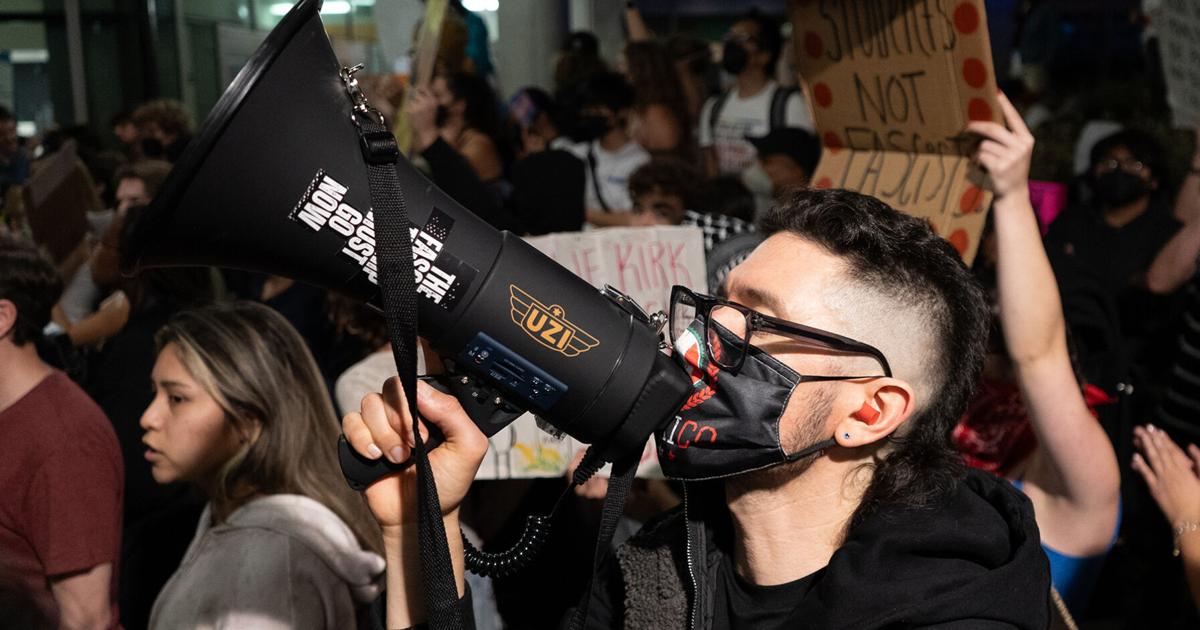
Turning Point USA, or TPUSA’s stop at UC Berkeley last week was far more than just another campus event. It was a spectacle curated for virality. The event sold out, protests erupted, fights broke out and TPUSA walked away with exactly what it wanted: footage of conflict.
I stand with the protesters in the sense that when your tuition, your campus’s reputation and your values of inclusion are being used to legitimize and platform an organization built on hate and provocation, you’ve got every right to be mad. But I also believe we must protest in a smarter way than the viral bait game that TPUSA thrives upon. The left notoriously succeeds when it secures moral high ground, but we risk handing it away by playing into TPUSA’s media strategy.
TPUSA, founded by Charlie Kirk in 2012, claims to promote free speech, limited government and conservative values on more than 900 campuses. But according to higher education watchdogs, one of TPUSA’s key strategies is provocation. Its speakers are often purposely hostile to university environments, framing them as liberal indoctrination zones and then giving students a “them vs. us” moment.
UC Berkeley is a campus known for its liberal activism and symbolically powerful legacy as the birthplace of the Free Speech Movement, and this is exactly the kind of place where TPUSA expects pushback. This means the organization is already arriving with a set narrative that the left is intolerant, violent and against free speech — all of which are harmful portrayals of UC Berkeley protestors that have been notoriously spread in the past. The moment a protester screams something such as “Death to America” (which, as someone who attended the protests, happened multiple times) or a fight erupts, that footage becomes TPUSA’s proxy to power.
Once you fall into the bait, your message becomes about you instead of about why you’re angry. This is precisely how TPUSA gets media mileage — it can successfully propagate a narrative that leftists shut down free speech, leftists are violent and campuses like UC Berkeley are intolerant to opposing views. Even if your cause is valid, when the frame becomes grounded in hate, you lose rhetorical power.
This especially matters in protesting, where optics are crucial. According to the Foundation for Individual Rights and Expression 2025 Free Speech Rankings, based on 58,807 student responses at 257 colleges, institutions’ scores are judged heavily on how students report comfort expressing controversial views and institutional protection of that right. So when violence or aggressive rhetoric hijacks the optics, the public often sides with the perceived victim, not necessarily the one with the “stronger” argument.
We must flip the right’s narrative. What we’re really protesting is platforming hate, misuse of campus resources and the weakening of a campus culture of inclusive intellectual exchange — not speech itself. Anyone organizing protests like those against TPUSA should consider the following.
When we protest, we shouldn’t say the invited group should never speak. We should instead encourage people to reflect: does its presence here actually align with Berkeley’s mission? Is it being promoted as legitimate intellectual discourse, or as provocative bait?
When a major campus group invites a high-profile group with a known history of provocation, UC Berkeley incurs costs and reputational risks. Students, as active members of the community, deserve a stake in how our resources such as funds, space and campus safety are used.
If a group or individual’s rhetoric dismisses the safety or dignity of part of the student body, then protesting them isn’t “anti-speech,” it’s pro-campus.
In short, there’s a greater strength in emphasizing that we don’t hate the opposition. We love UC Berkeley; we love its ideals of open inquiry, rigorous debate and protection of all voices. And when we protest, we’re supposed to protect that legacy from being compromised. The next time a group like TPUSA hits campus, remember that your voice has an impact. Raising signs like “We’re not against speech, we’re against hate,” have more rhetorical potency than signs like “TP belongs in the toilet” ever could. Instead, highlight the group’s disconnect between UC Berkeley’s values and TPUSA’s behavior; if the group claims “free speech” but uses tactics of provocation and pre-filmable chaos, point it out.
Yes, “protesting from love” sounds idealistic. But change is always idealistic until it’s real. If we actively choose clarity and care over mere spectacle, we can reclaim narrative power. Obviously, it takes discipline and emotional control — which is admittedly hard when you’re against an organization that has, in essence, mastered the art of ragebaiting college kids — but when your message is grounded in a genuine love for your community, it becomes harder to dismiss.
Actively engage in smart protest; be loud in your logic, firm in your values and strategic in your expression. Show the news that your protest isn’t about outrage, but about a genuine love for our community and intellectual culture.
Because ultimately, we’re not anti-speech. We’re pro-UC Berkeley.