
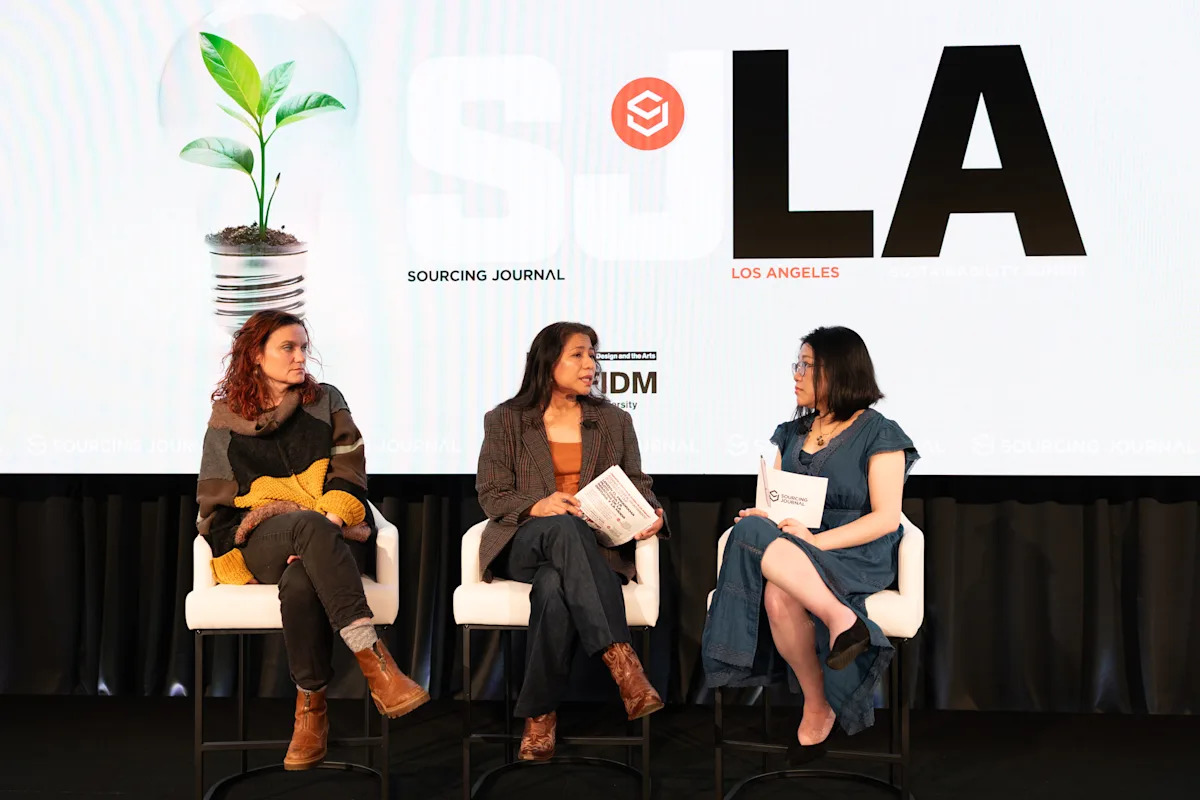
ICE raids across Los Angeles County’s garment ecosystem have created an atmosphere of fear and turmoil for the workers who sustain the region’s sizeable and long-standing manufacturing industry, according to Marissa Nuncio, the executive director of the Garment Worker Center.
The Garment Worker Center, which represents more than 300 members and reaches upwards to 10,000 workers a year through outreach efforts, has a close pulse on how garment workers are being affected by ICE raids across the city. At Sourcing Journal’s LA Sustainability Summit in Los Angeles last week, the Garment Center’s Marissa Nuncio and Lindsay Medoff, the founder and CEO of Suay Sew Shop, joined Jasmin Malik Chua, climate and labor editor at Sourcing Journal, in a discussion about the state of the city’s manufacturing sector.
More from Sourcing Journal
Nuncio said members are going out less, some are refraining from going to work, and others have lost their jobs. They’re also experiencing food and housing insecurity. “But let’s be clear that regardless of your immigrant status, you can be picked up. There’s absolutely racial profiling happening at the hands of these agencies. We’ve seen [several] citizens and documented people picked up in snatch-and-grabs and in raids,” she said.
Though LA County is often overshadowed by major production hubs such as Bangladesh, Vietnam and Cambodia, Nuncio said the region employs more than 30,000 apparel workers in Los Angeles County alone, with roughly 20,000 working in the city’s Fashion District. Fashion is the county’s second-largest creative sector and its second-largest manufacturing industry. It is also a deeply skilled workforce. A recent survey of Garment Worker Center members shows that they have an average of 21 years of industry experience, and nearly 70 percent identify as experts in their craft.
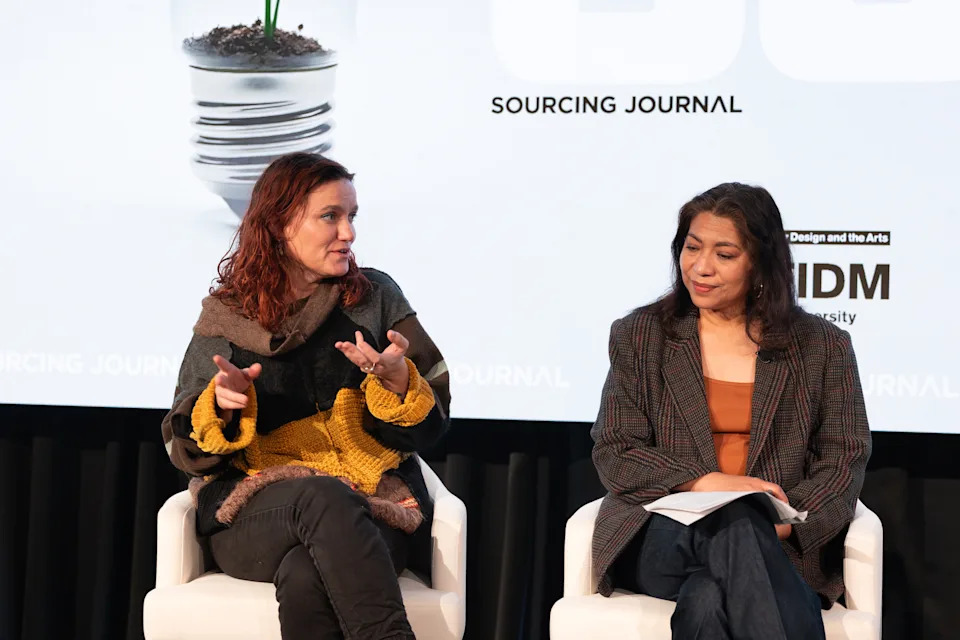
“The workers are primarily women, and they’re primarily from Mexico and Central America. About 85 percent of the workforce is from Mexico and Central America, and about 15 percent of the workforce is Chinese workers, primarily in San Gabriel Valley,” Nuncio said.
A perfect storm of worker-safety challenges, tariffs and declining consumer spending has turned 2025 into what Medoff describes as a “dumpster fire.”
“Overall, people don’t really care about garment workers. The entire fashion industry is based off profitability, which is the extraction of humans or materials,” she said.
Still, the L.A.-based visionary stands behind her choice to run a worker-centered upcycling business that pays fair wages.
Within L.A.’s retail scene, Medoff noted that the closed-loop recycling model largely stands alone. She described Suay as a movement centered on “worker power and cutting up old things and sewing them back together,” paired with a willingness to rethink how products are sold—an approach that traditional brands often find difficult to back.
While many brands publicly champion “responsible” or “sustainable” manufacturing, Medoff said the conversation often stops at superficial terms like “fair wages,” without addressing the deeper issue: valuing garment workers’ skills the same way other industries value cumulative experience.
“We have stopped worrying about trying to get businesses on board with caring about worker power. We try our very best, but we found that when it comes to profitability, they’re less likely to want to engage when they tell them what it takes to buy something from Suay if worker power is involved,” she said.
Instead, Suay is focused on getting the consumer to buy into worker power. “We’re working on cutting off the blood supply that’s going to these brands that are not focused on worker power, and we’re directly communicating to the consumer to get them on board and try to get them to convert—to show up for worker power and for true sustainability.”
Partnerships between organizations like Suay and the Garment Worker Center are essential to keeping the L.A. garment industry from dwindling. In 2024, the Garment Worker Center created the Alliance for Responsible Apparel Manufacturing and Purchasing (ARAMP) to incentivize fair labor practices, environmental sustainability, and community well-being by harnessing the purchasing power of large organizations. Nuncio said factory owners need anchor clients, but they don’t want to take large contracts if it means driving down wages to meet their demands.
“Our idea is to partner these factories with institutional purchasers like cities, universities, high schools, unions and hospitals so that we can give them that volume of production. However, the supplier factories must commit to a robust set of labor standards, including having the Garment Worker Center be able to have inroads and communication with workers so that they know what those labor standards are, and they can communicate back if there are concerns or violations,” she explained.
The vision for ARAMP is progress, not perfection. Nuncio emphasized that meeting all the various labor standards and industry compliance requirements in California can be challenging, especially without government support. This is where the Garment Worker Center is using its advocacy muscle as a community organization to encourage the city to invest in worker training and affordable rent.
One example of this advocacy was the successful campaign for SB62—the Garment Worker Protection Act—which passed in 2022 and eliminated the exploitative piece-rate wage system. “For the first time ever, we’re also seeing that workers who sewed a brand’s clothes can bring that brand to the negotiating table when they experience wage theft,” Nuncio said.
She added that seeing SB62 pass was a “galvanizing moment” for L.A.’s garment workers to organize and put forth their demands and a milestone for the Garment Worker Center, as it was the first time the organization came together with local businesses that share common interests, including Suay. “There are folks that want this industry to be better, but we’ve got to demand it, right? And so, I think that is movement… you have to have the vision and the hope to keep chipping away,” Nuncio said.