
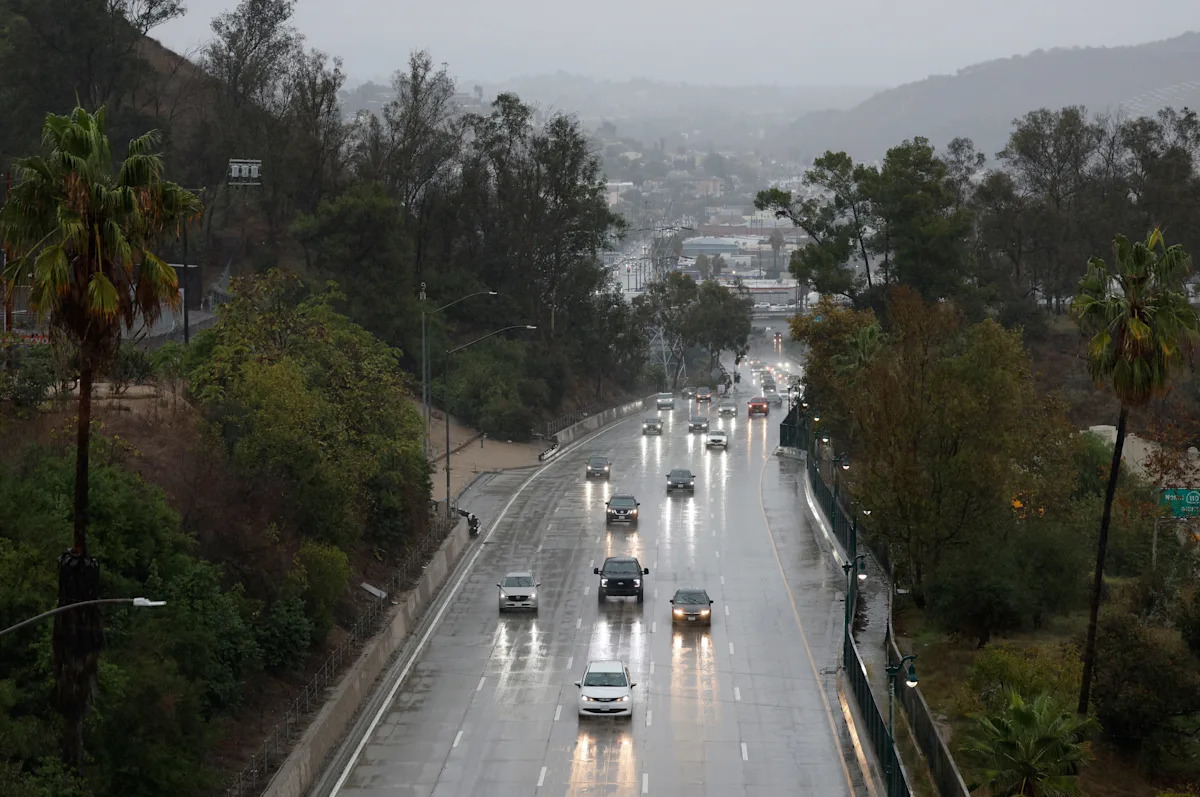
California remains in the grip of a powerful and deadly atmospheric river as a massive storm moves south along the coast toward northwestern Mexico.
The storm has already killed six and continues to produce heavy rain, thunderstorms and snow across the state, with conditions worsening in areas affected by recent wildfires. Burn scars from the Palisades and Eaton fires in Los Angeles County — which together consumed 58 square miles and claimed at least 31 lives earlier this year — make soils unusually water-repellent, increasing the risk of flash floods, mudslides and debris flows.
Officials began issuing evacuation orders and warnings on Friday, Nov. 14, for nearly a dozen locations in wildfire-impacted areas. Residents are being urged to avoid canyon roads and mountain passes, closely monitor weather updates and follow guidance from local authorities as additional rounds of the storm move through the region.
Several rounds are expected to continue through Wednesday, Nov. 19.
What we know about the 6 dead
At least six people have died as the atmospheric river continues to hammer California, the Associated Press reported, citing official agencies.
Monterey County: Authorities are still searching for a 7-year-old girl who was swept into the ocean by 15-foot waves at a state beach on Friday, Nov. 14. Her father, 39-year-old Yuji Hu of Calgary, Alberta, died while attempting to save her, according to the sheriff’s office.
Sutter County: A 71-year-old man died Friday, Nov. 13, when his vehicle was swept off a flooded bridge north of Sacramento, the California Highway Patrol said.
San Diego County: A wooden boat believed to be carrying migrants from Mexico capsized in stormy conditions off the coast on Saturday, Nov. 15. Four people were killed and four others were hospitalized, according to the U.S. Coast Guard.
How much more rain will California get this week?
Some areas can expect steady rain and high-elevation snow as a storm system moves across the western U.S. These are the estimated rainfall totals through Nov. 22, according to the NOAA Weather Prediction Center’s 5-day outlook.
Far Northern California / Coastal Mountains: Around 1–2 inches, with some isolated pockets over 2 inches on wind-facing slopes. Mountain roads may become slick, and small creeks could rise quickly.
Northern Sierra / Southern Cascades: Generally 0.75–1.5 inches of liquid precipitation. Higher elevations could see locally higher totals, much of it falling as snow above pass level, leading to possible travel delays.
Central California (Central Coast, interior valleys, and surrounding foothills): Expect 0.25–0.75 inches overall. Coastal hills may trend toward the upper end of that range, while interior valleys remain lighter.
San Francisco Bay Area: Most locations receive 0.25–0.75 inches, with locally higher totals in the Santa Cruz Mountains. Light flooding impacts are unlikely but possible in poor-drainage spots.
Central Valley: Rainfall generally 0.25–0.50 inches, with up to 0.75 inches near the Sierra foothills. Some ponding is possible on rural roads.
Southern California (LA Basin, Ventura, Orange County, Inland Empire): Widespread 0.10–0.50 inches, with 0.50–0.75 inches in the coastal mountains. Heavier downpours are unlikely but cannot be ruled out in foothill areas.
Southern California Deserts (Palm Springs, Coachella Valley, Mojave): Lightest totals — typically 0.10–0.25 inches, with somewhat higher amounts possible along nearby mountain slopes. Minimal flooding risk.
What is an atmospheric river? How does it differ from a standard storm system?
On the West Coast, atmospheric rivers approach from the Pacific Ocean, carrying tremendous amounts of water. They occur most frequently during specific weather patterns, including El Niño, which can increase their frequency or intensity; however, they can also occur in other years.
These long, narrow corridors of air have been responsible for as much as 65% of the West’s extreme rain and snow events, USA TODAY formerly reported.
According to the National Oceanic and Atmospheric Administration, an atmospheric river — described as a “river in the sky” — transports water vapor outside of the tropics. While they vary in size and strength, the average system carries an amount of water vapor equivalent to the average flow of the Mississippi River at its mouth.
Past atmospheric rivers have caused widespread impacts. For example, earlier this year, two systems drenched Southern California, triggering severe flooding, tornadoes, avalanches, and mudslides. Cities including San Francisco and Redding received up to a month’s worth of rain, prompting evacuations and rescues from southern Santa Barbara to Orange County.
Is an atmospheric river the same as a ‘pineapple express’?
A “Pineapple Express” is a type of atmospheric river originating from near Hawaii, bringing warm, wet air and heavy rainfall to areas such as California and the Pacific Northwest.
According to the National Weather Service in Portland, the current atmospheric river is forming as a strong weather system over the Gulf of Alaska pulls in subtropical moisture and funnels it toward the region.
Meteorologists track these systems using a technique called integrated water vapor transport, which measures the amount of moisture moving through the atmosphere. High readings on this metric are a key indicator that an atmospheric river is approaching.
How to prepare for an atmospheric river
The weather service in Portland said residents should take these steps to prepare for the heavy rain:
Check your home’s gutters and clean them out if they are clogged with leaves from recent winds.
Practice caution around low water crossings, where street drains may back up and cause rain to pool.
Slow down while driving off interstate and bridge ramps and when making turns. Recent heat has caused oil in the road to come to the surface, making roads slick when rainfall is added.
Expect creeks to rise and have more flow in the Coastal Range, Willapa Hills and Cascades.
Check your local weather forecast for expected rainfall amounts and timing.
California weather watches and warningsStay informed. Get weather alerts via text
Brandi D. Addison covers weather across the United States as the Weather Connect Reporter for the USA TODAY Network. She can be reached at baddison@gannett.com. Find her on Facebook here.
This article originally appeared on Palm Springs Desert Sun: Atmospheric river continues in California. What we know about 6 deaths