
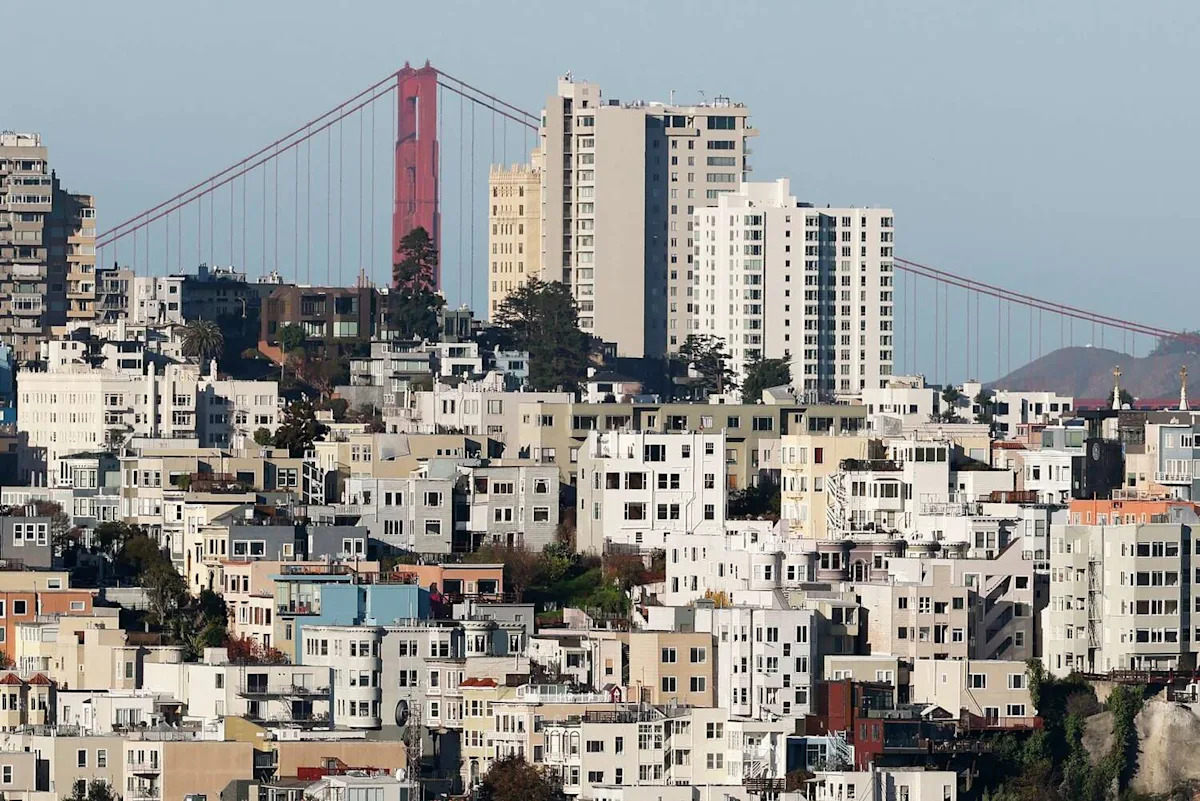
Thousands of condo owners in 126 pre-1975 San Francisco high-rises will have to pay $300,000 or more – and face potentially lengthy displacements – under an ordinance requiring towers built before 1975 to install automatic fire sprinklers in every room of every unit.
While the sprinkler installation doesn’t have to be completed until the start of 2035, the homeowners associations say they will have to start assessing owners upward of $2,500 a month now to build up reserves to pay for the work, which in many cases will involve extensive demolition, along with the installation of the tanks, generators and new piping needed to pump water through the sprinkler system.
Condo owners say the unexpected assessment, which applies to about 9,800 units, could force them to sell their units, while real estate brokers say the ordinance is already depressing prices and sales activity in the buildings that are on the list.
The ordinance requires homeowners to obtain building permits by January 2027, a process that in itself could cost hundreds of thousands of dollars and require extensive paperwork, according to Supervisor Stephen Sherrill, who represents the Marina and Pacific Heights, where about 40 buildings fall under the ordinance.

Supervisor Stephen Sherrill, who represents neighborhoods with dozens of buildings covered by the ordinance, says the assessment will hit older condo owners hard. (Manuel Orbegozo/For the S.F. Chronicle)
Sherrill said the sprinkler requirement is causing “panic” among his constituents, mostly seniors on fixed income.
“It feels like every community meeting I go to I meet another five people, all senior citizens, who are really nervous about this,” he said. “This is not an amorphous ‘something to worry about in the future’ situation. In order for them to hit that deadline they have to start financial planning now. That means the homeowner associations have to start charging monthly assessments.”
Adopted by the Board of Supervisors in 2023, the sprinkler ordinance applies to buildings of 12 stories or more that do not have two interior stairs that are separated from the rest of the building by two-hour fire-rated walls, which are designed to resist fire for at least two hours.
At Wednesday’s San Francisco Fire Commission meeting, Fire Marshal Chad Law said the new sprinkler requirement is an effort to make the city safer for residents and firefighters and that delaying the work would only make compliance more expensive. He said the cost of installing the sprinklers has tripled since 2016, when the requirement was proposed.
Fire codes, he said, “are updated because bad things have happened.”
“My hesitation of extending the time for the whole process is that it would lose steam and sprinkler costs would go up,” he said.

San Francisco Fire Commissioner Allan Low said the 12-year deadline for automatic sprinklers to be installed should give owners of high-rise condos plenty of time to plan. (Lea Suzuki/S.F. Chronicle)
Fire Commissioner Allan Low said the 12-year deadline should give residents plenty of time to plan.
“You have 12 years to complete it – it’s not something you have to do tomorrow,” he said. “It’s going to be safer for the residents of the building. It’s going to be safer for our firefighters.”
A half-dozen condo owners addressed the commission Tuesday during a hearing on the city’s fire code, which is updated every three years. The fire code, which includes the new sprinkler requirements, still has to be approved by the Board of Supervisors. Sherrill is working on legislation that would delay the ordinance deadline and require a study on the cost of logistics of complying with it.
Condo owners say they care about fire safety but that the cost of putting sprinklers in every room, along with the disruption the work will entail, represents a hardship. Many of the condo buildings impacted by the ordinance have recently spent upward of $10,000 a unit to comply with the city’s “sleeping ordinance,” which requires residential buildings with three or more units to have a minimum fire alarm sound level of 75 decibels in sleeping areas.
Tom Gage, who lives in a 58-unit building on Chestnut Street in the Marina, said, “We have many elderly citizens who, should this mandate be enforced, would be required to leave the building and find alternative accommodations.
“If they are required to leave their dwelling, it would be a significant hardship,” he said. “We feel this mandate is totally unreasonable.”

Many condo owners in San Francisco high-rises say the sprinkler assessment, which applies to about 9,800 units, could force them to sell their units. (Yalonda M. James/S.F. Chronicle)
Diane Ayre, a retired professor of early childhood education at San Mateo County Community College District who lives in Fontana Tower West on North Point Street, said the 2022 ordinance was adopted with “no consultation with the public that it impacts.”
“Nobody is anti-fire safety. We have been extremely vigilant with our safety issues, with taking care of the building,” she said. “But the implications of the ordinance have not been considered. So many people would be humanely and financially affected. How many people are going to be displaced? How do you measure that cost?”
Ayre said she doesn’t know where she will go if she has to move out of her condo during sprinkler installation. Because most of the towers targeted by the ordinance are historic, it’s likely that the sprinkler installation process will involve removing lead paint and asbestos.
“I don’t have any family in the area. I’m recently widowed,” she said. “I’m dumbfounded to be honest.”
Already the sprinkler ordinance is impacting the condo market, according to Frank Nolan, a San Francisco real estate agent and president of Vanguard Properties.
“The new ordinance is making buyers very cautious about moving forward on a purchase if there are too many unknowns,” he said. “Not all buyers care, but the ones that do will likely try to find an alternative option.”
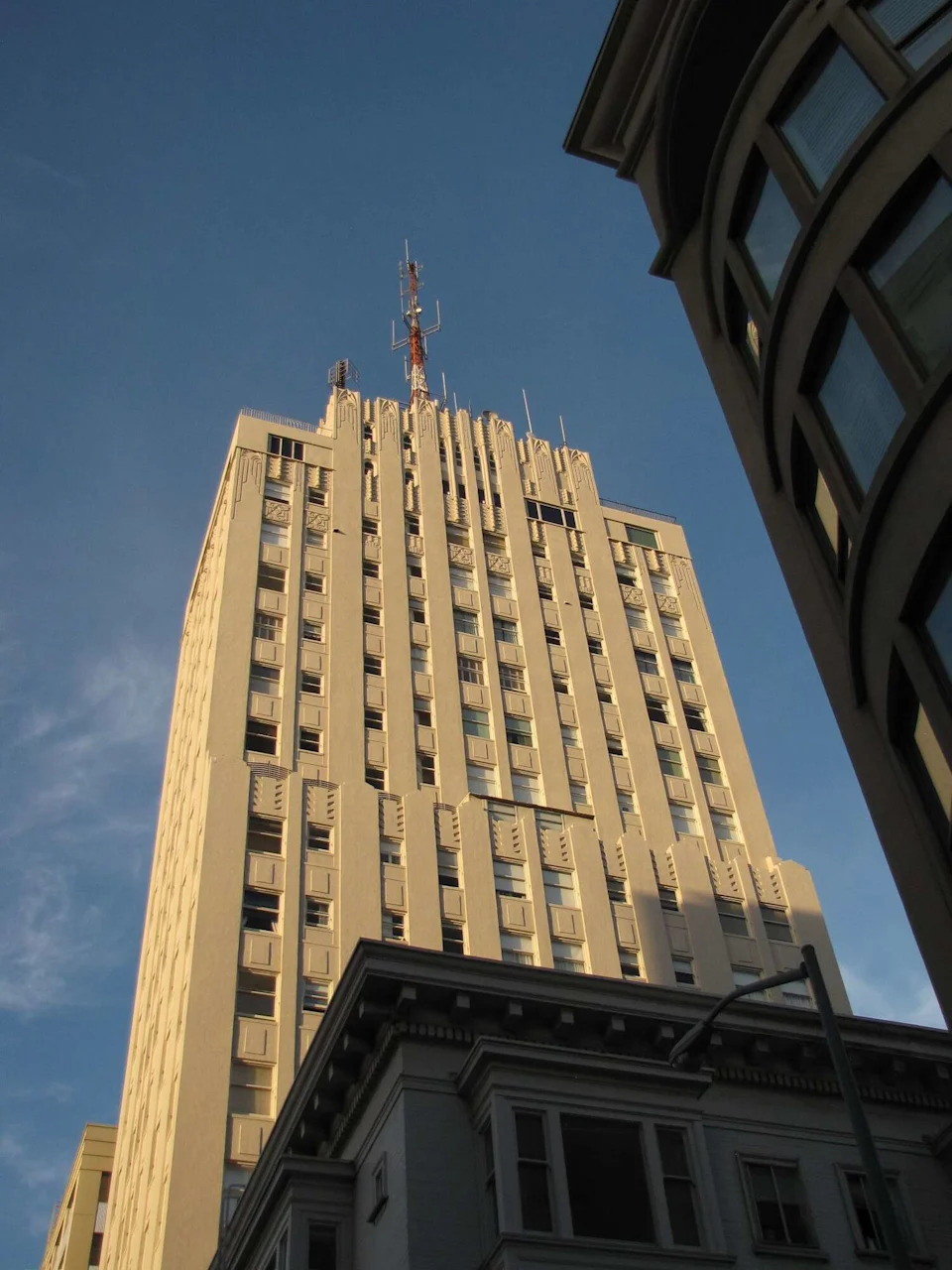
The Clay-Jones Apartments on Nob Hill is one of the buildings that falls under the automatic sprinkler ordinance. (John King/S.F. Chronicle)
Vanguard broker Mike Shaw said he is representing a retired couple from Arizona who are looking to buy a unit in an elevator building on the north side of San Francisco – exactly the type of classic San Francisco apartment towers that fall under the ordinance.
“They are running into this pretty consistently,” Shaw said. “They are freaked out by it. Having a buyer walk into a property that could potentially face hundreds of thousands of dollars in special assessments per unit is daunting. It’s definitely affecting buyers, and I think it’s going to affect sellers and value of their properties if they are on the list. They are going to get far fewer buyers willing to step up.”
Shaw said he is hopeful that the ordinance will be delayed or amended, but he can’t count on that.
“We as real estate agents have to be really cautious,” he said. “We can’t give legal advice and we can’t say to clients, ‘This seems pretty egregious, and it seems likely it will get amended in some way.’ We just don’t know.”
Fire Commissioner Stephen Nakajo said he empathizes with the residents on the disruption and financial burden.
“I am concerned about displacement. I am concerned about cost,” he said. “But if the discussion is that versus safety and death, I mean come on, we are the fire commission. Our concern is safety, of course.”

Real estate brokers say a sprinkler assessment on owners of older high-rise condos could depress prices and sales. (Stephen Lam/S.F. Chronicle)
At the hearing, Dan Torres, business representative for Sprinkler Fitters Local 483, said ordinance opponents were overstating the cost and risk of displacement. In the aftermath of deadly fires, he said, “people are always up in arms asking, ‘What could have been done to prevent this? ‘”
“Yes, there is going to be a cost to install the sprinklers, but I want to ask you this question: What is a life worth?” he said.
Kelly Joslin, who teaches in the Castro Valley public schools, said the ordinance would double the $2,500 month homeowners assessment she and her husband already pay. She said it would probably force them to sell their Green Street condo at a loss.
“The reasoning behind (the ordinance) isn’t wrong – obviously we all want everyone and anyone to survive any catastrophic event,” she said. “But when the mandate was put in place, there weren’t any projections of costs. There weren’t any studies done in individual buildings to see whether it’s even necessary.”
This article originally published at Sprinkler shock: Owners of S.F. high-rise condos stunned by $300K mandate.