
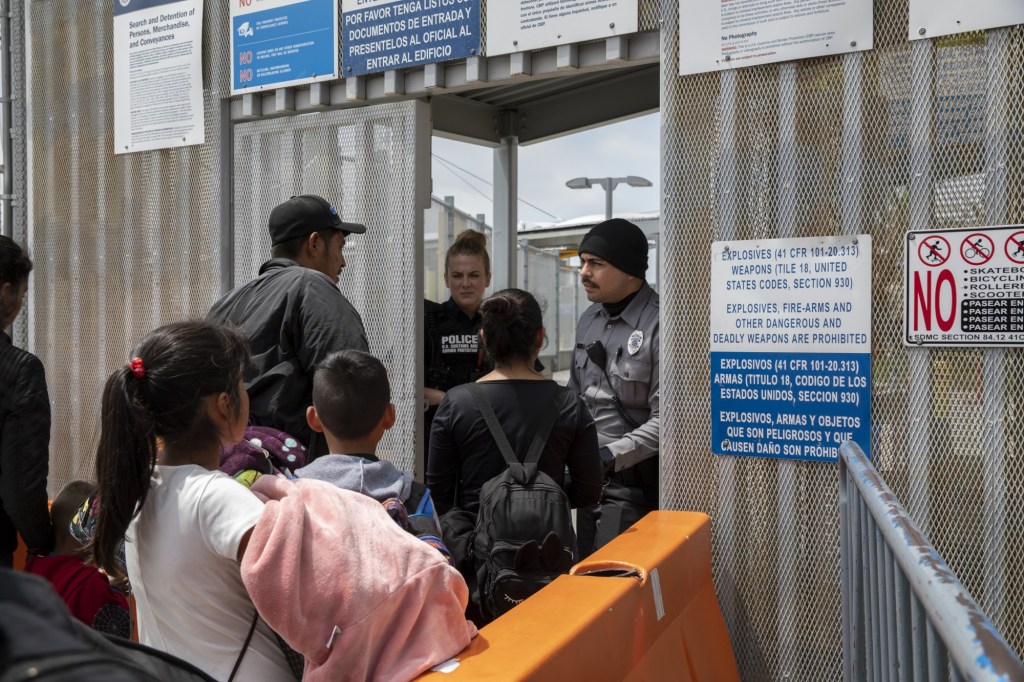
The U.S. Supreme Court on Monday agreed to hear the Trump administration’s appeal of a San Diego case dealing with “metering,” or the practice of U.S. border officials turning away asylum-seeking hopefuls at the U.S.-Mexico border and forcing them to wait in Mexico if the officials determined a border crossing to be at capacity.
The practice, which was implemented during the Obama administration and later formalized by the first Trump administration, was ended by the Biden administration. But attorneys for the current Trump administration argued that metering is a “critical tool for addressing border surges and for preventing overcrowding at ports of entry along the border,” and that such a tool might be necessary in the future.
The question at the heart of the case the Supreme Court agreed to hear is what exactly it means to arrive in the United States, because according to federal law, any immigrant “who is physically present in the United States or who arrives in the United States … at a designated port of arrival … may apply for asylum.”
The Trump administration wants “arrives in” the U.S. to be defined literally as someone who takes at least one step onto U.S. soil at a port of entry. But a San Diego judge and later the 9th U.S. Circuit Court of Appeals ruled the government’s interpretation was too literal — and unlawful.
“For a person coming to the United States to seek asylum, the relevant destination is the U.S. border, where she can speak with a border official,” the 9th Circuit decided last year in a 2-1 opinion. “A person who presents herself to an official at the border has therefore reached her destination — she has ‘arrive[d].’”
In its petition to the Supreme Court, the Trump administration argued that the 9th Circuit’s ruling was erroneous. The administration argued that an immigrant who is turned away on the Mexican side of a U.S. port of entry has not met the legal definition of arriving in the U.S.
“An alien ‘arrives in the United States’ only when he actually crosses the border and enters the United States,” Trump administration attorneys wrote in their petition.
Secretary of Homeland Security Kristi Noem is the lead petitioner in the case. In a statement, Assistant Secretary Tricia McLaughlin said the Department of Homeland Security was looking forward to presenting its case to the Supreme Court.
“As our attorneys have already made abundantly clear, the Trump administration has advanced the clear meaning of federal law and basic common sense in this case since day one,” McLaughlin said.
Al Otro Lado, an organization that supports immigrants in Tijuana, was one of the groups that successfully sued the government in San Diego federal court over the metering policy, along with more than a dozen anonymous asylum seekers. Those groups and individuals are the named respondents in the Supreme Court case.
“The issue before the Court is whether noncitizens seeking safety at ports of entry along the U.S. southern border have a legal right to apply for asylum in the United States,” attorneys for the respondents said in a statement Monday. “As the 9th Circuit correctly concluded, our immigration laws require the government to inspect and process people seeking asylum at ports of entry and allow them to pursue their legal claims in the United States.”
The attorneys for the respondents called the metering policy “an illegal scheme to circumvent these requirements by physically blocking asylum seekers arriving at ports of entry and preventing them from crossing the border to seek protection. Vulnerable families, children, and adults fleeing persecution were stranded in perilous conditions where they faced violent assault, kidnapping, and death. We look forward to presenting our case to the Court.”
The practice of metering began in the final few months of the Obama administration at the San Ysidro Port of Entry in response to a growing number of Haitian arrivals. U.S. Customs and Border Protection officers began sending Haitians away with instructions to return on a later date.
Under the first Trump administration, the policy soon spread to all arriving asylum seekers across the entire U.S.-Mexico border, and DHS formalized the policy in 2018.
The case now before the Supreme Court started a year prior, in 2017, when Al Otro Lado and the individual asylum seekers filed their class-action lawsuit in San Diego federal court, challenging the legality of such a practice.
U.S. District Judge Cynthia Bashant, who is now chief judge of the San Diego region, ruled in favor of the asylum seekers and Al Otro Lado in 2021, ruling that an asylum seeker who reached the border had met the legal definition of arriving at the border. The 9th Circuit upheld her ruling last year.
In its petition asking the Supreme Court to review the 9th Circuit’s ruling, the Trump administration argued that the appeals court’s interpretation of what it means to arrive in the U.S. “defies common sense.” The administration also argued that the 9th Circuit’s definition created “line-drawing problems” — just how close must an asylum seeker physically be to a port of entry to have arrived?
“The statute that Congress enacted draws its own clear line — at the border,” the administration argued. “Aliens must be inspected and may apply for asylum if they are in the United States, but not if they are outside the United States. The (9th Circuit’s) interpretation, by contrast, lacks an obvious stopping point, as it is wholly unclear how close to the border an alien must come to ‘arrive in’ the United States.”
Attorneys for Al Otro Lado and the asylum seekers argued there was no need for the Supreme Court to hear the case. They argued in part that if the literal definition of arrival favored by the government is accepted, it “would empower border officials to render … inspection and asylum processing requirements wholly inoperable at ports of entry … by simply blocking asylum seekers from stepping on U.S. soil.”
The attorneys argued that such a loophole was “not what Congress contemplated when it mandated inspection and processing of arriving asylum seekers.”
The attorneys also argued that the question of what constitutes arriving in the U.S. is essentially moot, since so much has changed in border enforcement policy in recent years.
During the COVID-19 pandemic, the first Trump administration invoked the public health order Title 42 to block the vast majority of asylum seekers and other immigrants from entering the U.S. The Biden administration ended Title 42 in 2023 but severely restricted the asylum process, mostly limiting it to those who used the CBP One app, which was often plagued with bugs, was only available in certain languages and typically forced asylum seekers to wait months for appointments.
The Biden administration again restricted asylum in 2024, withholding asylum when there were certain stretches of time with a high number of immigrant encounters at the border.
On President Donald Trump’s first day back in office, he canceled all asylum screening appointments made through the CBP One app and directed DHS to cease use of the app.
Al Otro Lado has filed a new lawsuit against Trump, Noem and other federal officials arguing that the administration has “shut down all access to asylum.” That lawsuit is still pending in San Diego federal court.